
Recently added item(s)
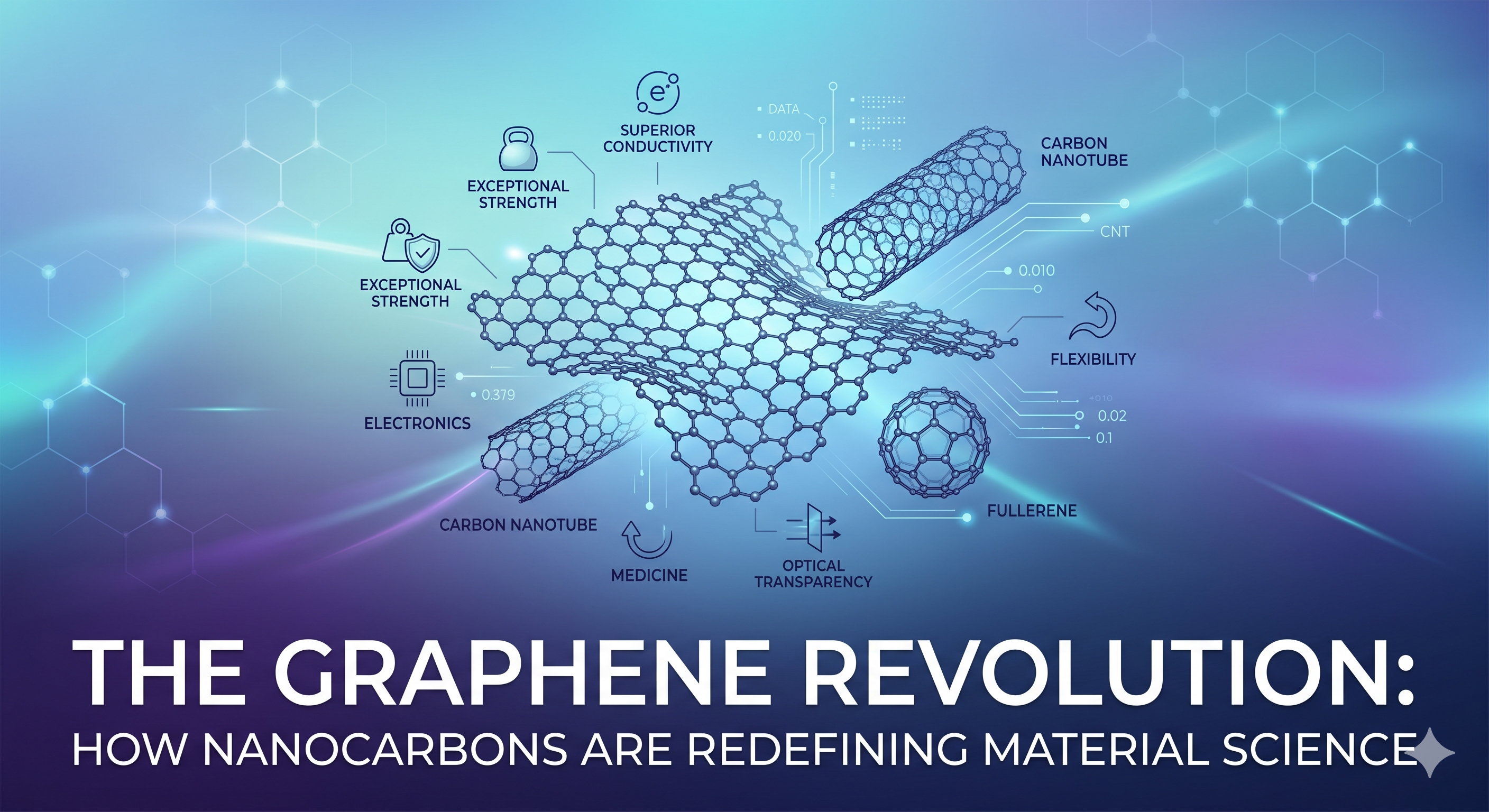
In 2004, a simple experiment involving adhesive tape and a piece of graphite changed the world forever. Two researchers at the University of Manchester managed to isolate a single layer of carbon atoms, a feat previously thought to be physically impossible. This material, known as Graphene, earned them the Nobel Prize and ignited a global race to harness the power of “Nanocarbons.”
Today, we stand at the threshold of a new era. From foldable electronics to life-saving medical devices, graphene and its nanocarbon cousins are not just improving existing technologies—they are redefining the very laws of material science.
1. What is Graphene? The “Wonder Material” Explained
To understand the revolution, we must first look at the structure. Graphene is a single layer of carbon atoms arranged in a two-dimensional hexagonal lattice, resembling a honeycomb. Despite being only one atom thick, it possesses a suite of superlative properties that seem almost like science fiction:
-
Unmatched Strength: It is approximately 200 times stronger than steel by weight.
-
Extreme Conductivity: Electrons move through graphene with 100 times less resistance than in copper.
-
Supreme Flexibility: It can be stretched by up to 20% of its length without breaking.
-
Optical Transparency: It absorbs only 2.3% of visible light, making it nearly invisible to the naked eye.
Beyond graphene, the “nanocarbon” family includes Carbon Nanotubes (CNTs)—which are essentially graphene sheets rolled into cylinders—and Fullerenes (Buckyballs). Together, these materials provide a toolbox for engineering at the atomic scale.
2. Electronics: Beyond the Silicon Limit
For decades, Silicon has been the king of electronics. However, as we try to make chips smaller and faster, we are hitting a wall called the “Silicon Limit,” where heat and quantum leakage prevent further progress.
The Rise of Graphene Transistors
Recent research in 2025 and early 2026 has successfully integrated graphene into semi-conductor manufacturing processes. Unlike silicon, graphene does not overheat as easily, allowing for processors that can operate at Terahertz (THz) speeds—thousands of times faster than current laptops.
Flexible and Wearable Tech
Because graphene is both conductive and flexible, it is the primary candidate for the next generation of “skin-like” electronics. Imagine a smartphone that wraps around your wrist like a bandage or a contact lens that displays your heart rate in real-time. These are no longer concepts; prototypes using graphene-based inks are already undergoing industrial testing.
3. Energy: Charging Your Car in Minutes
The transition to green energy is currently throttled by battery technology. Lithium-ion batteries take a long time to charge and degrade over time. Nanocarbons are changing this equation.
-
Supercapacitors: Graphene-based supercapacitors can store a massive amount of energy and discharge it almost instantaneously. In practical terms, this could mean an electric vehicle (EV) that charges in 5 minutes rather than 5 hours.
-
Graphene-Anode Batteries: By adding graphene to the anodes of traditional batteries, manufacturers have increased energy density by 45%. Major automotive brands are currently piloting “Graphene-Enhanced” battery packs in 2026 models to achieve ranges exceeding 1,000 kilometers on a single charge.
4. Biomedical Breakthroughs and Clinical Trials
Perhaps the most profound impact of nanocarbons is in the field of medicine. Because carbon is the basis of life, these materials can be engineered to interact seamlessly with the human body.
Targeted Drug Delivery
Graphene Oxide (GO) has a massive surface area, allowing it to act as a “nanocarrier.” Scientists can attach chemotherapy drugs to GO flakes and functionalize them with antibodies that only target cancer cells.
-
Recent Clinical Data: Early-phase clinical trials in 2025 showed that graphene-enabled drug delivery reduced the required dosage of toxic drugs by 60%, significantly lowering side effects like hair loss and organ damage.
Neural Interfaces: “The Graphene Brain Bridge”
Graphene’s high conductivity makes it ideal for neural implants. Research published within the last year describes graphene electrodes that are soft enough to match the texture of brain tissue. These implants are being tested in clinical settings to restore motor function in paralyzed patients by bypassing spinal cord injuries, offering a “bridge” for neural signals.
Biosensors for Early Diagnosis
Graphene sensors are sensitive enough to detect a single molecule of a virus or a cancer biomarker in a drop of blood. This could lead to “lab-on-a-chip” devices that diagnose diseases years before symptoms appear.
5. Environmental Restoration: Cleaning Air and Water
As we face a climate crisis, the “Smart Porosity” of nanocarbons provides a glimmer of hope.
-
Desalination: Graphene membranes act as a molecular sieve. They allow water molecules to pass through while blocking salt ions. This requires significantly less energy than traditional reverse osmosis, potentially solving the global water scarcity crisis.
-
Carbon Capture: New research into “Functionalized Graphene Aerogels” has produced materials capable of sucking CO2 directly from the atmosphere with unprecedented efficiency. These materials are being integrated into industrial smokestacks to prevent emissions at the source.
6. Advantage vs. Risk Assessment
While the potential of the Graphene Revolution is staggering, it is vital to balance enthusiasm with scientific rigor.
Advantages
-
Resource Efficiency: We can do more with less. A few grams of graphene can replace kilograms of heavier, rarer metals.
-
Sustainability: Carbon is abundant. Unlike “Rare Earth Elements,” nanocarbons do not require environmentally devastating mining.
-
Multifunctionality: One material can provide structural strength, electrical sensing, and thermal management simultaneously.
Risks and Challenges
-
Nanotoxicity: There are ongoing concerns about “Carbon Nanotubes” behaving like asbestos if inhaled. Rigorous safety standards are essential to ensure that nanoparticles do not enter the lungs or the ecosystem.
-
Scalability: Producing “pristine” single-layer graphene in tons is still more expensive than producing lower-quality graphene powder. The “Quality Gap” remains a hurdle for mass-market adoption.
-
Biodegradation: While carbon is organic, some engineered nanocarbons are highly stable. We must ensure that medical nanobots can be safely broken down and excreted by the body.
7. The Road Ahead: 2030 and Beyond
We are moving from the “Discovery Phase” to the “Integration Phase.” In the coming decade, graphene will likely become an “invisible” technology—hidden inside the concrete of our bridges to make them smarter, embedded in the paint of our houses to collect solar energy, and flowing through our veins to keep us healthy.
The graphene revolution proves that the most powerful solutions to our biggest problems are not found in the massive, but in the microscopic. By mastering the nanocarbon, we are mastering the very building blocks of the future.