
Recently added item(s)
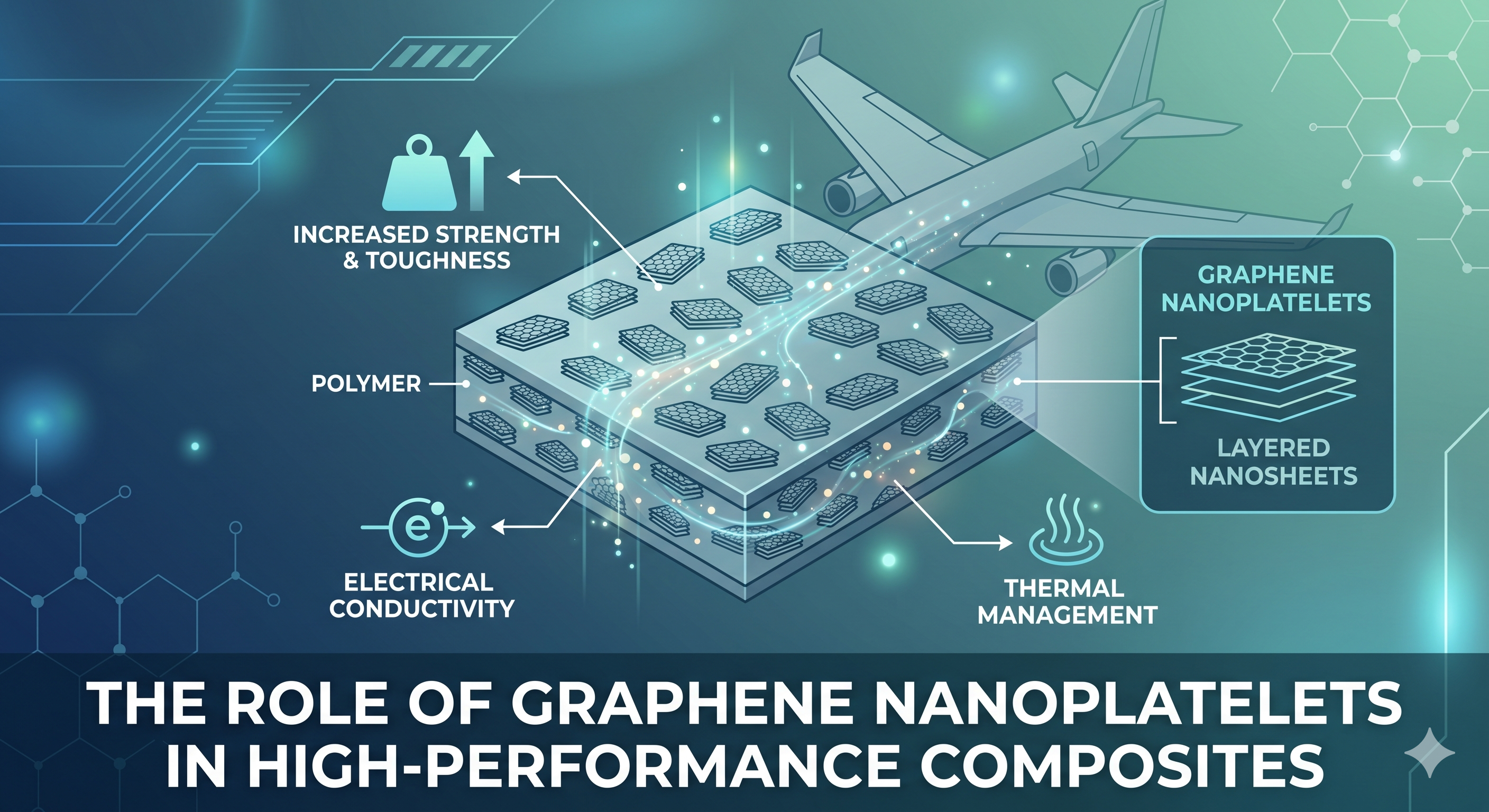
In the world of advanced engineering, the quest has always been to find materials that are lighter than plastic yet stronger than steel. For decades, carbon fiber was the undisputed champion of this domain. However, a new contender has emerged from the nanoworld to push the boundaries of what “high-performance” truly means: Graphene Nanoplatelets (GNPs).
While pure, single-layer graphene often grabs the headlines for its Nobel-prize-winning properties, GNPs are the pragmatic heroes of modern industry. They are the bridge between the exotic world of quantum materials and the practical world of aerospace, automotive, and sports engineering.
1. What are Graphene Nanoplatelets (GNPs)?
To understand GNPs, imagine a deck of cards where each card is a single layer of graphene. While “pristine graphene” is just one card, Graphene Nanoplatelets are small stacks of these cards—typically between 10 to 40 layers thick.
They are produced through the exfoliation of graphite, making them significantly more affordable and easier to manufacture in bulk than single-layer graphene. Despite being “multi-layered,” they retain most of the superlative properties of carbon:
-
Extreme Mechanical Strength: They reinforce polymers at the molecular level.
-
Electrical Conductivity: They can turn insulating plastics into conductors.
-
Thermal Management: They act as heat sinks, preventing materials from overheating.
-
High Aspect Ratio: Their flat, plate-like shape provides a massive surface area for bonding with other materials.
2. Reinventing the Matrix: How GNPs Enhance Composites
In a composite material, you have a “matrix” (usually a plastic or resin) and a “reinforcement” (like carbon fibers). By adding a tiny amount of GNPs—often less than 1% by weight—into the resin, the entire structure undergoes a transformation.
Mechanical Toughening
Standard composites can be brittle. When a crack starts in a normal resin, it travels straight through. However, GNPs act as microscopic “roadblocks.” Because of their plate-like structure, cracks are forced to weave around them, dissipating energy and preventing the material from snapping.
Barrier Properties
GNPs are impermeable to gases and liquids. When integrated into packaging or fuel tanks, they create a “tortuous path” that molecules cannot easily penetrate. This makes them ideal for hydrogen storage tanks in next-gen green vehicles, where preventing the leak of tiny hydrogen atoms is a major challenge.
3. High-Performance Industry Applications
The impact of GNP-enhanced composites is already being felt across several high-stakes sectors as we move through 2026.
Aerospace: Beyond Carbon Fiber
Current aircraft like the Boeing 787 use carbon fiber composites to save weight. However, these materials are susceptible to lightning strikes because plastic is an insulator. By adding GNPs to the composite skin of an airplane, engineers can create a conductive “Faraday Cage” that safely disperses electricity, eliminating the need for heavy copper mesh.
Automotive: The Quest for Range
For Electric Vehicles (EVs), every gram counts. GNPs are being used to create lightweight battery enclosures and structural components that are 20% lighter than traditional composites. Furthermore, 2025 research has shown that GNP-filled tires have lower rolling resistance and better heat dissipation, extending EV range by up to 5%.
Sporting Goods: The “Graphene Grip”
From tennis rackets to professional cycling frames, GNPs are being used to provide “dampening.” They absorb vibrations much better than carbon fiber alone, reducing the risk of injuries like “tennis elbow” while allowing for more powerful hits.
4. Biomedical Perspective: “Smart” Composites and Clinical Safety
While “clinical trials” are usually reserved for drugs, the biomedical industry performs extensive Biocompatibility Assessments for materials used in implants and prosthetics.
Bone Tissue Engineering
A fascinating area of research in 2026 involves GNP-reinforced hydroxyapatite composites. These are used to create synthetic bone scaffolds. Clinical studies have shown that the electrical conductivity of GNPs can actually stimulate osteoblast (bone cell) growth, helping fractures heal faster than with traditional titanium implants.
Wearable Health Monitors
GNP-silicone composites are being used to create “electronic skin.” These highly flexible sensors can detect a pulse or a change in muscle tension with 10 times the sensitivity of traditional metallic sensors, providing a new level of data for athletes and recovering surgery patients.
5. Advantage vs. Risk Assessment
As we integrate GNPs into more consumer and industrial products, we must weigh their incredible benefits against potential drawbacks.
Advantages
-
Cost-Effectiveness: GNPs provide a “graphene-like” boost at a fraction of the cost of single-layer graphene.
-
Multi-functionality: One additive provides strength, heat management, and electrical conductivity all at once.
-
Compatibility: They can be easily mixed into existing manufacturing processes like injection molding or 3D printing.
Risks and Challenges
-
Dispersion Issues: The biggest enemy of GNPs is “clumping.” If the platelets are not perfectly spread out in the resin, they can actually weaken the material.
-
Nanotoxicity Concerns: There is ongoing debate regarding the environmental impact of nanoparticles if they are released during the recycling or “shredding” of old composites. Strict “Safe-by-Design” protocols are being implemented in 2026 to ensure GNPs remain trapped within the polymer matrix.
-
Standardization: Not all GNPs are created equal. Variations in thickness and “lateral size” can lead to inconsistent performance in industrial batches.
6. The 2026 Research Frontier: Self-Sensing Materials
The most exciting development in current GNP research is the creation of “Self-Sensing” structures. Because GNPs make a composite conductive, any tiny crack or stress in a bridge or an airplane wing changes the electrical resistance of the material.
Instead of sending human inspectors to look for cracks, the material itself can send a signal to a computer saying, “I am under too much stress in the left corner.” This shifts maintenance from “reactive” to “predictive,” potentially saving lives and billions in repair costs.
7. Conclusion: The Invisible Infrastructure
Graphene Nanoplatelets are the silent enablers of the next industrial revolution. They don’t require us to rebuild our factories; they simply require us to “tweak” the recipes of the materials we already use.
As we move toward a future of greener transportation, smarter cities, and more resilient healthcare, GNPs will be the invisible force providing the strength and intelligence within the very walls, cars, and bones of our civilization. The “Graphene Era” isn’t coming; thanks to nanoplatelets, it is already being built.