
Recently added item(s)
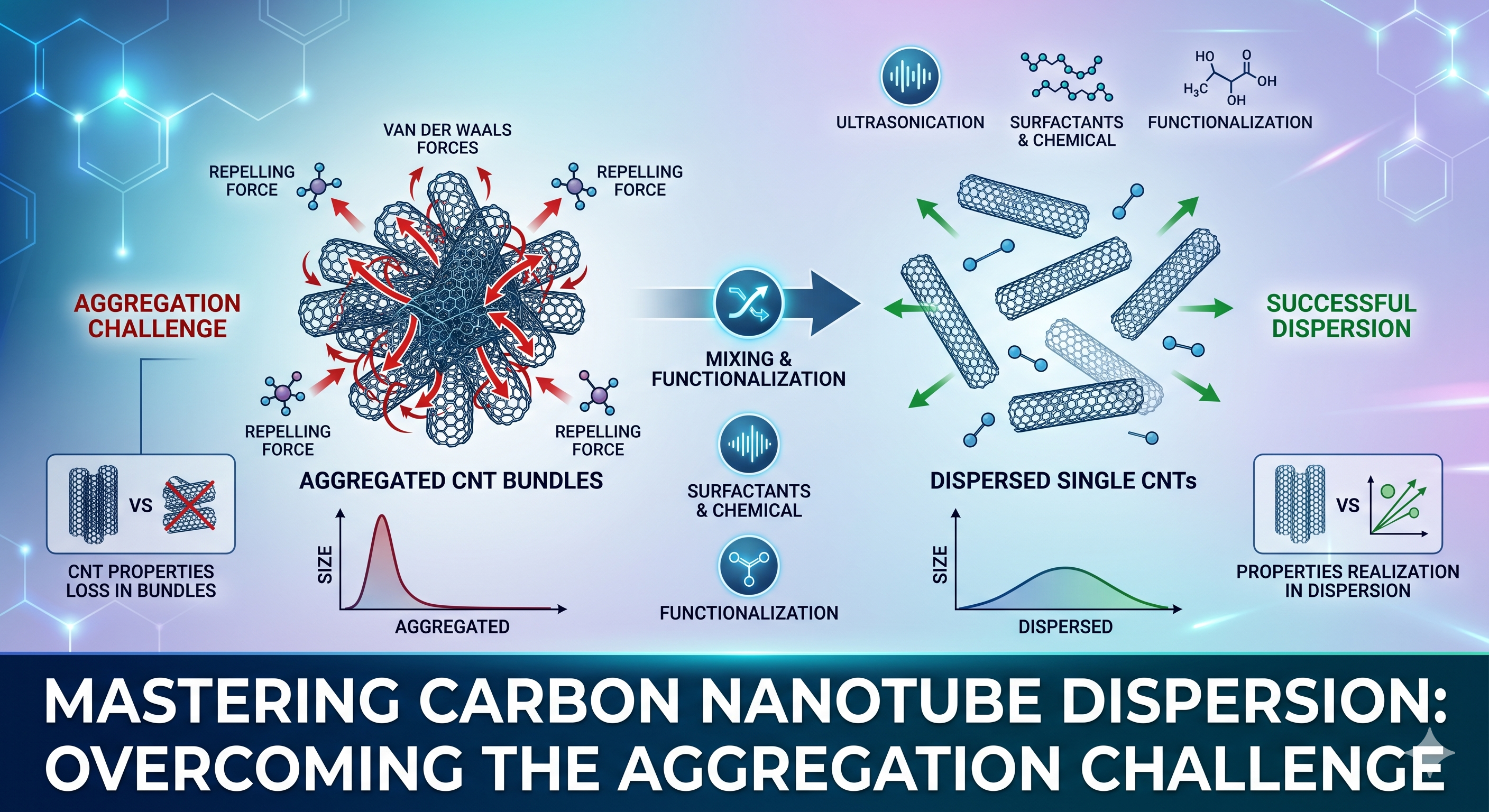
Carbon Nanotubes (CNTs) are often described as the “superheroes” of the material world. They possess electrical conductivity 1,000 times greater than copper, mechanical strength 100 times that of steel, and the ability to conduct heat better than a diamond. However, every superhero has a weakness. For CNTs, that weakness is aggregation.
Imagine trying to weave a silk dress out of a giant, sticky ball of tangled yarn. No matter how strong the individual silk threads are, the dress will be lumpy and weak if you can’t untangle them. This is the “Aggregation Challenge” in nanotechnology. To unlock the true power of CNTs, we must master the art of dispersion.
1. The Science of the “Tangle”: Why Do CNTs Clump?
At the molecular level, carbon nanotubes are incredibly “sticky.” This isn’t due to glue, but because of Van der Waals forces. These are weak attractive forces that exist between all molecules, but because CNTs have a massive surface area relative to their size, these forces become incredibly strong.
When CNTs are produced, they naturally exist as “bundles” or “ropes”—thousands of tubes tightly packed together. In this bundled state, they lose their extraordinary properties. They become like a clump of salt rather than individual grains; they don’t mix well, they don’t conduct electricity efficiently, and they create “weak spots” in composite materials.
2. Breaking the Bonds: Primary Dispersion Techniques
Scientists have developed several “battle plans” to separate these stubborn nanotubes. These are generally divided into mechanical and chemical methods.
Ultrasonication: The Power of Sound
This is the most common laboratory method. High-frequency sound waves are sent through a liquid containing the CNTs. These waves create tiny bubbles that collapse with immense energy (cavitation), literally “blasting” the nanotubes apart.
-
The Catch: If the sound is too intense or applied for too long, it can “chop” the nanotubes into short pieces, ruining their high-aspect-ratio benefits.
High-Shear Mixing
Think of this as a molecular-scale blender. By forcing the CNT mixture through tiny gaps at high speeds, mechanical forces pull the bundles apart. This is the preferred method for industrial-scale manufacturing in 2026.
3. Chemical “Social Distancing”: Surfactants and Functionalization
Mechanical force alone is often not enough because, once you stop mixing, the nanotubes want to clump back together (re-aggregation). To prevent this, we use chemical “spacers.”
-
Surfactants: These are molecules (like soap) that have one end attracted to the nanotube and the other attracted to the liquid (water or oil). They coat the CNTs, creating a “protective buffer” that keeps them apart through electrical repulsion.
-
Covalent Functionalization: Scientists can “graft” chemical groups directly onto the walls of the nanotubes. By adding oxygen or nitrogen molecules to the surface, the nanotubes become “happier” to be in a liquid and naturally push away from each other.
-
Recent Research (2025-2026): New studies focus on Bio-inspired Dispersion. Using DNA sequences or specific proteins to wrap around CNTs has shown 99% dispersion efficiency without damaging the nanotube structure.
4. Why Dispersion Matters: Industry Impacts
Next-Gen Electronics
In 2026, the race for the 2-nanometer chip is on. If CNTs are not perfectly dispersed in the conductive inks used to print circuits, the “clumps” cause short circuits. Mastered dispersion allows for transparent, foldable displays that are more durable than anything currently on the market.
Aerospace and Defense
When adding CNTs to the carbon fiber wings of a jet, dispersion is a safety requirement. Clumped nanotubes create “stress concentrators”—points where a crack is likely to start. Evenly dispersed CNTs, however, create a molecular web that makes the wing nearly indestructible.
5. Biomedical Perspective: Safety and Clinical Studies
In medicine, dispersion is not just about performance; it is about life and death. Clumped nanotubes can act like tiny needles that damage cell membranes or cause blockages in the bloodstream.
Targeted Cancer Therapy
Recent clinical trials in late 2025 have explored using “Individualized” (perfectly dispersed) CNTs to deliver heat directly to tumors. When exposed to a specific radio frequency, the CNTs vibrate and heat up, killing the cancer cells.
-
Clinical Finding: The study highlighted that only fully dispersed nanotubes could penetrate deep enough into the tumor tissue. Bundled nanotubes were filtered out by the body’s immune system before reaching the target.
Toxicity and the “Asbestos” Comparison
There has been a long-standing risk assessment regarding CNTs and lung health. Research confirms that the danger lies primarily in agglomerated (clumped) fibers, which the lungs cannot easily clear. Mastering dispersion in the manufacturing stage (converting powders into liquid masterbatches) is the primary way the industry is mitigating this risk in 2026.
6. Advantage vs. Risk Assessment
Advantages of Mastered Dispersion
-
Property Realization: You get 100% of the strength and conductivity you paid for.
-
Processability: Dispersed CNTs can be 3D printed, sprayed, or injected into molds like common plastics.
-
Transparency: Only individual nanotubes are small enough to be invisible to the human eye, enabling “smart glass” technologies.
Risks and Challenges
-
Structural Damage: Over-processing during dispersion can “break” the nanotubes, turning a miracle material into expensive soot.
-
Chemical Interference: Some surfactants used for dispersion can interfere with the final product’s chemistry (e.g., preventing a glue from hardening).
-
Cost: Achieving “perfect” dispersion adds an extra layer of cost to the manufacturing process.
7. The Future: “Self-Dispersing” Nanotubes
The “Holy Grail” of 2026 research is the development of Self-Dispersing CNTs. Instead of using sound waves or soaps, scientists are engineering the nanotubes during the growth phase to have a natural “repulsion” for one another.
By mastering the interface between the nanotube and its environment, we are moving away from “forcing” them apart to “inviting” them to spread out. As we solve the aggregation challenge, the gap between “science fiction” materials and the products in our pockets is closing faster than ever.