
Recently added item(s)
The world is built on concrete. It is the second most consumed substance on Earth, surpassed only by water. However, our reliance on this gray foundation comes with a heavy price: the cement industry alone is responsible for nearly 8% of global CO2 emissions. To build the sustainable “Cities of Tomorrow,” we don’t just need new designs; we need a radical upgrade to the very atoms of our building blocks.
Enter Graphene-Enhanced Concrete. Often referred to as “Concretene” in industrial circles, this revolutionary material infuses traditional concrete with graphene nanoplatelets (GNPs) to create a stronger, thinner, and significantly greener alternative. As we move through 2026, the transition from laboratory curiosity to skyline reality is accelerating.
1. The Science of “Concretene”: How It Works
Graphene is a single layer of carbon atoms arranged in a hexagonal lattice, famous for being 200 times stronger than steel. When integrated into a concrete mix, it acts as a mechanical and chemical catalyst at the nano-scale.
Reinforcement at the Molecular Level
In traditional concrete, cracks are inevitable. They start microscopic and grow over time. Graphene nanoplatelets act as nano-bridges. They bridge the gaps between cement particles, stopping microscopic cracks before they can even start.
Accelerated Hydration
Graphene provides a massive surface area for the chemical reaction (hydration) that makes concrete harden. Recent studies in early 2026 have shown that graphene allows the cement to bond more effectively with water, resulting in a denser, less porous microstructure. This makes the final product almost impermeable to water and salt—the primary enemies of structural longevity.
2. Environmental Impact: Solving the Carbon Crisis
The most compelling reason for the shift to graphene-enhanced concrete is its environmental footprint.
-
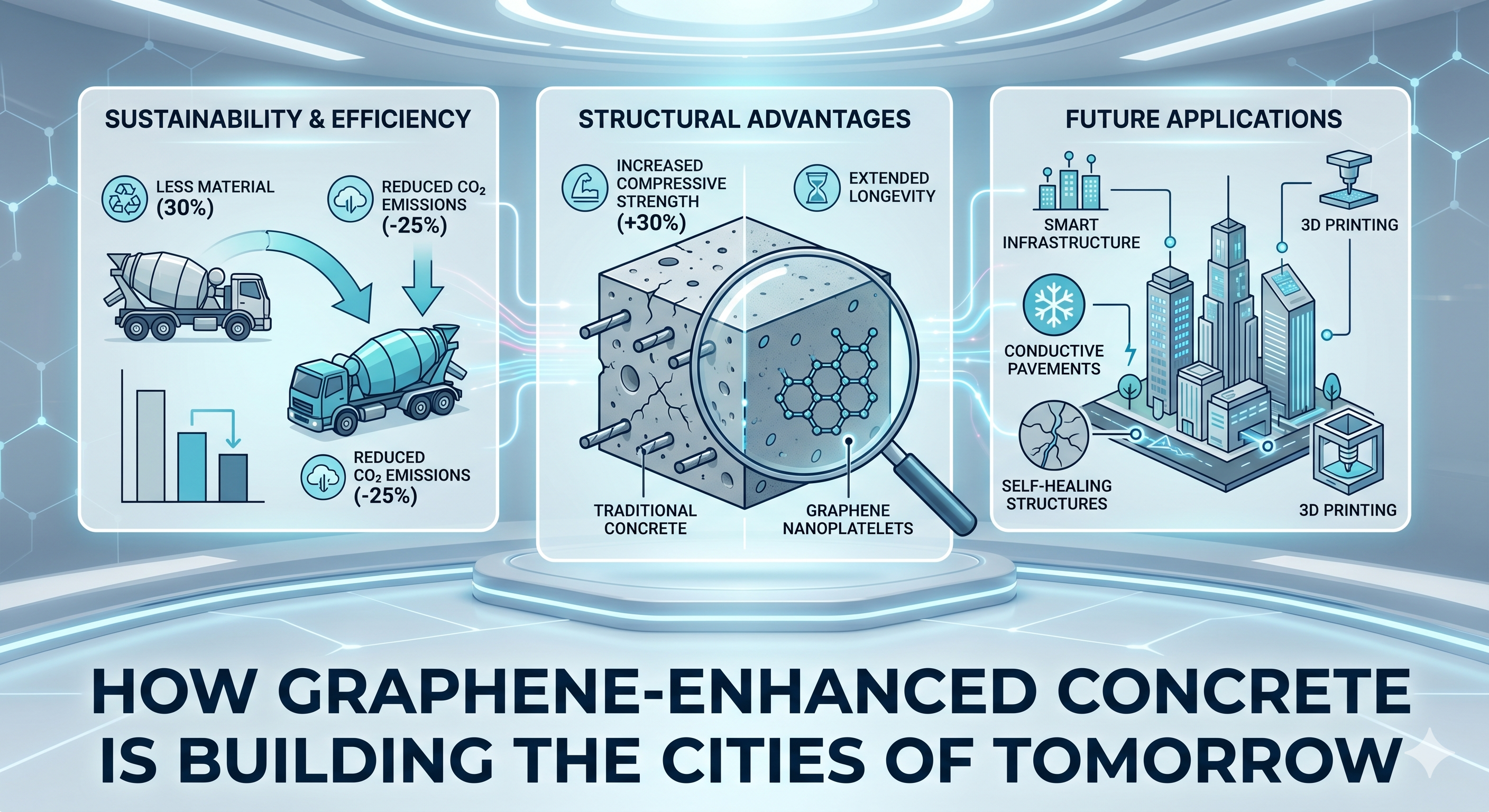
The 30% Reduction Rule: Because graphene makes concrete significantly stronger, engineers can use 30% less material to achieve the same structural integrity. This leads to a massive reduction in the amount of cement required, which directly translates to a 20-30% cut in embodied carbon for a typical building project.
-
Lowering Building Costs: While graphene itself is an added cost, the ability to use 30% less concrete and eliminate the need for traditional steel reinforcement (in some cases) makes the overall construction budget more efficient.
-
Net Zero 2050: Organizations like UK Research and Innovation (UKRI) highlight graphene concrete as a primary pathway for the construction industry to reach Net Zero targets by 2050.
3. Performance Metrics: Stronger, Thinner, Smarter
According to the latest research published in Scientific Reports (April 2026), the performance gains of optimized graphene nanoplatelet (GNP) dosages are staggering:
| Metric | Improvement over Standard Concrete |
| Compressive Strength | Up to 30% increase (reaching 47 MPa) |
| Flexural Strength | Up to 25% increase |
| Water Absorption | Reduced from 4.5% to 1.6% |
| Chloride Permeability | Dropped by ~35% |
These numbers mean that structures built today with graphene will last twice as long with half the maintenance, resisting the “chloride ingress” that typically causes rebar to rust and bridges to fail.
4. Real-World Applications: From Tunnels to Pavements
As of 2025 and 2026, we are seeing the first large-scale commercial deployments:
-
Tunnels and Underground Infrastructure: Large-scale field experiments have demonstrated that graphene concrete is uniquely suited for high-pressure environments. Its ability to resist “creep” (deformation under constant pressure) makes it the ideal material for the next generation of subway tunnels.
-
Precast Products: Companies like Concretene are successfully securing multi-million pound grants to scale “GRAPHcast” technology, creating pre-fabricated stairs, panels, and floor slabs that are lighter and easier to transport.
-
Roller Discos and Slabs: In Manchester, UK, real-world trials on massive floor slabs have already proven a reduction of 4,265kg of CO2 per single large-scale pour compared to traditional steel-reinforced solutions.
5. Advantage vs. Risk Assessment
Every technological leap must be evaluated with a sober eye toward safety and practicality.
Advantages
-
Longevity: Dramatic reduction in porosity means fewer repairs and a service life exceeding 100 years.
-
Sustainability: Less cement means fewer emissions and less water consumption.
-
Smart Features: Graphene is conductive. Future graphene-concrete roads could potentially de-ice themselves using electricity or act as sensors to monitor traffic patterns.
Risks and Challenges
-
Health and Safety: Graphene is a nanomaterial. If inhaled as a dry powder during the mixing phase, it can cause lung inflammation or fibrosis. The industry is currently moving toward “liquid admixtures” (slurries) to eliminate the risk of airborne dust.
-
Standardization: Because “graphene” refers to a family of materials, inconsistent quality in the supply chain can lead to varying performance. International standards for “Construction Grade Graphene” are currently being drafted in 2026.
-
Initial Cost: While reducing material volume saves money, the high price of graphene production still makes it a “premium” choice for many developers today.
6. The Future Vision: Self-Healing and Sensing Cities
Research into Graphene Oxide (GO) is opening doors to “Self-Healing Concrete.” When a crack occurs, the graphene can act as a scaffold for bacteria or chemical agents to migrate and seal the gap automatically.
Furthermore, the conductive nature of graphene transforms a static wall into a data-capturing surface. Tomorrow’s cities won’t just stand; they will talk. Buildings will sense their own structural health, and bridges will alert authorities the moment they experience an overload or seismic stress.
7. Conclusion: The Invisible Revolution
The “Graphene Revolution” in construction isn’t about flashy new designs; it’s an invisible revolution happening inside the slurry. By mastering the nano-scale, we are finally decoupling urban growth from environmental destruction. As we look at the skyline of 2030, we won’t see the graphene, but we will feel its impact: in the cleaner air we breathe and the resilient structures that will house generations to come.