
Recently added item(s)
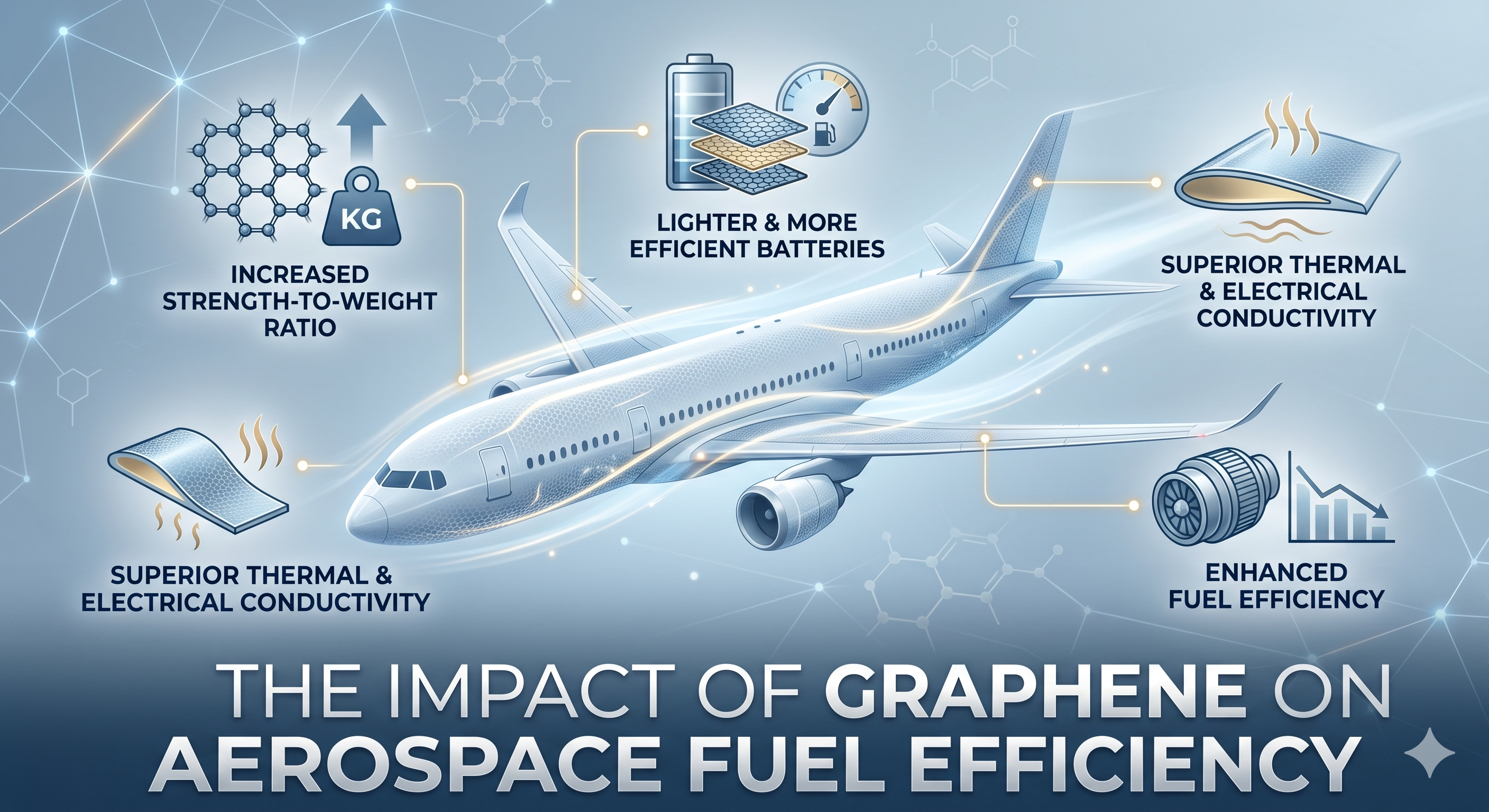
The aerospace industry is at a critical crossroads. With global travel rebounding and environmental regulations tightening, the pressure to reduce carbon emissions and improve fuel economy has never been higher. While traditional metallurgy and standard carbon fibers have served us well for decades, they are reaching their physical limits. Enter graphene—a single layer of carbon atoms arranged in a hexagonal lattice that is 200 times stronger than steel yet incredibly lightweight.
This “wonder material” is no longer confined to laboratory experiments. It is actively reshaping how we think about aircraft design, propulsion, and overall efficiency.
1. The Physics of Weight: Why Graphene Matters
In aerospace, weight is the ultimate enemy. Every kilogram saved on the airframe translates directly into less fuel burned during takeoff and cruise. Traditional aerospace materials like aluminum and titanium are heavy, and while current carbon-fiber-reinforced polymers (CFRPs) are lighter, they can be brittle.
By integrating graphene into composite materials, engineers can create “Graphene-Enhanced Polymers.” These materials are significantly stronger and stiffer than standard composites. This allows manufacturers to use thinner sections of material to achieve the same structural integrity, leading to a weight reduction of up to 20% to 30% in certain components.
2. Aerodynamic Efficiency and Nano-Coatings
Fuel efficiency isn’t just about weight; it’s also about how smoothly an aircraft moves through the air. Skin friction drag accounts for a massive portion of fuel consumption. Graphene-based coatings are being developed to create “ultra-slick” surfaces.
-
Anti-Icing Properties: Traditional de-icing involves heavy mechanical systems or chemical sprays. Graphene’s high electrical conductivity allows for thin, lightweight heating elements embedded in the wings that prevent ice buildup with minimal energy use.
-
Reduced Drag: Nano-coatings can fill microscopic imperfections on the aircraft’s surface, creating a laminar flow that reduces air resistance.
3. Revolutionizing Propulsion and Energy Storage
The impact of graphene extends deep into the engines and power systems.
Thermal Management
Jet engines operate at extreme temperatures. Graphene’s exceptional thermal conductivity allows for better heat dissipation in engine components and electronics. This enables engines to run at higher, more efficient temperatures without the risk of melting or degrading sensitive parts.
The Shift to Electric and Hybrid
As the industry moves toward “More Electric Aircraft” (MEA), battery weight becomes a hurdle. Graphene-enhanced batteries and supercapacitors offer:
-
Faster Charging: Essential for quick turnaround times at airports.
-
Higher Energy Density: Providing more power for less weight compared to standard Lithium-ion batteries.
-
Longevity: Graphene stabilizes the internal chemistry of batteries, making them safer and longer-lasting.
4. Current Research and Real-World Applications
Recent studies have moved from theory to “flight-ready” testing.
-
The University of Manchester & Haydale: Research partnerships in the UK have already flown unmanned aerial vehicles (UAVs) with graphene-skinned wings. These tests proved that the wings were more impact-resistant and lighter than those made with standard materials.
-
Graphene Flagship: This massive European research initiative has been investigating graphene “wicks” for heat pipes in satellites and aircraft, proving that the material can handle the vacuum of space and the high-stress environment of flight.
-
Airbus and Boeing: While often secretive about proprietary tech, both giants have filed numerous patents involving graphene-enhanced composites for fuselage and wing structures to meet the “Flightpath 2050” goals of reducing $CO_2$ emissions by 75%.
5. Risk Assessment: The Challenges of a Nano-Revolution
Despite its potential, graphene is not a “magic powder” that can be tossed into a factory overnight.
The Challenges (Risks)
-
Scalability and Cost: Producing high-quality, defect-free graphene at an industrial scale remains expensive. While prices are dropping, they are still higher than traditional carbon black or fiberglass.
-
Manufacturing Integration: Incorporating a 2D material into 3D manufacturing processes requires new techniques. If the graphene is not dispersed perfectly within a polymer, it can actually create “weak spots” instead of strengthening the material.
-
Health and Safety: As with any nanomaterial, there are ongoing studies regarding the inhalation of dry graphene powder during the manufacturing phase. Strict “clean room” protocols are mandatory.
The Advantages
-
Unmatched Strength-to-Weight Ratio: No other known material offers this level of reinforcement.
-
Multifunctionality: One material can provide structural strength, electrical conductivity, and thermal management simultaneously.
-
Sustainability: Lower fuel burn leads to a massive reduction in the carbon footprint of the global aviation fleet.
6. The “Clinical” View: Material Testing and Certification
In aerospace, we don’t call them “clinical trials,” but “certification programs.” Every graphene-enhanced part must undergo thousands of hours of stress testing.
Current “clinical” evaluations focus on Lightning Strike Protection (LSP). Traditionally, aircraft use a heavy copper mesh embedded in the fuselage to dissipate lightning. Research shows that a thin layer of graphene can do the same job at a fraction of the weight, protecting the passengers and the aircraft’s electronic brain from 30,000-ampere strikes.
7. Future Outlook: Beyond 2030
We are currently in the “composite integration” phase. The next decade will likely see graphene moving into the interior of the cabin (lighter seats and floor panels) and eventually into the primary load-bearing structures of commercial giants like the A350 or 787 successors.
The synergy between AI-driven design and graphene manufacturing will allow us to “grow” aircraft parts that are optimized at the molecular level. This isn’t just an incremental improvement; it is the fundamental shift required to make sustainable aviation a reality.
Conclusion
Graphene is the key to unlocking the next generation of aerospace efficiency. By tackling the triple threat of weight, drag, and thermal inefficiency, it provides a path toward a greener sky. While the road to full certification is long and paved with rigorous safety checks, the rewards—lower costs for airlines, cheaper tickets for passengers, and a healthier planet—are well worth the journey.