
Recently added item(s)
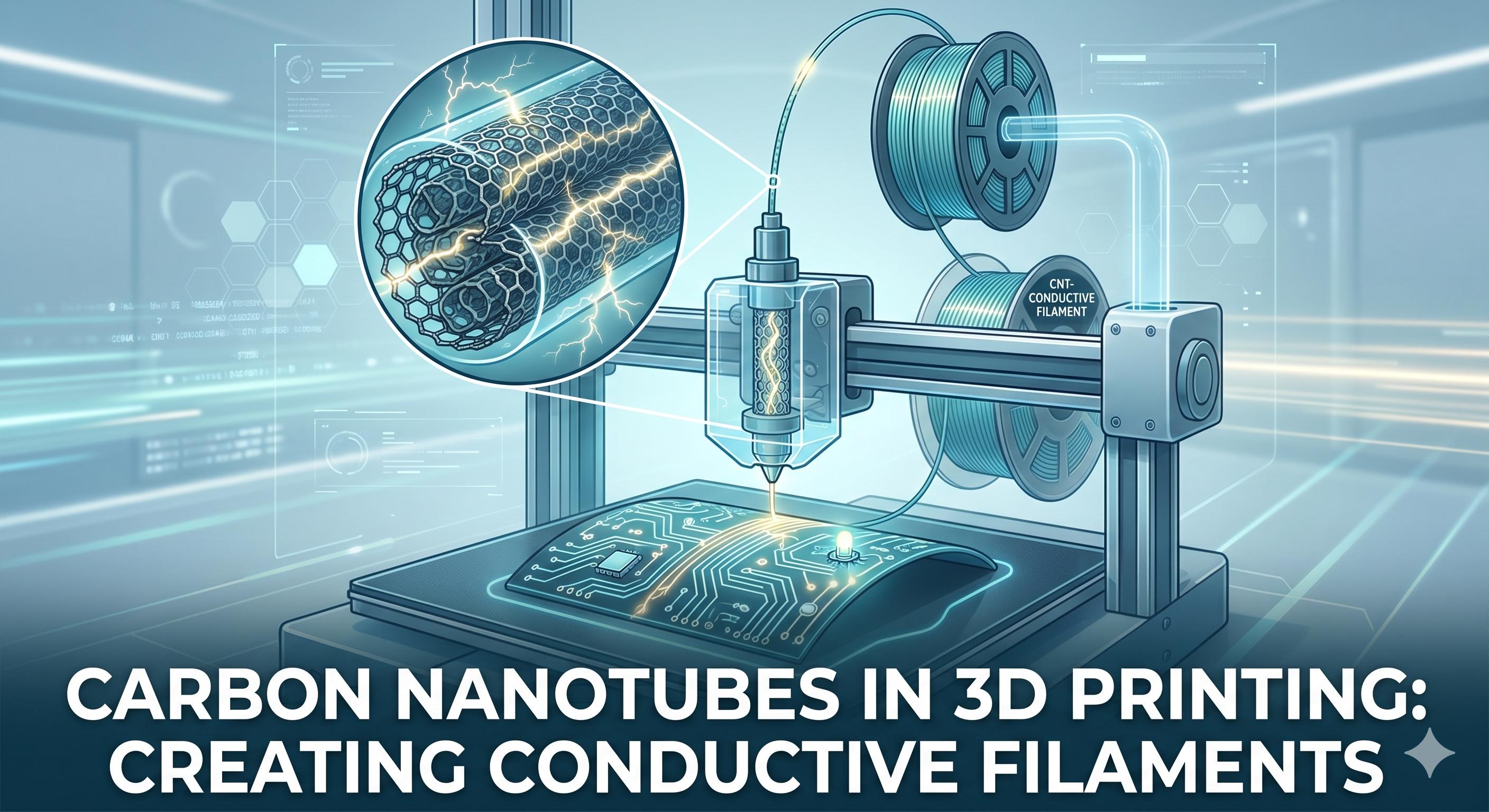
For years, 3D printing was primarily viewed as a tool for rapid prototyping—creating “look-alike” models that were visually impressive but functionally limited. If you wanted a part that could conduct electricity or withstand extreme mechanical stress, you typically had to revert to traditional manufacturing like injection molding or CNC machining.
However, we are currently witnessing a massive shift. The integration of Carbon Nanotubes (CNTs) into 3D printing filaments is moving the industry toward “functional additive manufacturing.” By embedding these microscopic cylinders of carbon into polymer matrices, we are no longer just printing shapes; we are printing circuits, sensors, and electromagnetic shields. As of 2026, the ability to create highly conductive, 3D-printable materials is one of the most significant breakthroughs in the nanotechnology and chemical sectors.
What are Carbon Nanotubes? The “Atomic Rebar”
To understand why they are so revolutionary for 3D printing, we have to look at their structure. Carbon Nanotubes are essentially sheets of graphene rolled into a cylinder. They come in two primary forms:
-
Single-Walled Carbon Nanotubes (SWCNTs): A single layer of carbon atoms, offering the highest electrical conductivity and strength.
-
Multi-Walled Carbon Nanotubes (MWCNTs): Multiple nested layers of carbon, which are often more cost-effective for industrial-scale filament production.
In terms of physical properties, CNTs are nothing short of miraculous. They have a tensile strength 100 times greater than steel at one-sixth the weight, and their electrical conductivity can be as high as copper. In the context of a 3D printing filament, think of them as “atomic rebar”—they reinforce the plastic while providing a superhighway for electrons.
The Conduction Mechanism: The Percolation Threshold
The magic of conductive 3D printing doesn’t require the entire filament to be made of carbon. Instead, it relies on a concept called the Percolation Threshold.
When CNTs are dispersed into a polymer (like PLA, ABS, or PEEK), they are initially isolated from one another. As the concentration of nanotubes increases, they eventually begin to touch, forming a continuous, three-dimensional network throughout the plastic. This “tipping point” is the percolation threshold.
Once this network is established, electricity can flow through the part. Because CNTs have a very high “aspect ratio” (they are very long compared to their diameter), they can achieve conductivity at much lower concentrations (often 1% to 5% by weight) than traditional fillers like carbon black or metal powders. This is critical for 3D printing because adding too much filler can make the filament brittle and impossible to extrude through a standard nozzle.
Manufacturing Conductive Filaments: Challenges in Dispersion
The biggest hurdle for companies like Nanokar or other chemical innovators is not the nanotubes themselves, but dispersion.
CNTs are naturally “sticky” due to Van der Waals forces; they want to clump together into “bundles.” If these bundles are present in a 3D printing filament, two things happen:
-
Nozzle Clogging: The clumps act like sand in a pipe, leading to failed prints.
-
Poor Performance: Instead of a consistent conductive network, you get “islands” of conductivity separated by insulating plastic.
Modern manufacturing uses high-shear twin-screw extrusion and chemical functionalization (attaching specific molecules to the surface of the CNTs) to ensure they spread evenly. By 2026, the use of AI-driven mixing protocols has allowed manufacturers to monitor dispersion in real-time, resulting in “Masterbatch” pellets that can be diluted into various resins with surgical precision.
Current Research and Breakthroughs (2024–2026)
The research landscape has moved beyond simply “making it work” to “making it smart.”
1. Anisotropic Conductivity via Nozzle Alignment
One of the most exciting areas of study involves using the 3D printing process itself to align the nanotubes. As the molten filament is forced through a narrow nozzle, the shear forces naturally align the long CNTs in the direction of the print path.
-
The Result: Parts that are significantly more conductive along the “X-Y” axis than the “Z” axis. Researchers are now using this to create directional sensors and advanced antennas.
2. 4D Printing and Self-Sensing Structures
We are seeing the rise of “4D printing,” where 3D-printed parts change shape in response to an electrical current. By using CNT-filled filaments, engineers can print a flat structure that “folds” into a complex shape when a voltage is applied, thanks to the Joule heating effect of the nanotubes.
3. Structural Health Monitoring (SHM)
In aerospace and civil engineering, research is focused on “self-sensing” parts. If a 3D-printed drone wing made with CNT filament develops a microscopic crack, the electrical resistance of the part changes instantly. This allows the aircraft’s computer to detect structural failure before it becomes visible to the naked eye.
Advantage-Risk Assessment: A Professional Evaluation
For any business owner or engineer, the decision to move to CNT-enhanced filaments involves a trade-off between performance and logistics.
The Advantages
-
Integrated Electronics: You can print “traces” directly into a mechanical part, eliminating the need for traditional PCBs and wiring in tight spaces.
-
EMI/RFI Shielding: CNT filaments are excellent at blocking electromagnetic interference. This is vital for the automotive industry (EVs) and telecommunications.
-
Weight Reduction: Replacing metal conductive parts with CNT-reinforced plastics can reduce the weight of a component by up to 80%.
-
Mechanical Reinforcement: Even if conductivity isn’t the goal, the nanotubes act as a powerful reinforcement, increasing the heat deflection temperature and impact resistance of the base plastic.
The Risks and Challenges
-
Cost: CNT filaments remain significantly more expensive than standard materials. The ROI must be calculated based on the reduction in assembly time and part complexity.
-
Health and Safety: During the manufacturing of the filament, raw CNT powder is a respiratory hazard. However, once embedded in the filament, the risk is minimized. Still, 3D printing enthusiasts should ensure proper ventilation to avoid inhaling any nanoparticles released during the melting process.
-
Brittleness: While CNTs add strength, they can reduce the “elongation at break.” A part might be stronger but will snap rather than bend when it finally fails.
-
Machine Wear: Carbon nanotubes are abrasive. Standard brass nozzles will wear out quickly; hardened steel or ruby-tipped nozzles are a requirement for long-term production.
Clinical and Environmental Context: Bio-Compatible Conductivity
Interestingly, CNT-conductive 3D printing has entered the biomedical field. Recent clinical trials have explored 3D-printed scaffolds for nerve regeneration.
Because nerves communicate via electrical impulses, a conductive scaffold can provide the necessary electrical cues to “guide” nerve growth across a gap caused by injury. By using bio-compatible polymers mixed with purified carbon nanotubes, researchers have successfully printed structures that support cell adhesion while providing the necessary electrical conductivity for tissue repair.
The Road Ahead: The Global Supply Chain
As we look toward the end of the decade, the goal is “multimaterial extrusion.” Imagine a single 3D printer with two nozzles: one printing a high-strength insulating polymer and the other printing a CNT-conductive “wire” inside the part.
This would allow for the automated production of fully functional devices—from hearing aids to satellite components—in a single print job. For the nanotechnology industry, the challenge remains scaling the production of high-purity nanotubes to bring costs down to the level of traditional materials.
Conclusion
Carbon Nanotubes have transformed 3D printing from a hobbyist’s tool into a high-tech manufacturing powerhouse. By overcoming the challenges of dispersion and leveraging the unique “percolation” properties of these nanotubes, we are entering an era of “intelligent matter.”
Whether it is for shielding sensitive electronics in an electric SUV, monitoring the integrity of a pipeline, or healing damaged nerves, CNT-conductive filaments are the key to a lighter, smarter, and more connected world. For the entrepreneur and the engineer alike, the frontier is no longer just what we can build, but how well that building can “think” and “conduct.”