
Recently added item(s)
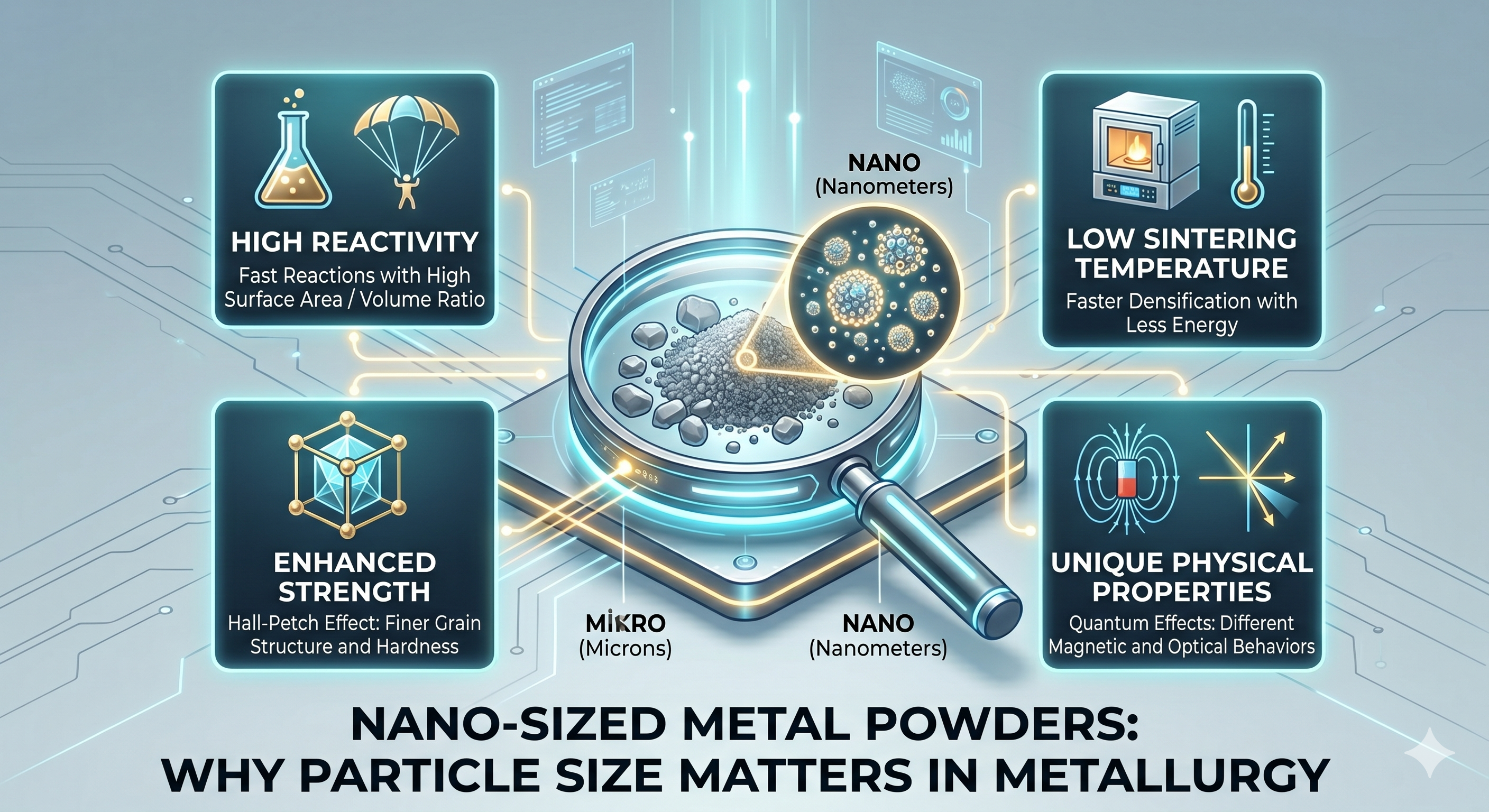
The history of metallurgy is a history of scale. For thousands of years, humans have manipulated metals by melting, hammering, and casting them. But in the 21st century, the most significant breakthroughs are not happening in massive blast furnaces; they are happening at the level of the atom.
Welcome to the world of Nano-Sized Metal Powders. In modern materials science, “size” is not just a physical dimension—it is a functional property. When a metal is reduced to the nanoscale (typically between 1 and 100 nanometers), it begins to ignore the classical laws of physics and starts behaving according to the rules of quantum mechanics. This shift is revolutionizing industries from aerospace and electronics to medicine and green energy.
1. The Power of “Small”: The Surface Area Revolution
To understand why particle size matters, we must first discuss the Surface-Area-to-Volume Ratio. Imagine a solid cube of iron. Most of the iron atoms are “trapped” inside the cube, unable to interact with the environment. Now, imagine grinding that cube into billions of nano-sized particles.
Suddenly, a massive percentage of the atoms are on the surface. Because surface atoms have “unfilled” chemical bonds, they are incredibly reactive. In metallurgy, this means:
-
Faster Chemical Reactions: Nano-powders can catalyze reactions at a rate thousands of times faster than bulk metals.
-
Enhanced Bonding: When used as coatings or additives, nano-powders create more intimate contact with other materials, leading to stronger composites.
2. Lowering the Melting Point: The Sintering Advantage
In traditional metallurgy, “sintering” is the process of compacting and forming a solid mass of material by heat or pressure without melting it to the point of liquefaction.
One of the most essential reasons particle size matters is that nanoparticles have a lower melting point than bulk materials. This phenomenon, known as melting-point depression, occurs because the high surface energy of the nanoparticles makes it easier for the atoms to break free from their rigid crystal structure.
Energy Efficiency and Precision
For high-melting-point metals like Tungsten or Molybdenum, being able to sinter at lower temperatures is a game-changer. It allows manufacturers to:
-
Save Energy: Reducing the furnace temperature by even 200°C significantly cuts industrial power consumption.
-
Prevent Grain Growth: In traditional sintering, long heat cycles cause metal grains to grow larger, which often makes the final product weaker. Rapid, low-temperature sintering with nano-powders keeps the internal structure fine and incredibly strong.
3. Strengthening the “Bone” of the Metal: The Hall-Petch Effect
In the world of structural engineering, there is a famous principle called the Hall-Petch Relationship. It states that as the grain size of a metal decreases, its hardness and yield strength increase.
By starting with nano-sized metal powders, metallurgists can create alloys with “ultrafine” grains. These materials are much harder than their traditional counterparts. This is why nano-powders are essential for:
-
Cutting Tools: Creating drill bits that never dull.
-
Aerospace Components: Making engine parts that are lighter yet stronger than ever before.
-
Armor Plating: Developing materials that can absorb high-velocity impacts without fracturing.
4. High-Performance Applications: From Carbonyl Nickel to Tungsten
Different metals gain different “superpowers” when reduced to the nanoscale.
Carbonyl Nickel Nano-Powder
Nickel nano-powders are essential in the production of high-performance batteries and fuel cells. Their high surface area allows for faster ion exchange, which translates to faster charging times for electric vehicles (EVs). Furthermore, their magnetic properties change at the nanoscale, making them useful for electromagnetic interference (EMI) shielding in sensitive electronics.
Nano-Tungsten and Heavy Alloys
Tungsten is prized for its density and heat resistance. Nano-sized tungsten powder is the backbone of “heavy alloys” used in radiation shielding and kinetic energy penetrators. By using nano-sized precursors, these alloys achieve a theoretical density that is nearly impossible to reach with standard micro-powders.
Nano-Copper for Conductive Inks
In the electronics world, nano-copper is used to create conductive inks for printed circuit boards (PCBs). Because the particles are so small, they can be “printed” through inkjet nozzles, allowing for the 3D printing of complex electronic circuits on flexible surfaces like plastic or even paper.
5. Current Research and “Clinical” Industrial Testing (2025–2026)
Research into nano-sized powders has accelerated in the last 24 months, particularly in the realm of Additive Manufacturing (3D Printing).
-
Nano-Stabilization in 3D Printing: A major challenge in metal 3D printing is “hot cracking,” where the metal cracks as it cools. Recent research (2025) has shown that adding nano-sized “nucleants” (like nano-titanium) to the powder bed acts as a seed for crystal growth, ensuring a uniform, crack-free structure during the laser melting process.
-
Hydrogen Storage: Researchers are currently testing nano-magnesium powders as a medium for solid-state hydrogen storage. Nano-powders can “soak up” hydrogen gas and release it on demand much more efficiently than bulk storage tanks, potentially solving one of the biggest hurdles in the green energy transition.
-
Self-Healing Metals: Experiments are underway using nano-capsules of metal powders embedded in structural materials. When a micro-crack forms, the capsules rupture, and the nano-powder reacts to “weld” the crack shut automatically.
6. Advantage vs. Risk Assessment: The Balancing Act
While the advantages of nano-sized metal powders are clear, they come with significant technical and safety challenges.
The Advantages (The Pros)
-
Unmatched Reactivity: Enables new chemical pathways and faster production cycles.
-
Structural Superiority: Produces metals with higher strength, hardness, and wear resistance.
-
Miniaturization: Allows for the creation of smaller, more powerful electronic and medical devices.
The Risks and Challenges (The Cons)
-
Pyrophoricity (Fire Risk): Many nano-sized metal powders (like Aluminum or Iron) are pyrophoric—they can spontaneously ignite when exposed to air. This requires specialized “inert gas” (Argon or Nitrogen) handling systems, increasing operational costs.
-
Toxicity and Inhalation: Because these particles are so small, they can easily be inhaled and cross the blood-brain barrier. Strict PPE (Personal Protective Equipment) and specialized filtration are mandatory in production environments.
-
Agglomeration: Nanoparticles have a “sticky” nature due to Van der Waals forces. They tend to clump together (agglomerate), which can ruin the benefits of their small size. Specialized chemical coatings (surfactants) are often needed to keep them separated.
7. The Procurement Perspective: Quality and Characterization
For industries utilizing these materials, the challenge is not just buying “nano-powder,” but buying the right nano-powder. The characterization of these materials requires advanced tools:
-
SEM/TEM (Scanning/Transmission Electron Microscopy): To verify the actual size and shape of the particles.
-
BET Analysis: To measure the specific surface area.
-
XRD (X-Ray Diffraction): To ensure the purity of the metallic crystal structure.
As supply chains become more sophisticated, the demand for high-purity, micronized, and nano-metal powders is expected to grow by 15% annually through 2030, driven largely by the medical and defense sectors.
8. Conclusion: The Future is Built on Small Things
Particle size is not just a detail in metallurgy; it is the defining factor of the next industrial revolution. By manipulating metal at the nanoscale, we are no longer limited by the “natural” properties of elements. We can design materials that are stronger than steel but lighter than aluminum, and catalysts that can turn waste CO2 into fuel.
As we move toward more sustainable and high-tech manufacturing, the ability to produce, handle, and apply nano-sized metal powders will be the hallmark of the world’s most advanced companies. The backbone of tomorrow’s machines is being built today, one nanometer at a time.