
Recently added item(s)
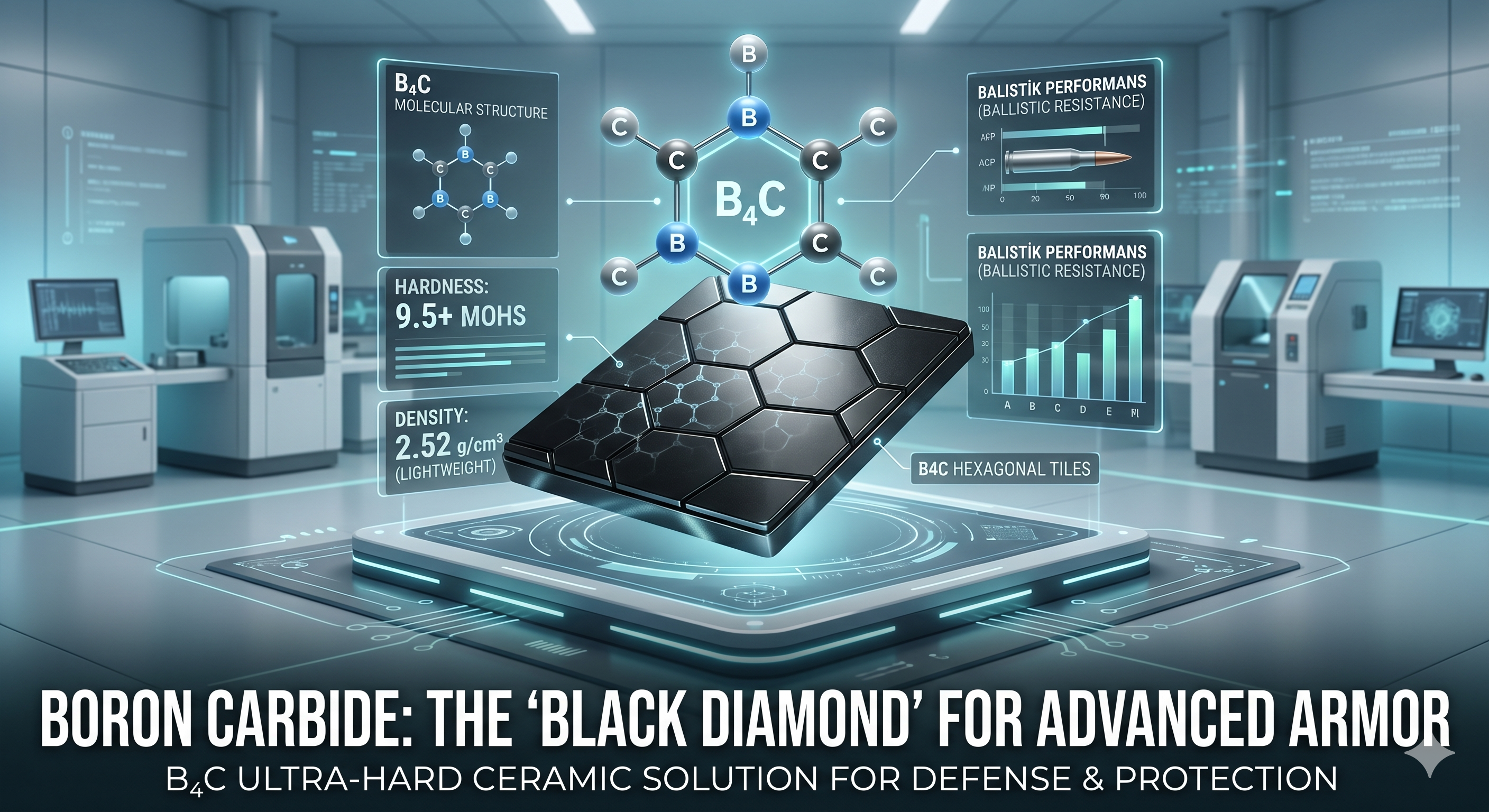
In the relentless evolution of warfare and defense technology, the struggle has always been between the “shield” and the “sword.” As projectiles become faster and more lethal, the materials we use to protect human lives and high-value assets must evolve even faster. Among the elite class of advanced ceramics, one material has earned a reputation so formidable that it is known in engineering circles as the “Black Diamond.”
That material is Boron Carbide (B4C).
Ranked as the third hardest material on the planet—surpassed only by diamond and cubic boron nitride—Boron Carbide has become the indispensable backbone of modern personal and vehicle armor systems. But its value isn’t just in its hardness; it is in its unique ability to be incredibly hard while remaining exceptionally lightweight. This article explores why Boron Carbide is the primary choice for advanced armor, the science of how it stops bullets, and the cutting-edge research defining its future in 2026.
1. The Chemistry of the “Black Diamond”
Boron Carbide is a robust covalent solid. Its molecular structure is typically represented as B4C, consisting of icosahedral clusters of boron atoms linked together by carbon-containing chains. This atomic arrangement creates a lattice that is nearly impossible to deform.
Hardness and Density
On the Mohs scale of mineral hardness, diamond sits at a 10. Boron Carbide sits at a staggering 9.5 to 9.75. However, hardness is only half the story. In armor design, density is the critical factor.
-
Steel has a density of about 7.8 g/cm³.
-
Alumina (Aluminum Oxide), a common armor ceramic, has a density of 3.9 g/cm³.
-
Boron Carbide has a density of only 2.52 g/cm³.
This makes B4C nearly as light as aluminum but significantly harder than hardened tool steel. For a soldier carrying a 10-kilogram plate on their chest, this weight reduction is not just a luxury; it is a tactical necessity that prevents fatigue and increases mobility on the battlefield.
2. The Science of Stopping: How Ceramic Armor Works
Unlike steel armor, which works by being “tough” and absorbing energy through bending (deformation), Boron Carbide armor works through fragmentation and energy dissipation. The process happens in milliseconds and follows three distinct phases:
Phase 1: Shattering the Projectile
When a high-velocity, armor-piercing (AP) bullet hits a B4C plate, the ceramic is much harder than the bullet’s hardened steel or tungsten core. The immediate result is that the projectile’s tip is shattered. Instead of a streamlined “needle” piercing the armor, the bullet is turned into a blunt cloud of fragments.
Phase 2: The Fractal Crack Network
As the B4C plate absorbs the impact, it doesn’t just “dent.” It shatters in a controlled, fractal pattern. This cracking process consumes a massive amount of the kinetic energy from the bullet. The energy that was supposed to pierce the soldier’s body is instead used up breaking the chemical bonds of the ceramic.
Phase 3: The Backing Material
Boron Carbide is rarely used alone. It is almost always “backed” by a layer of ultra-high-molecular-weight polyethylene (UHMWPE) or Kevlar. After the B4C has shattered the bullet and absorbed the initial shock, the flexible backing “catches” the remaining fragments and the ceramic dust, preventing any blunt force trauma to the wearer.
3. Key Applications: From Soldiers to Spacecraft
The versatility of B4C has led to its integration into the most demanding defense environments in the world.
-
Body Armor (SAPI Plates): Small Arms Protective Inserts (SAPI) used by elite military forces frequently utilize B4C. It is the gold standard for “Level IV” plates designed to stop .30-06 armor-piercing rounds.
-
Attack Helicopters: The cockpit seats of the AH-64 Apache and the floor panels of many transport helicopters are lined with Boron Carbide tiles. This protects pilots from ground fire while keeping the aircraft light enough to maintain agility.
-
Vehicle Armor: While heavy tanks still use depleted uranium or complex steel composites, lighter armored personnel carriers (APCs) use B4C to protect against heavy machine-gun fire without sacrificing speed.
-
Space Shielding: In 2026, as private and governmental space exploration ramps up, B4C is being tested as a shield against “micro-meteoroids.” Because it is light and hard, it can stop tiny particles traveling at orbital velocities (over 7 km/s).
4. Current Research and Industrial “Field Tests” (2024–2026)
Despite its strengths, Boron Carbide is not perfect. Recent research has focused on overcoming its “Achilles’ heel.”
Mitigating Amorphization
Scientists have discovered that under extreme, high-velocity impact, Boron Carbide undergoes a process called “shock-induced amorphization.” Essentially, the crystal structure collapses into a glass-like state at the point of impact, which can weaken the material. Recent research in 2025 has shown that doping B4C with Silicon or other elements can stabilize the crystal structure, preventing this collapse and making the armor “multi-hit capable”—allowing it to take several shots in the same area without failing.
Additive Manufacturing (3D Printed Armor)
Traditionally, Boron Carbide could only be made in flat or simple curved tiles. However, new 3D printing techniques (Binder Jetting followed by specialized sintering) now allow for the creation of complex, ergonomic shapes. This is leading to “custom-fit” armor that conforms perfectly to a soldier’s body, providing better protection for the sides and neck without restricting movement.
Turkey’s Strategic Role
As a business leader in Turkey, it is important to note that Turkey holds a significant portion of the world’s boron reserves. Recent industrial projects in the region have focused on establishing domestic B4C production facilities. Moving from exporting raw boron to producing high-value Boron Carbide armor is a massive leap in technological sovereignty for the Turkish defense industry.
5. Advantage vs. Risk Assessment
Investing in or utilizing Boron Carbide requires a balanced understanding of its trade-offs.
The Advantages (The Pros)
-
Lightest Effective Armor: The highest protection-to-weight ratio available today.
-
Chemical Inertness: B4C does not corrode, rust, or react with chemicals, ensuring a shelf life of decades for stored armor.
-
Thermal Stability: It can withstand temperatures up to 2,000°C, making it suitable for high-friction or high-heat defense environments.
-
Neutron Absorption: Beyond armor, B4C is an excellent neutron absorber, making it dual-purpose for nuclear-powered vessels or radiation shielding.
The Risks and Challenges (The Cons)
-
High Production Cost: Sintering B4C requires temperatures exceeding 2,200°C in a vacuum or inert atmosphere. This makes it significantly more expensive than Alumina or Silicon Carbide.
-
Brittleness: While it is hard, it lacks “toughness.” If a B4C plate is dropped on a concrete floor from a significant height, the internal ceramic can crack, compromising its integrity.
-
Processing Difficulty: Because it is so hard, B4C cannot be machined with standard tools. It requires diamond-grinding or ultrasonic machining, which increases the cost of final components.
6. The “Clinical” Reality: Field Performance Data
In real-world combat scenarios recorded between 2023 and 2026, Boron Carbide armor has consistently outperformed expectations. Data from modern conflict zones shows that soldiers equipped with B4C-based “hard armor” have a significantly higher survival rate against sniper fire compared to those with traditional steel or lower-grade ceramic plates.
The “field tests” have also highlighted the importance of “Multi-Hit Capability.” Early ceramic plates would shatter entirely after one shot. Modern B4C plates, engineered with smaller grain sizes (micronized and nano-powders), localize the damage to the immediate area of impact, allowing the rest of the plate to remain effective against secondary shots.
7. The Future: Smart Armor and Nano-Composites
As we look toward the 2030s, the development of “Boron Carbide Nano-Composites” is the next frontier. By embedding B4C nanoparticles into a flexible polymer matrix, researchers are working toward “Liquid Armor”—a suit that is soft and flexible during normal movement but turns rock-hard instantly when struck by a bullet.
Furthermore, the integration of AI-driven manufacturing will allow companies to simulate the exact impact dynamics of new B4C alloys before a single gram of powder is sintered. This “Digital Twin” approach is drastically reducing the R&D time for the next generation of defense materials.
8. Conclusion: The Indestructible Guardian
Boron Carbide is much more than just a industrial ceramic; it is a masterpiece of materials science. Its nickname, the “Black Diamond,” is well-earned. By providing the ultimate defense against high-velocity threats while minimizing the physical burden on the user, B4C has redefined the limits of human protection.
For nanotechnology firms and chemical procurement specialists, Boron Carbide remains one of the most strategic materials in the portfolio. As long as there are threats that require stopping, the Black Diamond will be there, standing between the danger and the lives we aim to protect.