
Recently added item(s)
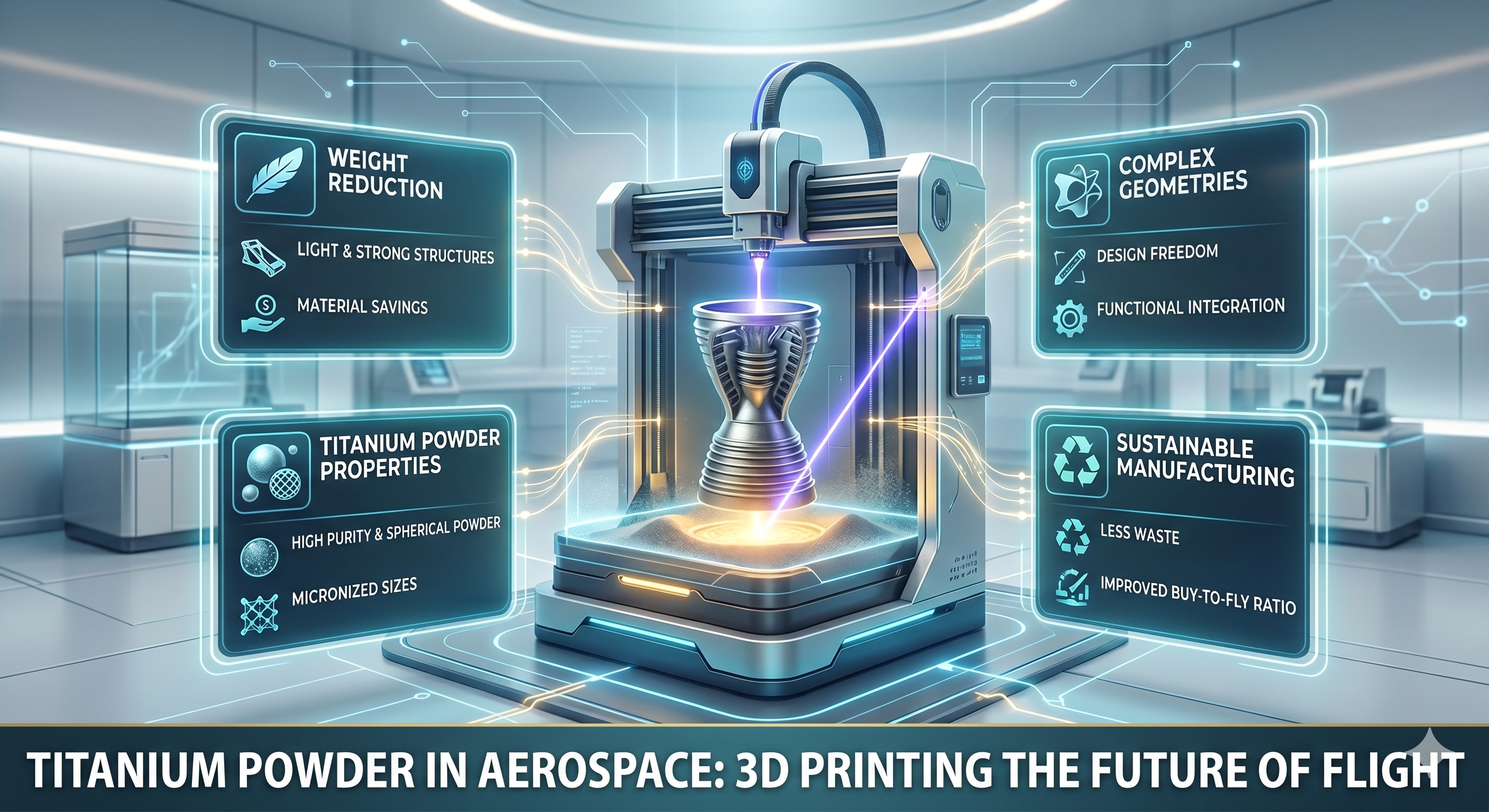
In the history of aviation, every major leap has been driven by a breakthrough in material science. From the wood and fabric of the Wright brothers to the aluminum alloys of the mid-20th century, the goal has always been the same: Higher, Faster, and Lighter. For decades, Titanium has been the “dream metal” of aerospace engineers due to its incredible strength-to-weight ratio and resistance to extreme temperatures.
However, titanium has always had a significant drawback: it is notoriously difficult and expensive to machine. Traditionally, making a titanium aerospace part involved “subtractive manufacturing”—starting with a large block and carving away up to 90% of the material as waste. Today, we are witnessing a seismic shift. The rise of Additive Manufacturing (AM), or 3D printing, powered by high-purity Titanium Powder, is transforming the aerospace industry from a waste-heavy sector into a model of precision engineering.
1. The Chemistry of Flight: Why Titanium Grade 5?
While there are many grades of titanium, the aerospace industry revolves primarily around Ti-6Al-4V (Grade 5). This “workhorse” alloy is composed of 90% titanium, 6% aluminum, and 4% vanadium.
At the molecular level, this alloy is a masterpiece. The aluminum stabilizes the “alpha” phase (providing strength and creep resistance), while the vanadium stabilizes the “beta” phase (allowing the material to be heat-treated to incredible hardness). When this alloy is converted into a fine, spherical powder, it becomes the raw fuel for the most advanced 3D printers on Earth.
Key Physical Properties:
-
High Strength-to-Weight Ratio: It is as strong as steel but 45% lighter.
-
Corrosion Resistance: It is virtually immune to the corrosive effects of salt air and jet fuel.
-
Cryogenic Stability: Unlike many metals that become brittle in the extreme cold of high altitudes or space, titanium maintains its toughness.
2. The Powder Revolution: From Ingots to Spheres
For 3D printing to be viable in aerospace, the quality of the titanium powder must be flawless. Even a tiny impurity or an irregularly shaped particle can cause a “void” in a critical engine part, leading to catastrophic failure.
Most aerospace-grade titanium powder is produced through Gas Atomization or Plasma Atomization. In these processes, a titanium wire or ingot is melted, and the molten stream is hit by high-pressure inert gas (Argon). This shatters the metal into millions of tiny droplets that solidify in mid-air into perfect spheres.
Why Sphericity Matters:
In a 3D printer, the powder must flow like water across a “bed.” Spherical particles ensure high flowability and high packing density. If the particles were jagged, they would clump together, creating microscopic air pockets in the final part. As an expert in micronized metal powders, you know that the “D50” (median particle size) is crucial here; for most aerospace 3D printing, the sweet spot is between 15 and 45 microns.
3. The Additive Process: L-PBF and EBM
Two primary technologies dominate the 3D printing of titanium in the hangar:
-
Laser Powder Bed Fusion (L-PBF): A high-powered fiber laser traces a cross-section of the part on a bed of titanium powder, melting the particles together. It offers extreme precision and thin-walled structures.
-
Electron Beam Melting (EBM): An electron beam melts the powder in a high-vacuum environment. This process happens at higher temperatures, which helps “stress-relieve” the titanium as it prints, making it ideal for large, structural components like landing gear brackets.
4. The Economics of “Buy-to-Fly” Ratio
In the world of aerospace procurement, the most important metric is the Buy-to-Fly ratio. This is the weight of the raw material purchased versus the weight of the final part that actually flies on the aircraft.
-
Traditional Machining: A 10:1 ratio is common. To make a 1kg part, you buy 10kg of titanium and turn 9kg into “chips” or scrap.
-
3D Printing: The ratio is closer to 1.5:1. Since you only put material where it is needed, waste is almost eliminated.
For a business owner, this isn’t just an engineering win; it’s a massive financial optimization. Reducing waste reduces the “cost-per-part” and shortens the supply chain, as you no longer need to wait for massive forged blocks to be delivered.
5. Real-World “Field Studies”: Success Stories from the Sky
We are no longer in the “experimental” phase. Titanium 3D printing is currently operational in the most advanced aircraft in the world:
-
GE Aviation’s LEAP Engine: Perhaps the most famous example, GE uses 3D-printed titanium fuel nozzles. These nozzles were previously made of 20 separate parts welded together; now, they are a single, 3D-printed piece that is 25% lighter and 5 times more durable.
-
Boeing 787 Dreamliner: Boeing was the first to use FAA-approved 3D-printed titanium structural parts. These components help take the load of the fuselage and have contributed to the Dreamliner’s superior fuel efficiency.
-
Airbus A350 XWB: Airbus utilizes 3D-printed titanium brackets and hinges. By using “topological optimization”—letting AI design the part to mimic organic, bone-like structures—Airbus reduced the weight of these parts by 45%.
6. Current Research and Innovations (2024–2026)
The current frontier of research is focused on making 3D-printed titanium even more reliable and versatile.
Nano-Additive Reinforcement
One of the most exciting research areas in 2025 has been the “seeding” of titanium powder with nanoparticles (such as Titanium Diboride or Graphene). These nanoparticles act as “nucleants” during the printing process, resulting in an ultra-fine grain structure that is significantly stronger and more resistant to “hot cracking” than standard Ti-6Al-4V.
Digital Twins and In-Situ Monitoring
New 3D printers are now equipped with high-speed cameras and AI sensors that monitor the “melt pool” in real-time. If the AI detects a tiny deviation in temperature or a microscopic flaw, it can adjust the laser power mid-print. This “Digital Twin” approach ensures that every part comes with a “birth certificate” of quality, satisfying the strict requirements of civil aviation authorities.
Post-Processing: HIP (Hot Isostatic Pressing)
Research continues into the optimization of Hot Isostatic Pressing. After printing, parts are placed in a chamber with high pressure and heat to “heal” any internal pores. Studies in 2026 are focusing on reducing the time and energy required for HIP, making the entire production cycle faster.
7. Advantage vs. Risk Assessment
Every revolutionary technology must be weighed against its challenges.
The Advantages (The Pros):
-
Massive Weight Reduction: Enables better fuel efficiency or higher payloads for satellites.
-
Design Freedom: Engineers can create “lattice” structures that are impossible to manufacture with traditional tools.
-
Part Consolidation: Turning 50 parts into 1 reduces assembly time and the risk of joint failure.
-
Supply Chain Agility: “Print on demand” means fewer warehouses filled with spare parts.
The Risks and Challenges (The Cons):
-
Surface Roughness: 3D-printed parts often have a “sandy” surface. In aerospace, this can be a starting point for fatigue cracks. Advanced polishing (like centrifugal finishing) is mandatory.
-
High Material Cost: Titanium powder is significantly more expensive than titanium ingots. While you use less of it, the “entry price” for the raw material remains high.
-
Certification Hurdles: The FAA and EASA are notoriously conservative. Proving that a 3D-printed part is as safe as a forged part requires thousands of hours of testing.
-
Porosity: Microscopic air bubbles can still form if the powder is not perfectly dry or the laser parameters are slightly off.
8. Conclusion: The Strategic Future
Titanium powder is the silent fuel of the next aerospace revolution. As space tourism becomes a reality and we look toward 6th-generation fighter jets and ultra-efficient commercial travel, the ability to 3D print complex titanium components will be the hallmark of industrial leadership.
For companies specializing in advanced materials and chemical procurement, the focus must be on purity, consistency, and innovation. By combining the “old school” strength of titanium metallurgy with the “new school” precision of AI-driven additive manufacturing, we are quite literally printing the future of flight.