
Recently added item(s)
In the world of mechanical engineering and advanced materials science, friction is the silent enemy. It consumes energy, wears down components, and eventually leads to system failure. While liquid oils and greases have been the traditional “peacekeepers” in this conflict for centuries, modern technology often pushes machinery into environments where liquids simply cannot survive. Whether it is the vacuum of deep space, the searing heat of a jet engine, or the delicate interior of a human joint replacement, liquid lubricants evaporate, freeze, or contaminate.
This is where Molybdenum Disulfide (MoS2)—often referred to as the “black lead” of the industrial world—steps in. As a premier solid lubricant, MoS2 has transitioned from a humble mineral to a cornerstone of 21st-century tribology. In this article, we will explore the molecular magic behind its slipperiness, its diverse applications from aerospace to clinical medicine, and the latest research defining its future.
The Anatomy of Slipperiness: What is MoS2?
Molybdenum Disulfide is a naturally occurring inorganic compound found in the mineral molybdenite. To the naked eye, it looks like a dark, silvery-gray powder, much like graphite. However, its performance characteristics are uniquely its own.
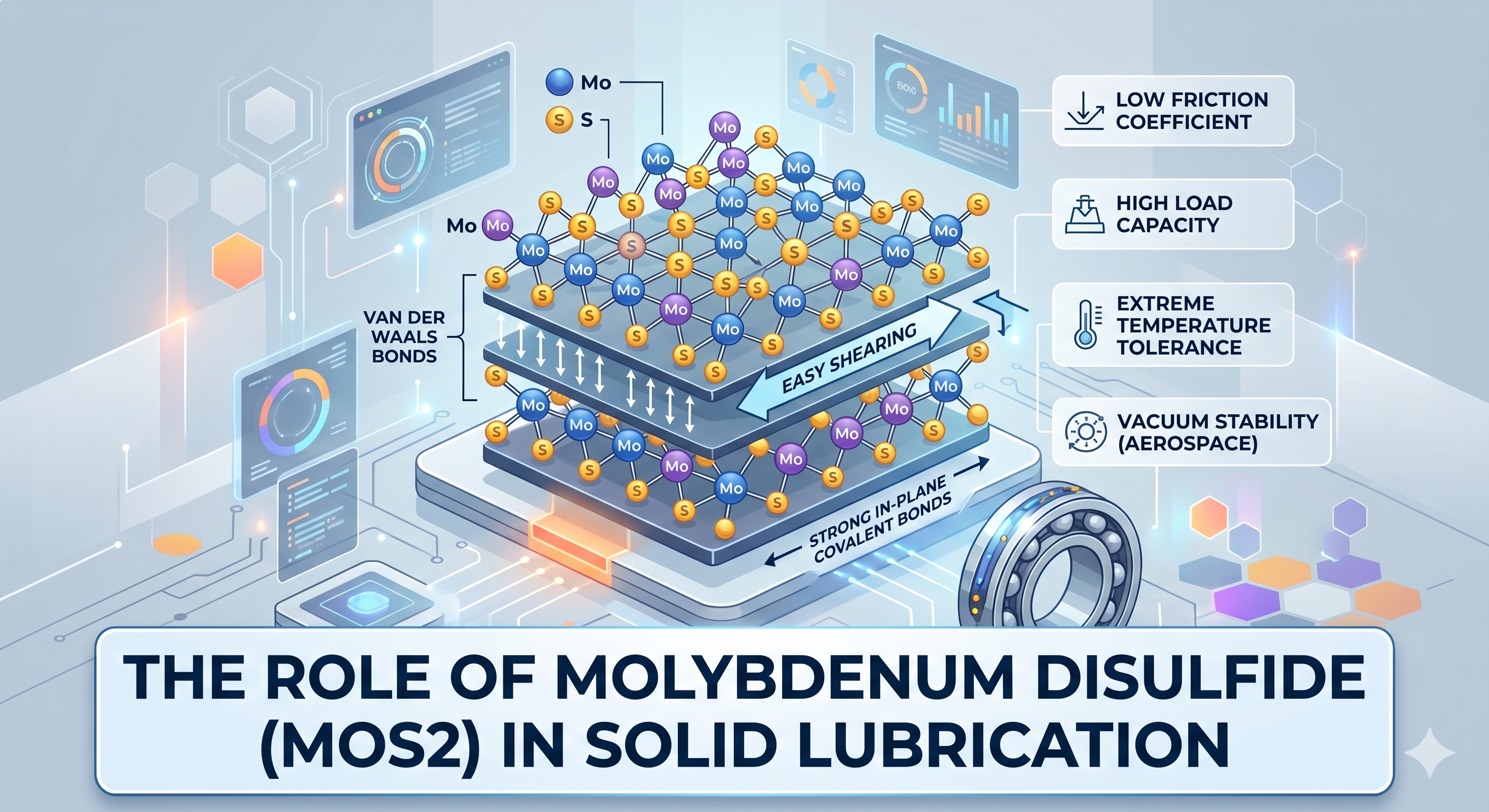
The secret to its lubricating prowess lies in its hexagonal crystal structure. Imagine a club sandwich: the “bread” layers are made of sulfur atoms, and the “meat” in the middle is a layer of molybdenum atoms. Within each “sandwich” (or molecular layer), the atoms are held together by very strong covalent bonds. However, the force holding one sandwich to the next is a weak physical attraction known as Van der Waals forces.
When a mechanical load is applied, these layers slide over one another with incredible ease, much like a deck of playing cards sliding across a table. This low shear strength between layers is what allows MoS2 to reduce friction coefficients to as low as 0.03 to 0.05—far lower than most polished metals.
Why Solid Lubrication? The Necessity of the “Dry” Approach
Standard lubricants work by creating a pressurized film of oil between moving parts. This works well until one of three things happens:
-
Extreme Temperature: Oils thin out and evaporate at high heat or become brittle and “glassy” in extreme cold.
-
Vacuum Environments: In space or vacuum chambers, liquids undergo “outgassing,” effectively evaporating away and leaving the machinery bone-dry.
-
High Loads: Under massive pressure, the oil film can be squeezed out, leading to metal-on-metal contact.
MoS2 thrives where liquids fail. Because it is a solid, it stays exactly where it is applied. It can withstand temperatures from -270 degrees Celsius (cryogenic) up to 400 degrees Celsius in normal air, and even higher (up to 1100 degrees Celsius) in a vacuum or inert atmosphere.
Applications Across Industries
1. Aerospace and Defense
In the vacuum of space, MoS2 is the gold standard. It is used on the deployment mechanisms of satellite solar panels, gimbal bearings, and even the gears of Mars rovers. Without MoS2, these parts would “cold weld” together in the vacuum, rendering millions of dollars of equipment useless.
2. Automotive and Heavy Industry
In your car, MoS2 is often used as an additive in engine oils or as a dry film coating on piston skirts. By reducing the friction between the piston and the cylinder wall, it improves fuel efficiency and extends engine life. In heavy industry, it is used for “for-life” lubrication in bearings that are inaccessible for regular maintenance.
3. Medical and Clinical Applications (The New Frontier)
One of the most exciting areas of current research is the use of MoS2 in clinical and biomedical settings. Orthopedic implants, such as hip and knee replacements, suffer from “fretting corrosion”—tiny movements that wear down the metal and release toxic particles into the bloodstream.
Recent clinical studies are investigating MoS2 as a biocompatible coating for titanium implants. Because MoS2 is chemically stable and has shown low toxicity in cellular environments, it can act as a protective barrier. Research published in journals like Biomaterials suggests that MoS2 coatings can significantly reduce the wear rate of prosthetic joints, potentially doubling the lifespan of the implant and reducing the need for painful revision surgeries.
Current Research: Nano-Lubricants and 2D Materials
We are currently living in the “Age of 2D Materials.” Following the discovery of graphene, MoS2 has gained a second life as a two-dimensional semiconductor. Researchers are now looking at nanoscale MoS2—particles so small they can penetrate the microscopic pores of metal surfaces.
Synergistic Lubrication: Recent studies have focused on combining MoS2 with other materials like Graphene or Carbon Nanotubes. These “hybrid” lubricants create a multi-modal defense against friction. While MoS2 provides the sliding layers, the carbon structures act like microscopic ball bearings, further reducing the rolling resistance.
Smart Coatings: Research is also delving into “self-healing” MoS2 coatings. These involve embedding MoS2 micro-capsules within a polymer matrix. When a scratch occurs, the capsules break, releasing the MoS2 to fill the gap and restore the lubricating film automatically.
Advantage vs. Risk Assessment
Like any specialized material, MoS2 is not a “magic bullet” for every situation. It is essential to weigh its benefits against its limitations.
The Advantages
-
High Load Carrying Capacity: Unlike oil, MoS2 does not “squeeze out.” It can handle extreme pressures (up to 250,000 psi).
-
Extreme Temperature Stability: It remains functional in environments that would vaporize traditional grease.
-
Chemical Inertness: It does not react easily with most acids or solvents.
-
Low Friction in Vacuum: Its performance actually improves in the absence of moisture and air.
The Risks and Limitations
-
Moisture Sensitivity: This is the “Achilles’ heel” of MoS2. In very humid environments (above 60% relative humidity), water molecules can get trapped between the sulfur layers, increasing friction and potentially leading to the formation of sulfuric acid, which can corrode the underlying metal.
-
Oxidation: In normal air, MoS2 begins to oxidize into molybdenum trioxide (MoO3) at around 400 degrees Celsius. MoO3 is abrasive rather than lubricating, which can cause sudden wear.
-
Application Difficulty: To get the best results, MoS2 must be properly bonded to the surface (burnishing, spraying, or PVD coating), which requires specialized equipment compared to simply “pouring” oil.
MoS2 vs. Graphite: A Comparison
Many people confuse MoS2 with Graphite because they look similar. However, they are functionally opposites:
-
Graphite requires moisture (water vapor) to be slippery. In a vacuum (space), graphite becomes abrasive.
-
MoS2 dislikes moisture. It performs best in dry or vacuum conditions.
This makes MoS2 the superior choice for high-tech, controlled, or extreme-environment applications.
The Future: Environmental Sustainability
As the world moves toward “Green Tribology,” MoS2 is being viewed as an environmentally friendly alternative to heavy-metal-based liquid additives. Because it lasts longer and requires less frequent application, it reduces the overall volume of chemical waste generated by industrial machinery. Furthermore, its ability to reduce friction directly translates to lower carbon emissions in transport sectors.
Conclusion
Molybdenum Disulfide is much more than just a dry powder. It is a fundamental tool that allows us to build machines that operate in the most hostile environments known to man. From the gears of a satellite orbiting Earth to the precision instruments used in robotic surgery, MoS2 provides the silent, sliding support that keeps our world moving.
As we continue to refine our ability to manipulate this material at the atomic level, we can expect MoS2 to play an even larger role in the next generation of high-efficiency engines, long-lasting medical implants, and sustainable industrial systems.