
Recently added item(s)
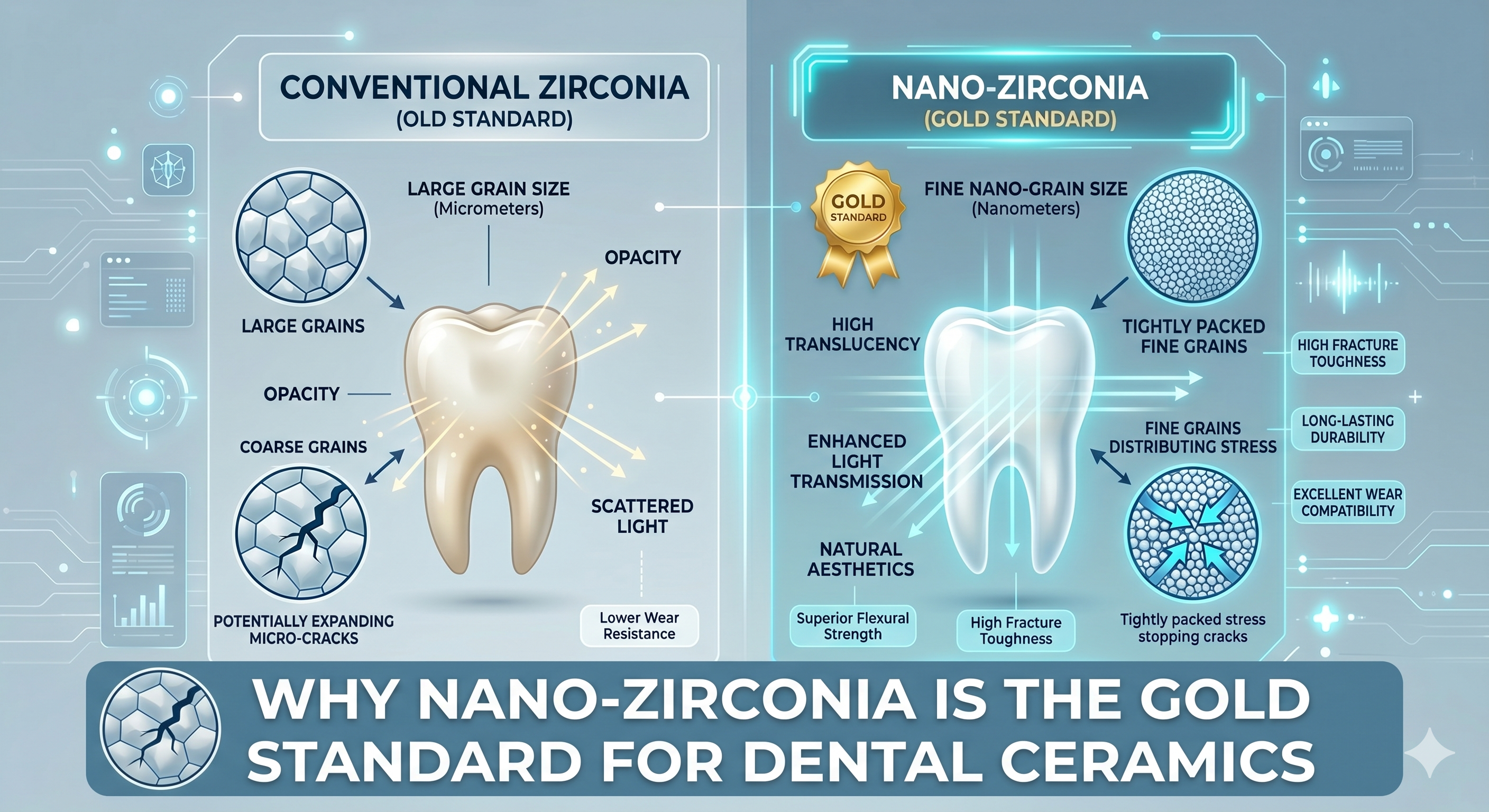
For decades, the quest for the perfect dental restoration has been a balancing act between two seemingly opposing forces: beauty and brawn. Patients want teeth that look indistinguishable from nature—translucent, vibrant, and light-reflecting. Dentists, however, need materials that can withstand the incredible forces of the human jaw, which can exert hundreds of pounds of pressure during chewing.
Enter Zirconia (Zirconium Dioxide). In its early days, it was known as “Ceramic Steel” for its toughness, but it was often criticized for looking like a flat, opaque bathroom tile. Today, thanks to the revolution of nanotechnology, Nano-Zirconia has claimed the throne as the undisputed gold standard. In this deep dive, we explore the science, the latest clinical breakthroughs, and why this material is the “forever” choice for modern dentistry.
The Evolution: From Industrial Toughness to Biological Beauty
To understand Nano-Zirconia, we must first look at its parent material. Zirconia is a crystalline oxide of zirconium. In dentistry, it is typically “stabilized” with yttria (Yttrium oxide) to keep it in a specific crystal phase at room temperature.
The “magic” of zirconia lies in a phenomenon called transformation toughening. Imagine a tiny crack begins to form in a zirconia crown. The stress of that crack causes the surrounding crystals to switch from a “tetragonal” phase to a “monoclinic” phase. As they switch, they actually expand in volume, essentially “pinching” the crack shut and preventing it from spreading.
While this made zirconia incredibly strong, the large grain sizes of early versions scattered light, making the crowns look chalky. Nano-Zirconia solves this by reducing the grain size to the nanometer scale (often less than 100 nm). When grains are smaller than the wavelength of visible light, the material becomes translucent, allowing it to mimic the “depth” of a natural tooth.
The Nano-Difference: Why Grain Size Matters
In the world of dental ceramics, size really does matter. Conventional zirconia has a grain size ranging from 0.5 to 2 micrometers. Nano-zirconia pushes this down to the 15–60 nanometer range. This shift results in three critical advantages:
1. Unmatched Translucency
In a natural tooth, light travels through the enamel and reflects off the dentin. Because nano-zirconia has fewer “boundaries” between large crystals to scatter light, it allows for a high degree of translucency. In 2025 and 2026, the industry has seen the rise of “Graded Zirconia” blocks, which use varying nano-particle densities to create a crown that is strong at the bottom (for chewing) and highly translucent at the top (for aesthetics).
2. Enhanced Wear Compatibility
A common fear with hard ceramics is that they will wear down the natural teeth on the opposite jaw. Research has shown that nano-zirconia, when polished to a high shine, is actually kinder to opposing enamel than traditional porcelain. This is because the nano-structure allows for an incredibly smooth surface that stays smooth even as it wears, unlike traditional porcelains which can become “sandpaper-like” over time.
3. Low-Temperature Degradation (LTD) Resistance
One of the historical risks of zirconia was “aging” or LTD, where moisture in the mouth causes the material to weaken over many years. Nano-sized grains are significantly more stable against this moisture-induced transition, ensuring that a bridge or crown placed today remains structurally sound for decades.
Recent Research and Clinical Breakthroughs (2024–2026)
The last 24 months have provided groundbreaking data regarding the clinical performance of nano-zirconia.
The “High-Yttria” Era
Recent studies have focused on 5Y-PSZ (5 mol% Yttria-Stabilized Zirconia). In clinical trials published in early 2025, 5Y-Nano-Zirconia demonstrated a 98.4% survival rate over a 5-year period for posterior bridges. These “high-yttria” versions provide the highest level of translucency ever recorded, making them the preferred choice for front-teeth (anterior) restorations where metal-free aesthetics are paramount.
Digital Workflow Integration
The integration of nano-zirconia with AI-driven CAD/CAM systems has reached a fever pitch in 2026. Because nano-zirconia powders are more uniform, they can be milled with much higher precision. Research into “Zero-Fit” technology allows dentists to scan a patient’s mouth and mill a nano-zirconia crown that fits with a margin of error of less than 10 microns—roughly one-tenth the thickness of a human hair.
Plaque Resistance
New clinical studies comparing nano-zirconia to gold and lithium disilicate (E-max) have found that nano-zirconia has the lowest bacterial adhesion rate. For patients, this means a lower risk of gum disease (periodontitis) around the base of the crown, as the “slick” nano-surface is difficult for bacteria to colonize.
[Image comparing translucency of nano-zirconia vs standard zirconia]
Advantage vs. Risk: A Detailed Evaluation
While Nano-Zirconia is the current gold standard, a professional evaluation requires looking at both sides of the coin.
The Advantages
-
Biocompatibility: Zirconia is chemically inert. Unlike metal-based crowns (PFM), there is no risk of allergic reactions or the “dark gray line” at the gumline.
-
Strength: It typically possesses a flexural strength of 800 to 1,200 MPa. For comparison, natural human enamel is around 10–20 MPa. It is virtually unbreakable under normal chewing conditions.
-
Conservation of Tooth Structure: Because the material is so strong, it can be made very thin. This means the dentist has to remove less of the patient’s natural tooth to make room for the crown.
-
Monolithic Design: “Monolithic” means the crown is made from a single solid block. This eliminates the risk of “chipping,” a common problem with older crowns where a ceramic layer was fused to a metal base.
The Risks and Limitations
-
Bonding Sensitivity: While zirconia is strong, “gluing” it to the tooth (cementation) requires a very specific chemical protocol involving MDP-primers. If the protocol isn’t followed exactly, the crown can come loose.
-
The “Hardness” Myth: While zirconia is kind to opposing teeth if polished, it can be devastating if it is left unpolished or “adjusted” by the dentist without re-polishing. A rough zirconia surface acts like a diamond file against natural teeth.
-
Cost: The high-tech manufacturing process of nano-powders and the sophisticated milling equipment required make these restorations more expensive than traditional options.
Nano-Zirconia vs. The Competition
How does it stack up against the other “big names” in dental ceramics?
| Feature | Nano-Zirconia (5Y) | Lithium Disilicate (E-max) | Porcelain-Fused-to-Metal (PFM) |
| Strength | Very High (800+ MPa) | Moderate (400 MPa) | High (Metal support) |
| Aesthetics | High | Very High | Moderate (Metal shadow) |
| Thinness | 0.4mm – 0.6mm | 1.0mm – 1.5mm | 1.5mm – 2.0mm |
| Durability | Excellent | Good (prone to fracture) | Excellent (metal) / Poor (ceramic chipping) |
| Bio-Friendly | Best | Excellent | Moderate (potential allergies) |
The Future: Bio-Active Nano-Zirconia
Looking ahead to the end of 2026 and beyond, research is now moving into “Smart” Zirconia. Scientists are experimenting with embedding nano-zirconia with “bio-active” glass particles. These particles could slowly release calcium and phosphate, essentially “healing” the surrounding bone and gum tissue.
Furthermore, the rise of 3D-printed zirconia (Additive Manufacturing) is set to reduce waste and allow for even more complex internal structures that mimic the exact density of a natural tooth root.
Conclusion
Nano-Zirconia has earned its title as the gold standard by successfully merging the mechanical properties of a structural metal with the optical properties of a gemstone. It offers a “biological harmony” that few other man-made materials can match.
For the patient, it means a smile that is not only beautiful today but will remain functional and healthy for decades. For the professional, it represents the pinnacle of material science—a material that works with the body, rather than just in it.