
Recently added item(s)
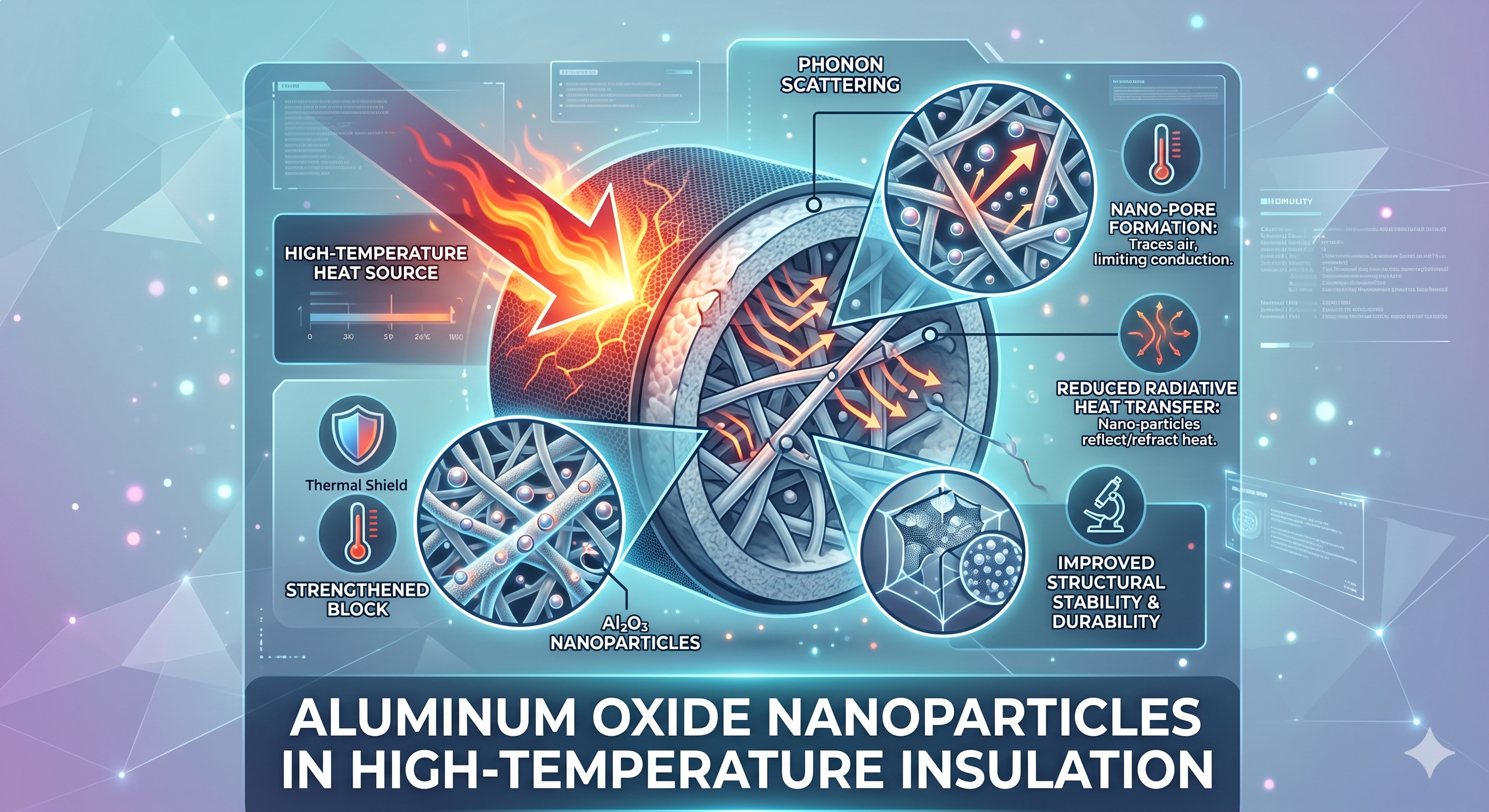
In the relentless pursuit of industrial efficiency, heat is both a tool and a tyrant. From the searing interiors of jet engines to the high-capacity furnaces used in semiconductor manufacturing, managing extreme temperatures is the difference between a breakthrough and a meltdown. Traditional insulation materials—like bulky ceramic fibers or heavy bricks—are reaching their physical limits.
The solution, however, isn’t found in getting bigger; it is found in going smaller. Aluminum Oxide (Al2O3) nanoparticles have emerged as the “secret sauce” in high-temperature insulation, offering a unique combination of thermal stability, mechanical strength, and microscopic precision. As we move through 2026, these nanoparticles are redefining what is possible in thermal management.
The Science of Alumina: Why Aluminum Oxide?
Aluminum Oxide, commonly known as Alumina, is one of the most versatile ceramic materials on the planet. In its macro-scale form, it is the primary component of sapphires and rubies. In its nano-scale form, it becomes a powerhouse of engineering.
Alumina is prized for its incredibly high melting point—approximately 2072 degrees Celsius (3762 degrees Fahrenheit)—and its chemical inertness. It doesn’t oxidize (because it is already an oxide), and it remains stable in most acidic or alkaline environments.
When we break Alumina down into nanoparticles (typically between 1 and 100 nanometers), its properties shift. The surface-area-to-volume ratio skyrockets. This means a handful of nano-alumina powder has more active surface area than a football field’s worth of traditional ceramic blocks. This surface area is the key to blocking heat.
The “Nano-Blocker”: How It Works at High Temperatures
To understand how Alumina nanoparticles insulate, we have to look at how heat moves. Heat travels through solids via “phonons”—vibrations that pass from one atom to another.
In traditional materials, phonons move relatively freely. However, when you introduce Alumina nanoparticles into an insulation matrix (like a coating or a ceramic fiber), you create millions of “interfaces” or boundaries. These boundaries act like microscopic speed bumps. When a heat vibration hits a nanoparticle, it scatters. This is known as phonon scattering.
Furthermore, at extreme temperatures, heat also moves through radiation (infrared waves). Alumina nanoparticles are exceptionally good at refracting and reflecting these waves, acting like a microscopic mirror system that bounces heat back toward the source rather than letting it soak through the wall.
Current Research (2025-2026): The Frontiers of Insulation
The research landscape for Alumina nanoparticles has exploded in the last two years, focusing on three major areas:
1. Nano-Enhanced Aerogels
Aerogels are the lightest solids known to man, often called “frozen smoke.” While they are incredible insulators, they are traditionally very brittle. Recent research has focused on “seeding” silica aerogels with Alumina nanoparticles. This creates a hybrid structure that can withstand temperatures up to 1200 degrees Celsius without shrinking or cracking, making them ideal for the next generation of Mars probes and hypersonic flight vehicles.
2. Thermal Barrier Coatings (TBCs) for Jet Engines
In the aerospace sector, engineers are using Plasma-Sprayed Nano-Alumina to coat turbine blades. By using a “nano-structured” coating rather than a traditional one, the blades can operate at temperatures higher than their own melting point. Current 2026 studies show that these nano-structured coatings are 30% more resistant to “spallation” (peeling off) than previous generations, directly leading to better fuel efficiency and longer engine life.
3. Additive Manufacturing (3D Printing)
We are now seeing the rise of 3D-printable ceramic pastes infused with Alumina nanoparticles. This allows for the creation of “complex internal cooling channels” within insulation blocks. Instead of a solid wall of insulation, we can print a microscopic “honeycomb” that traps air and scatters heat even more effectively, reducing the weight of industrial furnaces by up to 40%.
Health and Clinical Perspectives: The Human Side of Nanotech
While Alumina nanoparticles are industrial in nature, their impact on human health is a subject of intense clinical and toxicological study. As production scales up, workplace safety has become a priority.
Pulmonary Impact and “Nano-Safety”
Clinical studies involving “in-vitro” (cell culture) and “in-vivo” (animal model) research have investigated the effects of inhaled Alumina nanoparticles. Because they are so small, they can bypass the natural filters in the human nose and reach deep into the lungs.
A 2025 longitudinal study on factory workers suggested that while Alumina is chemically inert, the “physical shape” of the nanoparticles can cause oxidative stress in lung tissue if not properly managed. This has led to the “Gold Standard” of 2026 safety protocols: Closed-Loop Manufacturing. By ensuring that Alumina nanoparticles are only handled in liquid “slurries” or vacuum-sealed environments, the risk of inhalation is virtually eliminated.
Biocompatibility Research
Interestingly, Alumina’s stability has also led to clinical trials in orthopedic coatings. Because it is a great insulator and highly wear-resistant, nano-alumina is being tested as a thermal barrier for bone-drilling tools and as a component in hip replacements to reduce the heat generated by friction during movement.
Advantage vs. Risk Assessment
Every technological leap requires a careful weighing of the pros and cons.
The Advantages
-
Superior Thermal Resistance: It can withstand environments where plastics and metals fail instantly.
-
Weight Reduction: Because nano-insulation is more efficient, you need less of it. This is critical for electric vehicles (EVs) and aircraft where every gram counts.
-
Chemical Stability: It does not degrade or release toxic fumes when heated, unlike many polymer-based insulators.
-
Mechanical Reinforcement: Adding nano-alumina to a material doesn’t just insulate it; it makes it harder and more scratch-resistant.
The Risks and Challenges
-
Cost of Synthesis: Producing high-purity Alumina nanoparticles (especially Alpha-phase Alumina) requires high energy and specialized equipment, making it more expensive than traditional fiberglass.
-
Agglomeration: Nanoparticles have a tendency to “clump” together. If they clump, they lose their “nano” benefits. Ensuring a uniform dispersion in a coating is a complex engineering challenge.
-
Regulatory Hurdles: As a “New Material,” Alumina nanoparticles face strict scrutiny from environmental agencies regarding their long-term impact if they were to enter the water supply.
The Future: Smart Insulation
Looking toward 2030, the next step is “Adaptive Nano-Insulation.” Researchers are working on Alumina nanoparticles that can change their orientation based on the heat load. Imagine a furnace wall that becomes more insulating as it gets hotter, or a spacecraft skin that can “tune” its thermal properties based on whether it is facing the sun or the dark of space.
Conclusion
Aluminum Oxide nanoparticles represent a triumph of materials science. They have allowed us to take one of the earth’s most common minerals and turn it into a high-tech shield against the most extreme temperatures humans can create. While challenges remain in cost and safety management, the benefits—higher efficiency, lower emissions, and safer aerospace travel—make it the gold standard for the future of insulation.
As we continue to master the “small,” we find the strength to conquer the “big” challenges of industrial heat.