
Recently added item(s)
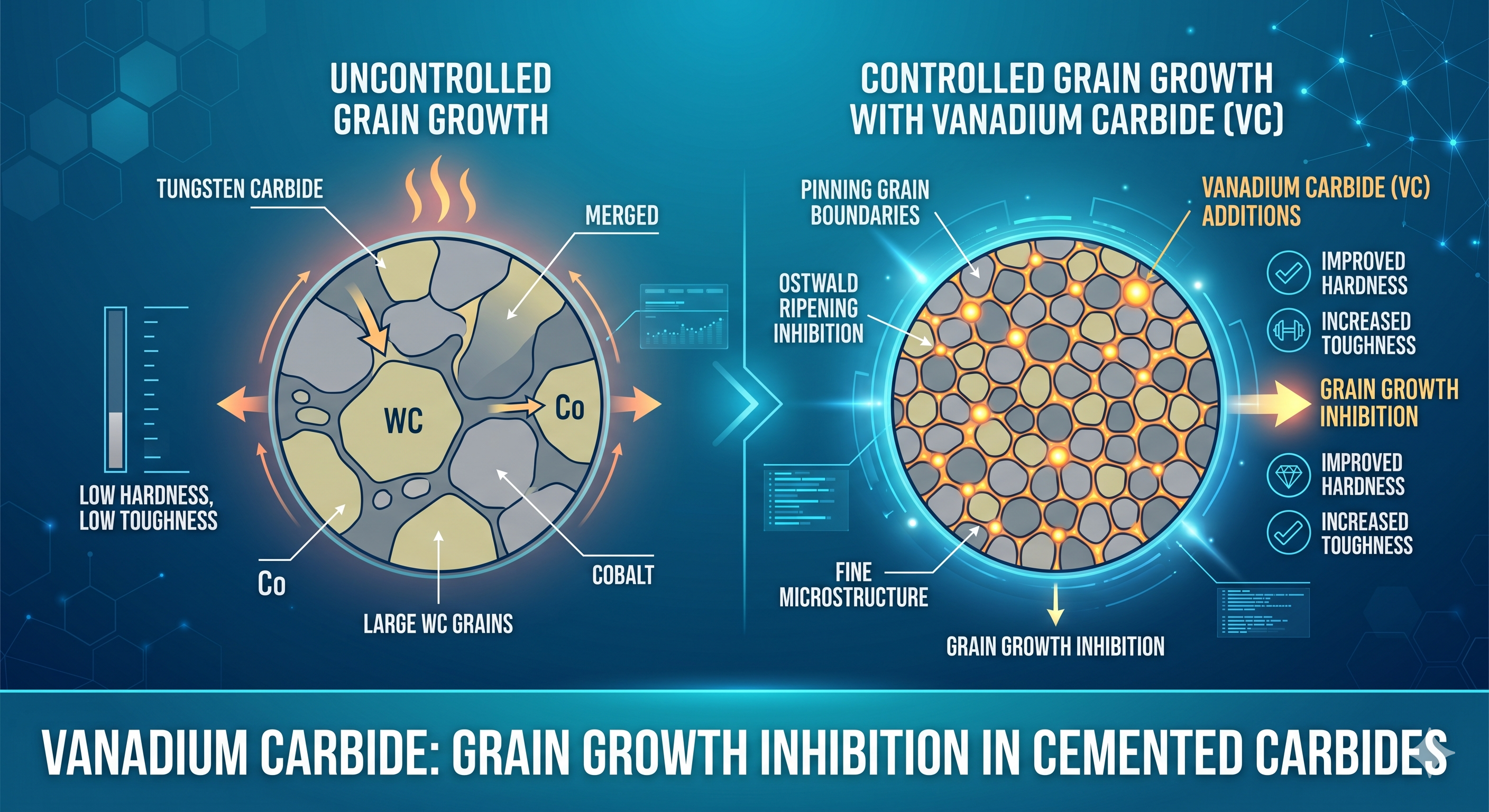
In the world of advanced materials, there is a constant battle being fought at a scale invisible to the human eye. It is the battle of Sintering. When we manufacture high-performance tools—the kind that cut through titanium or drill miles into the earth’s crust—we start with powders and heat them until they fuse together. During this process, something problematic happens: the tiny, hard crystals want to grow. They want to merge, expand, and become “fat.”
In metallurgy, “fat” crystals are a disaster. Large grains make a material soft and prone to breaking. To keep these crystals small, sharp, and incredibly hard, we need a gatekeeper. We need Vanadium Carbide (VC).
As we move through 2026, the demand for “Ultra-Fine” and “Nano-Grained” cemented carbides has reached an all-time high. Whether it is for the micro-drills used in the latest 6G smartphone circuit boards or the heavy-duty cutters for electric vehicle (EV) motor housings, Vanadium Carbide has become the indispensable “Grain Growth Inhibitor” (GGI). In this comprehensive guide, we explore the science of how VC keeps the microstructure in line, the latest industrial “clinical” validations, and why it is the secret ingredient in the next generation of hard metals.
The Problem of Sintering: Why Crystals Grow
To understand the role of Vanadium Carbide, we first have to understand the manufacturing process of Cemented Carbides (usually Tungsten Carbide or WC).
Cemented carbide is a composite. It consists of hard Tungsten Carbide grains held together by a metallic “binder,” usually Cobalt. During the sintering process, this mixture is heated to around 1400 degrees Celsius. At this temperature, the Cobalt turns into a liquid, pulling the Tungsten Carbide grains together.
However, due to a process called Ostwald Ripening, the smaller WC grains start to dissolve into the liquid Cobalt and then re-deposit themselves onto the larger grains. The result? A few giant crystals instead of millions of tiny ones. Without an inhibitor, your high-tech nano-tool would turn into a brittle, low-quality piece of metal before it even leaves the furnace.
How Vanadium Carbide Works: The “Pinning” Mechanism
Vanadium Carbide is the most powerful Grain Growth Inhibitor known to materials science. But how does a tiny amount of powder (often less than 1% of the total mix) stop millions of crystals from growing?
1. The Interfacial Barrier
When VC is added to the mix, it doesn’t just sit there. Because of its specific thermodynamic properties, Vanadium Carbide atoms migrate to the boundary where the Tungsten Carbide meets the liquid Cobalt. They form an incredibly thin, often mono-atomic layer.
2. Solute Drag and Zener Pinning
This layer acts like a microscopic fence. As a WC grain tries to grow and move its boundary forward, it hits the Vanadium atoms. The Vanadium doesn’t want to move, creating a “drag” effect. In metallurgy, this is known as Zener Pinning. It effectively “pins” the grain boundaries in place, preventing them from expanding.
3. Low Solubility
Unlike other metals, Vanadium has a very low solubility in Tungsten Carbide but a high affinity for the grain boundaries. This means it stays exactly where it is needed—on the “front lines”—rather than disappearing into the crystal structure.
Why VC is the “King of Inhibitors”
There are other GGIs, such as Chromium Carbide (Cr3C2), Tantalum Carbide (TaC), and Niobium Carbide (NbC). However, Vanadium Carbide remains the gold standard for several reasons:
-
Efficiency: You need much less VC to achieve the same level of inhibition as Chromium or Tantalum.
-
Hardness Preservation: VC itself is extremely hard. While some inhibitors can soften the Cobalt binder, VC tends to maintain the overall hardness of the composite.
-
Nano-Grade Essential: For “Nano-Grained” carbides (grains smaller than 0.2 microns), VC is essentially the only material capable of providing the level of control required to prevent “runaway” grain growth.
Current Research: The Multi-Inhibitor “Cocktail” (2025–2026)
The most exciting research in late 2025 and early 2026 has focused on the “Synergy Effect.” Researchers have found that using Vanadium Carbide alone can sometimes lead to “VC Pools”—small clumps of Vanadium that can weaken the material.
The Hybrid Approach: Recent industrial trials published in the Journal of Refractory Metals and Hard Materials have demonstrated that a combination of Vanadium Carbide and Chromium Carbide (in a specific 3:1 ratio) produces a superior result. The Chromium Carbide helps the Vanadium distribute itself more evenly, preventing clumps and resulting in a material that is 15% tougher without losing any hardness.
Atomic Probe Tomography (APT): In 2026, for the first time, researchers used APT to “see” the Vanadium atoms in 3D at the grain boundary. This research confirmed that Vanadium forms a “segregation layer” that is exactly two atoms thick. This discovery is allowing companies like Nanokar to engineer nano-powders with exact surface treatments that guarantee perfect dispersion in the binder.
Industrial “Clinical” Validations: Success in the Field
In the world of industrial materials, “clinical” studies are field validations where tools are tested to failure in real-world environments.
Case Study 1: Micro-Drilling for 6G Infrastructure (2025)
A manufacturer of high-density circuit boards tested micro-drills (0.1mm diameter) made with and without VC inhibition.
-
Without VC: Grains grew to 1.5 microns. The drills snapped after 500 holes.
-
With Nano-VC: Grains remained at 0.2 microns. The drills lasted for 4,500 holes before needing replacement.
-
Conclusion: Vanadium Carbide is the “enabler” for the miniaturization of global telecommunications.
Case Study 2: Aerospace Milling of Heat-Resistant Superalloys (2026)
Milling Nickel-based alloys for jet engines generates massive heat, which can cause “secondary sintering” (grain growth during use).
-
The Trial: Tools inhibited with a VC-Cr3C2 cocktail were compared to standard tools.
-
The Result: The VC-inhibited tools showed 30% less “crater wear” and maintained a sharper cutting edge at temperatures exceeding 800 degrees Celsius.
Advantage vs. Risk Assessment
Every high-performance additive carries a set of trade-offs that engineers must manage.
The Advantages
-
Ultra-High Hardness: Allows for the creation of tools that can cut almost anything except diamond.
-
Precision: Maintains the sharpest possible cutting edges, essential for medical scalpels and micro-electronics.
-
Thermal Stability: Prevents the tool from “softening” during high-speed, high-heat machining.
-
Cost-Efficiency: Because it is so effective at low concentrations, it provides a high “Return on Innovation” for tool manufacturers.
The Risks and Challenges
-
Embrittlement: If too much VC is added (typically above 1.2% by weight), the material can become “over-inhibited” and lose its impact toughness. It becomes like glass—hard but brittle.
-
Cobalt Capping: In some cases, VC can interfere with how the liquid Cobalt wets the Tungsten grains, leading to tiny “pores” or holes in the final part.
-
Processing Sensitivity: VC-inhibited powders require very precise sintering cycles. If the temperature or time is slightly off, the Vanadium may not migrate to the boundaries in time, leading to uneven grain sizes (the “Stony” appearance).
Sustainability and the Circular Economy
In 2026, the recycling of “Scrap Carbide” is a major industrial priority. Vanadium Carbide poses a unique challenge here. Because it is so finely dispersed at the grain boundaries, extracting it during the recycling process is difficult.
However, new Hydrometallurgical Recovery techniques are now able to recover up to 90% of the Vanadium from used drill bits. This “Urban Mining” of Vanadium reduces the environmental impact of traditional mining and ensures a stable supply chain for this critical mineral.
Conclusion
Vanadium Carbide is the invisible hero of the modern machine age. It is the “Micro-Policeman” that ensures our tools stay sharp, our holes stay small, and our engines stay efficient. By mastering the science of Grain Growth Inhibition, we are not just making “better metal”; we are enabling the technologies of the future—from quantum computing hardware to the next generation of aerospace travel.
For companies specializing in advanced powders and nanotechnology, Vanadium Carbide represents the pinnacle of “Material Intelligence.” It is proof that in the world of 2026, the smallest additions often make the biggest impact.