
Recently added item(s)
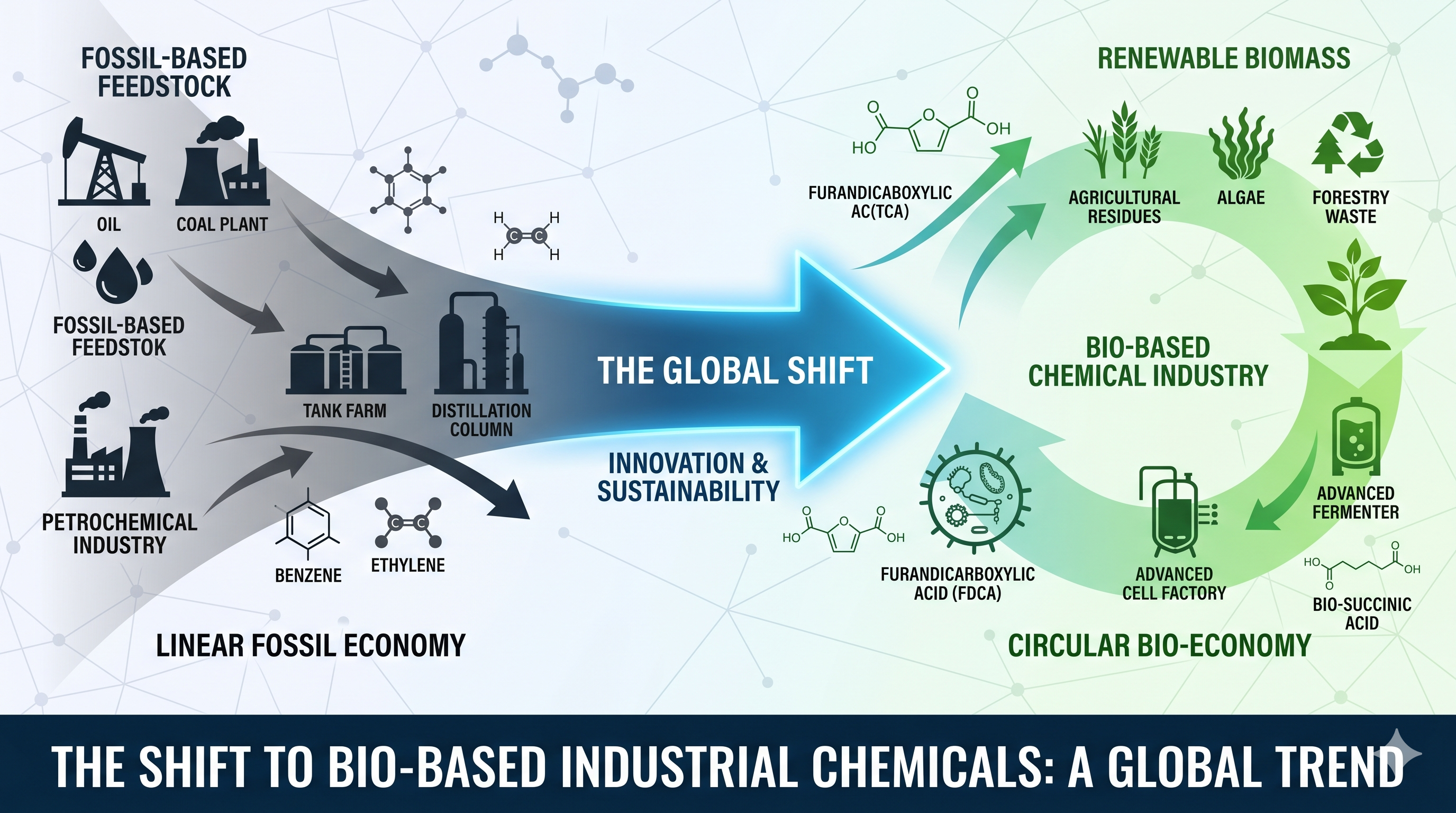
For over a century, the global industrial landscape has been dominated by a single, formidable pillar: petroleum. From the lubricants in our engines to the synthetic dyes in our clothing and the complex resins in our electronics, the “petrochemical era” defined the 20th century. However, as we move further into the 2020s, a tectonic shift is occurring. We are entering the age of Bio-Based Industrial Chemicals.
Driven by the urgent need for decarbonization, regulatory pressure, and breakthroughs in synthetic biology, the transition from fossil-derived molecules to those sourced from renewable biomass is no longer a niche “green” experiment—it is a multi-billion-dollar global trend. This article explores the science, the mechanisms, the risks, and the future of the bio-based revolution.
1. Defining the Transition: What Are Bio-Based Chemicals?
At its core, a bio-based chemical is a substance derived wholly or partly from biological sources, such as agriculture, forestry, marine biomass, or even industrial waste. Unlike traditional petrochemicals, which release “ancient” carbon into the atmosphere when degraded or incinerated, bio-based chemicals utilize “recent” carbon—carbon that was captured by plants via photosynthesis just seasons ago.
The Three Generations of Feedstock
The evolution of this industry is often categorized by the source of the raw material (feedstock):
-
First Generation: Derived from food crops like corn, sugarcane, and vegetable oils. While highly efficient, this generation faced criticism for competing with food supplies.
-
Second Generation: Sourced from non-food biomass, including agricultural residues (stalks, husks), wood waste, and dedicated energy crops. This is the current “sweet spot” for industrial scaling.
-
Third Generation: The frontier of research, involving algae and CO2-capturing microbes. These sources do not require arable land and can literally turn industrial emissions into chemical building blocks.
2. The Core Drivers: Why the World is Changing
The shift is not merely a choice; it is a response to a perfect storm of global factors.
Regulatory “Sticks” and “Carrots”
International frameworks like the EU Green Deal and the U.S. Sustainable Chemistry Research and Development Act are forcing companies to track their carbon footprints. Carbon taxes and stricter REACH (Registration, Evaluation, Authorisation, and Restriction of Chemicals) regulations are making traditional, toxic petrochemicals more expensive and legally risky to produce.
Corporate ESG and Consumer Demand
Investors now use Environmental, Social, and Governance (ESG) metrics to value companies. A chemical manufacturer that relies 100% on crude oil is now seen as a “high-risk” investment. Simultaneously, consumers are demanding “clean labels” not just in food, but in the paints on their walls and the components of their cars.
3. Breakthrough Molecules: From Lab to Factory Floor
Several key chemical categories are leading the charge. These aren’t just “eco-friendly” alternatives; in many cases, they offer superior performance.
A. Bio-Succinic Acid
Succinic acid is a “platform chemical,” meaning it serves as a starting point for dozens of other products, including plastics, detergents, and pharmaceuticals. Traditionally made from maleic anhydride (petroleum), it is now produced via fermentation using yeast or bacteria. Research shows that bio-based succinic acid can reduce greenhouse gas emissions by up to 90% compared to its fossil counterpart.
B. Furandicarboxylic Acid (FDCA)
FDCA is the “holy grail” for the packaging industry. It is used to create PEF (Polyethylene Furanoate), a 100% bio-based alternative to PET (the plastic used in soda bottles). Recent studies indicate that PEF has better barrier properties—it keeps oxygen out and CO2 in better than PET—which extends the shelf life of beverages.
C. Bio-Surfactants
Found in everything from shampoos to industrial degreasers, surfactants usually rely on ethylene oxide. Bio-surfactants, like sophorolipids, are produced by microorganisms. They are non-toxic, biodegradable, and remain effective in extreme temperatures and salinity, making them ideal for “green” industrial cleaning.
4. Current Research: The Science of “Cell Factories”
The most significant recent advancements aren’t happening in traditional refineries, but in labs utilizing Metabolic Engineering and CRISPR-Cas9.
Precision Fermentation
Scientists are now “programming” microbes to eat agricultural waste and “excrete” specific industrial chemicals. A 2025 study highlighted the use of engineered E. coli to produce high-value aromatic compounds that were previously only obtainable from coal tar. This allows for “on-demand” chemical production with zero toxic byproducts.
Lignin Valorization
Lignin is the “glue” that holds trees together and is a massive byproduct of the paper industry. For decades, it was simply burned for heat. New research into catalytic depolymerization is finally allowing us to break lignin down into bio-phenols and bio-BTX (benzene, toluene, xylene), providing a renewable source for the aromatic building blocks of the entire chemical industry.
5. Health and Safety: The “Clinical” Perspective
While most industrial chemicals don’t undergo “clinical trials” in the way drugs do, their impact on human health is scrutinized through Toxicological Assessment.
Reduced Endocrine Disruption
Many traditional plasticizers and stabilizers (like certain Phthalates and Bisphenols) are known endocrine disruptors, linked to hormonal imbalances and reproductive issues. Bio-based alternatives, such as those derived from isosorbide (from starch), show significantly lower biological activity in mammalian cell studies.
Volatile Organic Compounds (VOCs)
In industrial settings, “Off-gassing” of petroleum solvents is a major cause of respiratory issues and “Sick Building Syndrome.” Bio-based solvents, often derived from citrus (limonene) or fermented soy, generally have much lower vapor pressures. Clinical observations in manufacturing plants that switched to bio-solvents have noted a marked decrease in worker complaints regarding headaches and skin irritation.
6. Advantage–Risk Assessment
Transitioning the world’s chemical supply chain is a high-stakes balancing act.
Advantages
-
Decarbonization: Massive reduction in Scope 3 emissions.
-
Circular Economy: Utilizes waste streams (circularity) rather than extraction.
-
Energy Security: Reduces dependence on volatile oil-exporting regions; chemicals can be “grown” locally.
-
Performance: Some bio-molecules (like PEF) actually outperform their fossil predecessors.
Risks and Challenges
-
Land Use (The Food vs. Fuel Debate): If not managed, massive demand for bio-chemicals could drive deforestation or increase food prices.
-
Scalability and Cost: Petrochemical plants have had 70 years to optimize for efficiency. Bio-refineries are still in the “scale-up” phase, often resulting in higher initial costs.
-
Process Stability: Biological systems (fermentation) are more temperamental than high-heat chemical reactors. A slight change in temperature or a viral “phage” infection can ruin an entire batch of bio-chemicals.
-
Infrastructure Mismatch: Many bio-chemicals are “drop-ins” (identical to oil versions), but novel bio-molecules may require entirely new pipelines and manufacturing equipment.
7. The Global Roadmap: 2026 and Beyond
As of 2026, we are seeing the rise of “Hybrid Refineries.” Instead of building entirely new plants, traditional giants are retrofitting existing facilities to co-process bio-oils alongside crude oil.
We are also witnessing a shift toward Local Bio-Hubs. In regions with high agricultural output (like Brazil, the Midwestern US, and parts of Southeast Asia), chemical production is moving closer to the farm. This reduces the carbon footprint of logistics and creates new economic cycles in rural areas.
Digitalization is the final piece of the puzzle. AI-driven platforms are now used to simulate how a bio-based resin will age over 20 years, allowing companies to skip years of physical testing and bring sustainable products to market faster.
Conclusion
The shift to bio-based industrial chemicals is not merely a “trend”—it is an industrial evolution. While challenges regarding cost and land use remain, the scientific progress in metabolic engineering and waste valorization is making the transition inevitable. By moving from a “take-make-waste” fossil model to a “grow-use-regrow” biological model, the chemical industry is finally aligning itself with the Earth’s natural cycles. The future of industry is not just sustainable; it is alive.