
Recently added item(s)
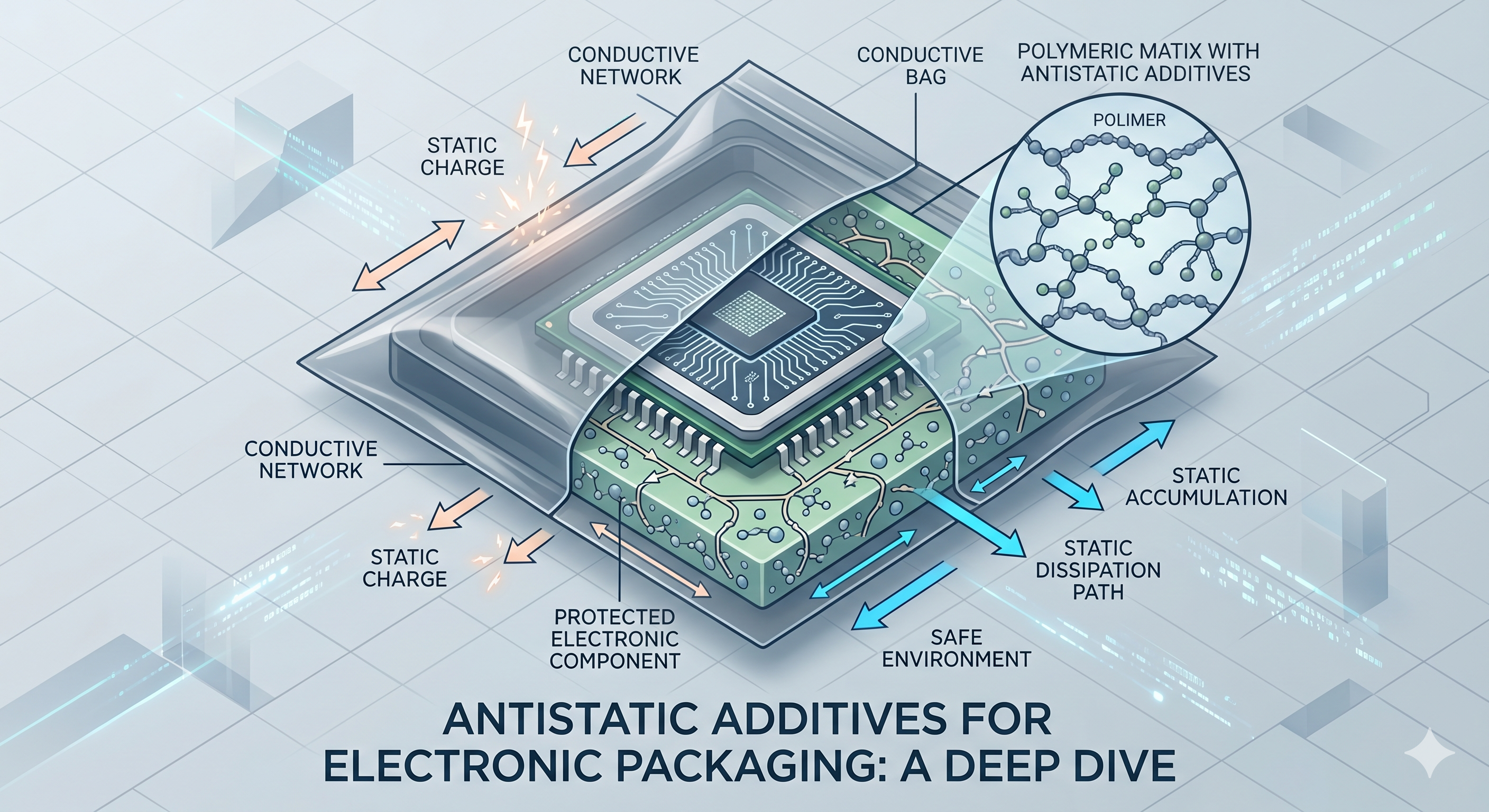
In the high-stakes world of semiconductor manufacturing and consumer electronics, there is a silent, invisible killer: Electrostatic Discharge (ESD). As our devices become smaller, faster, and more complex, they also become significantly more fragile. A single stray spark, often too small for a human to feel, can melt the microscopic circuits inside a smartphone processor or a medical sensor, rendering it a useless piece of silicon.
To prevent this, the global supply chain relies on a sophisticated class of materials known as Antistatic Additives. These chemical and mineral components are integrated into plastic packaging—bags, trays, foams, and tapes—to ensure that static electricity is managed, dissipated, or blocked entirely. This article explores the science behind static, the evolution of antistatic technologies, and the cutting-edge research defining the future of electronic protection.
1. The Physics of the “Zap”: Triboelectric Charging
Static electricity in packaging is primarily caused by the triboelectric effect. This occurs when two materials come into contact and then separate, causing a transfer of electrons. In a warehouse setting, this happens constantly: a plastic tray sliding across a conveyor belt, or a circuit board shifting inside a shipping bag.
When a standard plastic (which is naturally an insulator) builds up this charge, the electrons have nowhere to go. They sit on the surface until they find a path to ground—often through the sensitive pins of a microchip. This sudden rush of electricity is the ESD event.
To measure the effectiveness of packaging, engineers look at Surface Resistivity, measured in Ohms per square (ohm/sq).
-
Insulative: Above 10 to the 12th power ohm/sq (Dangerous for electronics).
-
Antistatic/Dissipative: 10 to the 6th to 10 to the 11th ohm/sq (The “Safe Zone”).
-
Conductive: Below 10 to the 5th ohm/sq (Rapid discharge, used for shielding).
2. The Mechanics of Protection: Types of Antistatic Additives
Not all antistatic solutions are created equal. They are generally categorized by how they are applied and how long they last.
A. Migratory (Surfactant-Based) Additives
These are the most common and cost-effective additives. They consist of molecules with a “hydrophilic” (water-loving) head and a “lipophilic” (fat-loving) tail. When mixed into a polymer like Polyethylene (PE), these molecules migrate (bloom) to the surface over time.
-
Mechanism: Once on the surface, the hydrophilic heads attract a microscopic layer of moisture from the surrounding air. This thin film of water acts as a conductive “highway” that allows static charges to dissipate into the air.
-
Limitations: They are highly dependent on atmospheric humidity. In very dry environments (like a heated warehouse in winter), they can fail completely.
B. Inherently Dissipative Polymers (IDPs)
IDPs are a permanent solution. Instead of a chemical that moves to the surface, the polymer itself is designed to be slightly conductive. These are often called “Polymer Alloys.”
-
Mechanism: These create a three-dimensional conductive network throughout the entire structure of the plastic.
-
Benefits: They do not rely on humidity, they do not wash off, and they do not “off-gas” or contaminate sensitive components.
C. Carbon-Based Conductive Additives
For applications requiring high-level protection, carbon is the gold standard.
-
Carbon Black: A traditional, low-cost filler that creates a conductive path. However, it is sloughing (leaves black marks) and is always opaque.
-
Carbon Nanotubes (CNTs) and Graphene: The “new guard” of additives. Because of their incredible aspect ratio, very small amounts (less than 1%) can create a highly efficient conductive network without making the plastic brittle or heavily discolored.
3. Current Research and Laboratory Breakthroughs
The field is currently moving toward “cleaner” and “smarter” additives. Recent studies have highlighted several key areas of innovation:
Nano-Fibers and MXenes
A 2025 research paper published in Advanced Functional Materials explored the use of MXenes—two-dimensional transition metal carbides—as antistatic coatings. MXenes offer metallic-grade conductivity but can be applied in layers only a few atoms thick. This research is critical for the next generation of transparent, foldable displays where traditional carbon black would be too bulky and opaque.
Humidity-Independent Organic Salts
Traditional migratory additives fail in low humidity. However, new research into Ionically Conductive Polymers (ICPs) has led to the development of organic salts that provide a conductive path regardless of moisture levels. These are being tested for aerospace applications where the air in cargo holds is extremely dry.
Clinical and Medical Device Integrity
In the medical field, ESD protection is a matter of life and death. Laboratory studies on “Smart Stents” and “Implantable Sensors” have shown that ESD during packaging can damage the calibration of these devices. New “bio-compatible” antistatic additives are being developed that prevent static build-up without leaching chemicals that could harm human tissue if the device is implanted.
4. Advantage vs. Risk Assessment
Choosing an antistatic strategy requires a careful balance of cost, performance, and contamination risks.
The Advantages:
-
Yield Improvement: By eliminating ESD damage, manufacturers can increase their “yield” (the percentage of functional products), saving billions of dollars annually.
-
Dust Prevention: Antistatic surfaces don’t just stop sparks; they also stop dust from being attracted to the product, which is essential for optical sensors and camera lenses.
-
Global Compliance: Meeting international standards like ANSI/ESD S20.20 is often impossible without high-quality additives.
The Risks and Challenges:
-
Contamination (The “Blooming” Problem): Migratory additives leave a chemical residue. In cleanroom environments, this “bloom” can contaminate silicon wafers or interfere with the “wire bonding” process during assembly.
-
Corrosion: Some older antistatic agents are based on amines, which can react with copper or silver traces on a circuit board, causing them to corrode over time.
-
Recycling Complications: Mixing carbon-filled plastics with clear recycling streams can “pollute” the batch, making it difficult to produce high-quality recycled resins.
5. Industry-Specific Applications
Automotive and EV Batteries
Modern Electric Vehicles (EVs) are essentially computers on wheels. The lithium-ion battery management systems (BMS) are incredibly sensitive. Packaging for these components now requires “high-load” carbon-based additives to ensure that no charge can build up during the high-vibration environment of shipping.
The Aerospace Sector
Aerospace components face extreme pressure changes. Research has shown that traditional antistatic bags can “out-gas” in a vacuum, depositing a thin film on delicate telescope lenses or sensors. This has led to the rise of Vapor Corrosion Inhibitor (VCI) combined with antistatic properties, providing a dual-layer of protection.
6. Future Trends: The Road to 2030
The next decade of antistatic technology will be defined by Sustainability and Intelligence.
Bio-Based Antistatic Agents
As the world moves away from petroleum, researchers are looking at nature for solutions. Modified starches and cellulose-based nanofibers are being engineered to provide dissipative properties. A 2026 pilot study showed that these bio-based additives could match the performance of traditional surfactants in 80% of consumer electronics applications.
Smart Packaging
Imagine a shipping box that can tell you if it has been exposed to a high-voltage ESD event. “Reactive” antistatic additives are being developed that change color or change their electrical resistance when hit by a spark, providing a permanent record of potential damage.
7. Selection Criteria for Engineers
When designing electronic packaging, the following “Checklist of Stability” is used:
-
Duration: Is the protection needed for 2 weeks or 2 years? (Migratory vs. Permanent).
-
Cleanliness: Can the part tolerate a thin chemical film? (Surfactants vs. IDPs).
-
Environment: Will it be stored in a dry desert or a humid tropical port?
-
Transparency: Does the customer need to see the part through the bag? (CNTs vs. Carbon Black).
Conclusion
Antistatic additives are the invisible guardians of the digital age. Without them, the global trade of semiconductors would grind to a halt under the weight of astronomical failure rates. While traditional chemical additives still dominate the market due to their low cost, the rise of nanotechnology and permanent, non-contaminating polymers is setting a new standard for quality.
As electronics continue to shrink toward the molecular level, the “Deep Dive” into antistatic science will only get deeper. We are moving toward a future where our packaging is as technologically advanced as the devices it protects—ensuring that every “zap” is neutralized before it can do harm.