
Recently added item(s)
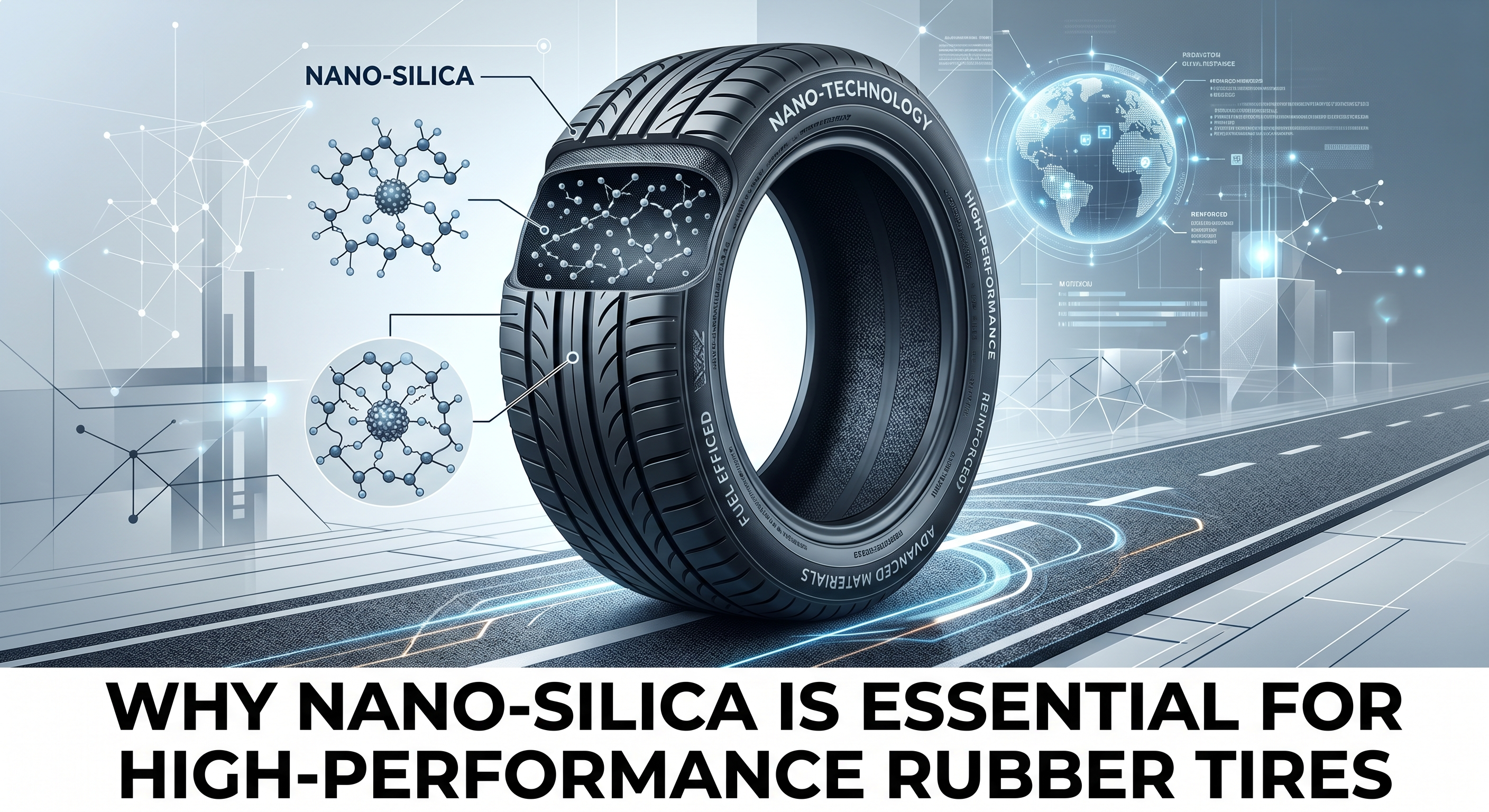
When we look at a car, we often focus on the engine’s horsepower, the sleekness of the design, or the high-tech infotainment system. Yet, the most critical component for both safety and efficiency is a set of four “black circles” that provide the only contact between the vehicle and the road. For decades, tires were essentially made of natural rubber and carbon black. However, a silent revolution has taken place beneath the surface of the tread.
Today, the secret to the “Green Tire”—one that saves fuel while gripping a rain-slicked road—lies in a microscopic additive: Nano-Silica ($SiO_2$). This advanced material has fundamentally changed the physics of driving. In this deep dive, we will explore why nano-silica is no longer just an option but a necessity for the high-performance tires of the 21st century.
1. Breaking the “Magic Triangle” of Tire Design
In the world of tire engineering, there is a legendary challenge known as the Magic Triangle. For nearly a century, engineers struggled with three conflicting properties:
-
Rolling Resistance: Low resistance means better fuel economy.
-
Wet Grip: High grip is essential for braking and safety in the rain.
-
Wear Resistance: This determines how many thousands of miles a tire will last.
Historically, if you improved one, you automatically made the others worse. If you used a soft rubber for amazing wet grip, the tire would wear out in weeks and kill your fuel mileage. If you made it hard for longevity, it became a sliding hazard on wet asphalt.
Nano-silica was the “miracle” ingredient that broke this cycle. By replacing a significant portion of carbon black with precipitated nano-silica, manufacturers discovered they could reduce rolling resistance (saving fuel) without sacrificing—and actually improving—wet traction.
2. The Science of Surface Area: Why “Nano” Matters
The term “nano” refers to the size of the silica particles, typically ranging from 10 to 100 nanometers. To put that in perspective, a human hair is about 80,000 to 100,000 nanometers wide.
In a tire’s rubber matrix, the filler (the silica or carbon black) acts as a reinforcement. The smaller the particles, the larger the total surface area available to interact with the rubber molecules. High surface area allows for a more complex and stable network within the tread.
The Hydrophilic Challenge
There is a catch: Silica is “hydrophilic” (it loves water), while rubber is “hydrophobic” (it hates water). Under normal circumstances, they don’t want to mix; it’s like trying to blend oil and water. To solve this, scientists use Silane Coupling Agents. These are “bridge” molecules that have one end that bonds to silica and another end that bonds to rubber. This chemical architecture creates a highly elastic, yet incredibly strong material that can withstand the immense heat and pressure of high-speed driving.
3. Fuel Efficiency and the EV Revolution
With the global shift toward Electric Vehicles (EVs), the role of nano-silica has become even more critical. EVs are significantly heavier than internal combustion engine (ICE) cars due to their massive battery packs. They also deliver instant torque, which puts extreme stress on the tires.
Range Extension
Rolling resistance accounts for roughly 20% to 30% of a vehicle’s energy consumption. For an EV, high rolling resistance directly translates to a shorter driving range. Nano-silica reduces the internal friction within the rubber (a phenomenon called hysteresis). Because less energy is lost as heat when the tire deforms and recovers while rolling, the vehicle can travel much further on a single charge.
Thermal Management
High-performance tires generate significant heat. Nano-silica-reinforced treads have superior thermal stability. They stay cooler at high speeds, which prevents the rubber from degrading prematurely and helps maintain a consistent grip, whether you’ve been driving for five minutes or five hours.
4. Current Research: The Rise of “Green Silica”
As we move through 2026, the focus has shifted from just “performance” to “sustainable performance.” Traditional silica production is energy-intensive, requiring the melting of sand at extremely high temperatures.
Rice Husk Ash (RHA) Research
Recent laboratory breakthroughs and pilot industrial studies have successfully extracted high-purity nano-silica from Rice Husk Ash. Rice husks are a massive agricultural waste product. By processing them into silica, tire companies are moving toward a circular economy. Research published in late 2025 indicates that RHA-derived silica actually has a more porous structure, which may improve its bonding with silane agents even further than traditional sand-derived silica.
Functionalized Nano-Silica
Scientists are now experimenting with “functionalizing” the surface of nano-silica with specific organic molecules before it is added to the rubber. This allows for even more precise control over the tire’s properties, creating specialized “Smart Tires” that can adjust their flexibility based on the ambient temperature.
5. Advantage vs. Risk Assessment
Like any advanced technology, the use of nano-silica involves a series of trade-offs.
Advantages:
-
Superior Safety: Shortens braking distances on wet roads by up to 15% compared to traditional carbon-black tires.
-
Environmental Impact: Lower rolling resistance reduces CO2 emissions in ICE vehicles and increases the efficiency of EVs.
-
Winter Performance: Silica-reinforced rubber remains flexible at freezing temperatures, making it indispensable for modern winter and “all-weather” tires.
-
Aesthetics: Unlike carbon black, silica doesn’t have a strong pigment, allowing for the creation of colored tires (though this remains a niche market).
Risks and Challenges:
-
Manufacturing Complexity: Mixing silica into rubber is much harder than mixing carbon black. It requires specialized equipment and precise temperature control during the “silanization” process.
-
Cost: Nano-silica and the necessary coupling agents are significantly more expensive than carbon black, which reflects in the premium price of high-performance tires.
-
Abrasive Wear: While silica is great for grip, it can be more abrasive. If the formulation isn’t perfect, the tire might have a slightly shorter lifespan in high-wear environments (like heavy trucking) compared to pure carbon black tires.
-
Health and Safety: In its raw powder form, nano-silica can pose respiratory risks (silicosis) to factory workers. However, once it is embedded in the rubber matrix of a finished tire, there is no risk to the end consumer.
6. The “Clinical” View: Testing and Lab Results
While we don’t “clinically” test tires on humans, the industry uses rigorous Dynamic Mechanical Analysis (DMA). In these tests, rubber samples are vibrated at different frequencies and temperatures to simulate road conditions.
Recent lab results from 2025 have shown that a specific blend of Nano-Silica and Graphene can provide an “Ultra-High Performance” (UHP) rating. These tests demonstrated that the graphene provides the structural “skeleton” while the nano-silica provides the “flesh” or grip. This hybrid approach is expected to become the standard for the next generation of luxury and sports car tires.
7. The Future: AI-Optimized Nano-Formulations
We are now entering an era where Artificial Intelligence is used to design the perfect “recipe” for tire treads. By simulating millions of interactions between nano-silica particles and polymer chains, AI can predict the performance of a tire before a single physical prototype is ever built. This is shortening the development cycle from years to months, allowing for faster integration of sustainable materials like bio-silica.
Conclusion
Nano-silica has transformed the tire from a simple rubber component into a high-tech safety device. It is the silent engine behind our fuel savings and the invisible shield that helps us stop just in time on a rainy highway. As we demand more from our vehicles—more range, more safety, and less environmental impact—the microscopic world of nano-silica will continue to be the foundation upon which the future of mobility is built.
Next time you check your tire pressure, remember: you aren’t just looking at rubber; you’re looking at one of the most successful applications of nanotechnology in human history.