
Recently added item(s)
Wood is perhaps the most beloved material in human history. From the intricate grains of an oak dining table to the expansive elegance of a walnut floor, it brings a warmth and organic beauty that synthetic materials simply cannot replicate. However, wood has a fundamental weakness: it is soft. Even the hardest hardwoods are vulnerable to the daily “assault” of life—sliding chairs, pet claws, dropped keys, and abrasive dust.
For decades, we relied on thick layers of polyurethane or lacquer to protect these surfaces. While effective, these traditional coatings often eventually succumb to micro-scratches that dull the finish and rob the wood of its luster. Enter Nano-Alumina (Aluminum Oxide, Al2O3). By shrinking one of the world’s hardest minerals down to the nanoscale, materials scientists have created an “invisible armor” that allows wood to retain its natural beauty while gaining the resilience of a much tougher material.
1. The Hardness Hero: What is Nano-Alumina?
To appreciate nano-alumina, we must first look at its “macro” parent. Alumina, or aluminum oxide, is the same material that makes up sapphires and rubies. On the Mohs scale of mineral hardness, alumina sits at a 9, surpassed only by diamonds. It is incredibly dense, chemically stable, and heat-resistant.
In the world of coatings, we don’t want a solid sheet of sapphire over our wood—that would be brittle and impossible to apply. Instead, we use Nano-Alumina, which consists of spherical or plate-like particles ranging from 10 to 40 nanometers in size. When these particles are dispersed into a liquid wood finish, they create a reinforced composite matrix.
Why “Nano” Matters
If you were to put regular sand or large alumina particles into a clear wood varnish, the result would be a cloudy, sandpaper-like mess. Because nano-alumina particles are smaller than the wavelength of visible light, they do not scatter light. This means the coating remains 100% transparent, allowing the natural grain and color of the wood to shine through while the surface is packed with millions of microscopic “shields.”
2. The Science of Scratch Resistance: How It Works
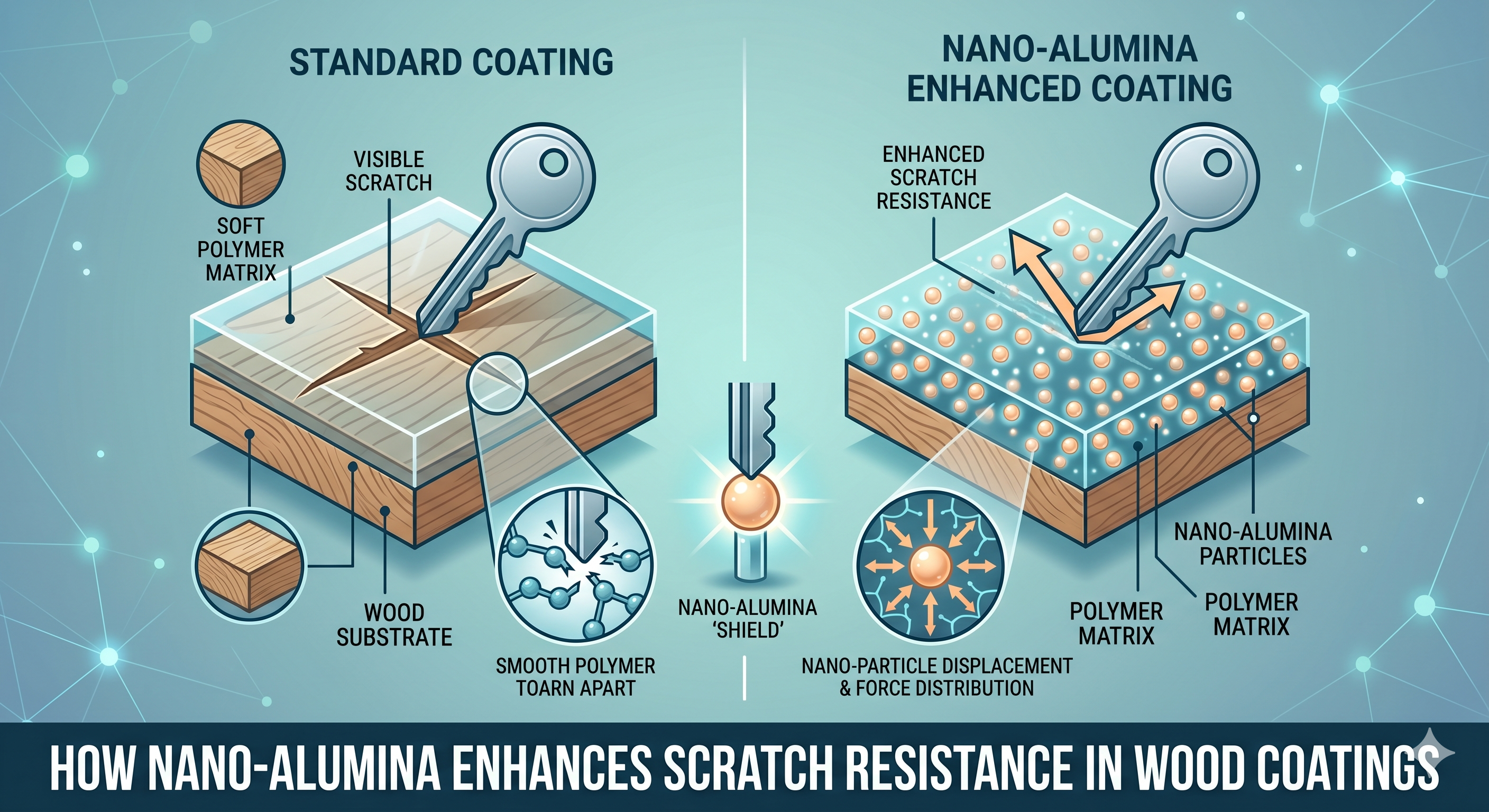
How does a tiny particle stop a metal key from scratching a floor? The mechanism is a combination of load distribution and structural reinforcement.
Load Displacement
When a sharp object applies pressure to a standard wood coating, the polymer (the plastic-like film) deforms or tears. In a nano-alumina reinforced coating, the hard nanoparticles act as load-bearing pillars. They absorb the initial impact and distribute the force across a wider area of the polymer matrix, preventing the sharp object from penetrating deep enough to create a visible scratch.
Reducing the “Coefficient of Friction”
Interestingly, nano-alumina also changes the way objects slide across the surface. By slightly altering the micro-topography of the coating, it can reduce friction. When an object slides more easily, it is less likely to “catch” on the surface and cause a mechanical tear.
Strengthening the Polymer Matrix
The nanoparticles don’t just sit there; they interact with the polymer chains of the varnish (like polyurethane or acrylic). Through a process called interfacial bonding, the particles act as cross-linking points, making the entire “skin” of the wood much more rigid and less prone to the microscopic “plowing” that characterizes a scratch.
3. Transparency vs. Performance: The Invisible Advantage
One of the biggest challenges in industrial wood finishing is maintaining High Gloss. Many additives that increase hardness usually dull the finish, resulting in a matte or “hazy” look.
Nano-alumina is the solution to this “transparency trade-off.” Because of its high refractive index and its tiny particle size, it provides what engineers call “Optical Clarity.” [Image Idea: Side-by-side comparison of wood with standard coating vs. nano-alumina coating under a microscope]
In high-end furniture manufacturing, this is vital. A piano-black finish or a high-gloss mahogany desk requires a glass-like surface. Nano-alumina provides the necessary scratch resistance to keep that surface looking “showroom new” for years without the cloudiness associated with traditional anti-scratch additives like waxes or larger silicas.
4. Current Research and Industrial “Clinical” Trends
The period between 2024 and 2026 has seen a surge in “functionalized” nano-alumina research. We are moving beyond just mixing particles into a bucket of paint.
Bio-Based Resins and Nano-Synergy
As the wood industry moves toward sustainability, there is a push for Bio-based Polyurethanes (derived from plant oils). These eco-friendly resins are often softer than their petroleum-based counterparts. Recent industrial studies have shown that adding just 1-3% nano-alumina by weight can bring the scratch resistance of a bio-resin up to—and often beyond—the performance of traditional heavy-duty industrial coatings.
Hybrid Fillers: Alumina + Graphene
New “clinical” trials in industrial flooring are testing hybrid systems. By combining nano-alumina (for hardness) with small amounts of graphene or carbon nanotubes (for toughness and anti-static properties), researchers have created “super-coatings.” These hybrids are being tested in high-traffic commercial environments like airport lounges and hotel lobbies, showing a 60% improvement in long-term gloss retention compared to standard finishes.
UV-Cured Systems
In factory settings, wood is often finished using UV-curable coatings, which harden instantly under ultraviolet light. Nano-alumina is particularly well-suited for these systems because it does not interfere with the UV light penetration, ensuring a full “deep cure” while providing a hard-as-nails surface finish.
5. Advantage vs. Risk Assessment
No technology is a “silver bullet.” While nano-alumina is revolutionary, it requires a balanced understanding of its implementation.
Advantages
-
Extreme Durability: Significantly extends the life of the wood finish, reducing the frequency of refinishing.
-
Preserved Aesthetics: Maintains the depth, clarity, and color of high-end wood species.
-
Heat Resistance: Alumina helps the coating withstand hot coffee mugs or plates better than pure polymer films.
-
Easy Maintenance: A smoother, harder surface is easier to clean as dirt cannot “embed” itself into micro-scratches.
Risks and Challenges
-
Sedimentation: Nano-alumina is dense. If not properly “stabilized” with dispersants, the particles can settle at the bottom of the can during storage, leading to an uneven finish.
-
Abrasiveness on Equipment: Because alumina is so hard, it can be abrasive to the spray nozzles and pumps used in industrial finishing lines, requiring more frequent maintenance of the application machinery.
-
Cost: Nano-alumina is a premium additive. While it reduces long-term maintenance costs, the “per gallon” price of the coating is higher.
-
Worker Safety: In its powder form, nano-alumina must be handled with extreme care to prevent inhalation. However, once it is mixed into a liquid coating, it is safely “locked” into the matrix and poses no respiratory risk to the end-user.
6. Applications: Where Does Nano-Alumina Shine?
While you might not need nano-alumina for a rustic garden fence, it is essential for specific high-performance applications:
-
Luxury Flooring: For homes with large pets or high foot traffic where the homeowner wants a “bare wood” look without the wear.
-
Kitchen Cabinetry: Protecting against the constant impact of fingernails, utensils, and cleaning supplies.
-
High-End Furniture: Desks, boardrooms tables, and musical instruments that require a pristine, reflective surface.
-
Marine Woodwork: Providing the hardness needed to survive the harsh, abrasive salt-air environment on yachts.
7. The Future: Self-Reporting and “Smart” Hardness
Looking toward the end of the decade, the next step is Self-Reporting Coatings. Researchers are working on nano-alumina particles coated with a fluorescent dye. When the coating eventually wears down to a specific thickness, the floor would “glow” under a specific light, telling the owner exactly when it’s time to apply a maintenance top-coat before the wood itself gets damaged.
Furthermore, we are seeing a move toward Water-Based Nano-Systems. Eliminating solvents while maintaining the hardness of alumina is the “holy grail” of the DIY wood-care market, making professional-grade durability available to the average hobbyist.
Conclusion
Nano-alumina has fundamentally changed our expectations for wood durability. It represents a perfect marriage between the ancient appeal of timber and the futuristic precision of nanotechnology. By incorporating these microscopic sapphire-like reinforcements, we no longer have to choose between a beautiful wood finish and a practical one. We can have both—strength without weight, and protection without compromise.
As we continue to refine how these nanoparticles interact with sustainable resins, the “immortal floor” might just become a reality. For the woodworker, the architect, and the homeowner, nano-alumina is the invisible partner that ensures the wood they love today looks just as good twenty years from now.