
Recently added item(s)
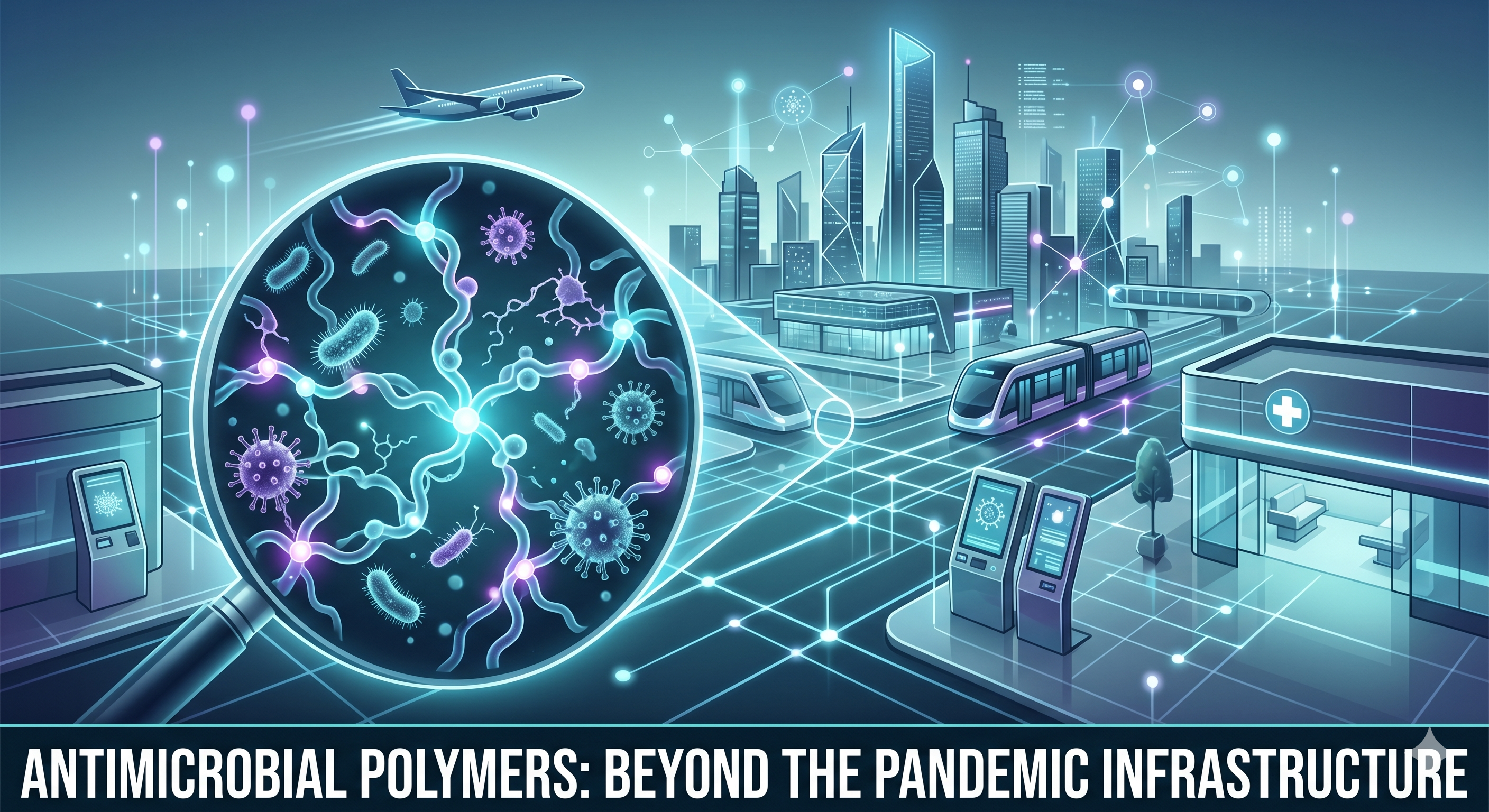
The global events of the early 2020s fundamentally changed how we perceive the surfaces around us. What was once a simple door handle, an elevator button, or a subway pole became a potential vector for disease. While the initial response relied on aggressive, manual chemical disinfection, the long-term solution has moved into the realm of materials science. We are no longer just cleaning surfaces; we are engineering them to be inherently hostile to pathogens.
Antimicrobial polymers represent the next generation of “invisible infrastructure.” These are materials designed to inhibit or kill microorganisms—including bacteria, viruses, and fungi—without the need for constant human intervention. As we look beyond the immediate reactive measures of the pandemic, these advanced materials are becoming permanent fixtures in our hospitals, food supply chains, and urban environments.
1. Defining the “Shield”: What are Antimicrobial Polymers?
In basic terms, an antimicrobial polymer is a plastic-like material that contains active chemical groups or physical structures that disrupt the life cycle of a microbe. Unlike a disinfectant spray, which works once and then evaporates, these polymers provide continuous, 24/7 protection.
They generally fall into two categories:
-
Polymeric Biocides: These are polymers that have antimicrobial properties built directly into their backbone. They don’t “leak” anything; the material itself is lethal to the microbe upon contact.
-
Biocide-Releasing Polymers: These act as reservoirs. They slowly and steadily release an active agent (like silver ions or chlorine) over months or years to create a “kill zone” on and around the surface.
2. The Kill Mechanism: How They Neutralize Pathogens
Microbes are remarkably resilient, but antimicrobial polymers use a variety of strategies to overcome their defenses.
The “Molecular Sword” (Contact-Kill)
Many advanced polymers are engineered with “polycationic” chains. These chains carry a strong positive charge. Since the cell membranes of most bacteria are negatively charged, the polymer acts like a microscopic magnet. It pulls the bacterium toward the surface and then physically ruptures its cell wall—essentially “popping” the microbe like a balloon.
Oxidative Stress (Ion Release)
Polymers infused with nano-silver or copper work by releasing ions. These ions penetrate the microbe and create “oxidative stress,” damaging its DNA and preventing it from replicating. This is particularly effective against a broad spectrum of pathogens, including the “superbugs” often found in hospital settings.
Anti-Adhesion (The Non-Stick Approach)
Sometimes, the best way to kill a microbe is to prevent it from ever landing. Certain “zwitterionic” polymers create a dense layer of water molecules on the surface. This creates a physical barrier that prevents bacteria from sticking and forming a biofilm—the protective “slime” that makes microbes up to 1,000 times more resistant to antibiotics.
3. Beyond the Hospital: Modern Applications
While healthcare remains the primary driver, the “Post-Pandemic Infrastructure” is seeing these polymers integrated into every facet of daily life.
Public Transportation and High-Traffic Hubs
In cities like Istanbul, London, or New York, millions of people touch the same surfaces every hour. Integrating antimicrobial polymers into the grab-bars of buses, the touchscreens of ticket machines, and the upholstery of seats creates a permanent layer of public health security.
The Food Revolution: Active Packaging
Food waste is a global crisis. Antimicrobial polymers are being used to create “active packaging” that kills food-borne pathogens like E. coli and Listeria. By lining a plastic container with an antimicrobial layer, the shelf life of fresh produce and meats can be extended by 20% to 40%, significantly reducing waste and improving food safety.
Water Filtration
Bio-fouling—the growth of algae and bacteria on filters—is the biggest cost factor in water desalination and purification. Modern filtration membranes are now being “grafted” with antimicrobial polymer chains that prevent microbes from clogging the system, ensuring cleaner water with lower energy consumption.
4. Current Research and “Clinical” Industrial Studies (2025–2026)
The research landscape has shifted from “can we kill microbes?” to “can we do it safely and sustainably?”
The Fight Against AMR (Antimicrobial Resistance)
A major study published in late 2025 highlighted the role of contact-kill polymers in the fight against antibiotic resistance. Because these polymers kill through physical disruption (the “molecular sword”) rather than chemical poisoning, microbes are far less likely to develop resistance. This makes them a vital tool in preventing the rise of new “superbugs” in communal environments.
Bio-Based Antimicrobial Polymers: The Chitosan Breakthrough
Sustainability is now a core requirement. Recent research has focused on Chitosan, a natural polymer derived from the shells of crustaceans. Scientists have successfully “functionalized” chitosan to create biodegradable antimicrobial films that are as effective as synthetic versions but leave no toxic footprint when they eventually break down.
AI-Driven Polymer Design
In 2026, the use of Generative AI has allowed materials scientists to simulate billions of polymer structures to find the “perfect” chain length and charge density. This “clinical” computational approach has led to the discovery of polymers that can distinguish between harmful pathogens and healthy human skin cells, ensuring that high-contact surfaces are 100% safe for children and sensitive individuals.
5. Advantage vs. Risk Assessment
No technology is without its trade-offs. Implementing antimicrobial infrastructure requires a balanced view.
Advantages
-
Reduced Human Error: Unlike manual cleaning, polymers never “forget” to disinfect.
-
Long-Term Cost Savings: While the initial material cost is higher, the reduction in infection-related healthcare costs and cleaning labor provides a massive return on investment.
-
Broad-Spectrum Efficacy: Effective against bacteria, fungi, and increasingly, enveloped viruses.
-
Infrastructure Longevity: By preventing bio-corrosion (microbes “eating” the surface), these polymers actually make the infrastructure last longer.
Risks and Challenges
-
Environmental Impact (Leaching): In older “biocide-releasing” systems, there is a risk of silver or copper ions entering the water table. This is why the industry is pivoting toward “non-leaching” contact-kill systems.
-
Human Microbiome Concerns: There is ongoing debate about whether “over-disinfecting” our environment could affect the “good” bacteria that help train the human immune system.
-
Initial Capital Expenditure: For a developing city or a small business, the cost of “smart” antimicrobial furniture or coatings can be a significant barrier.
-
Durability of the Effect: Just like a wood coating, these polymers can be worn away by physical abrasion. Maintaining the “kill-rate” over 10+ years of heavy use remains a challenge.
6. The Future: “Self-Reporting” Smart Surfaces
The next step in the evolution of this technology is the “Self-Reporting” surface. Imagine an airport terminal where the surfaces are coated with a polymer that changes color (e.g., from blue to clear) when its antimicrobial capacity is exhausted.
This creates a “visual maintenance schedule,” allowing facility managers to know exactly when a surface needs to be “re-charged” or replaced. This eliminates guesswork and ensures that the “invisible shield” is always active.
Conclusion
Antimicrobial polymers are the silent sentinels of the modern world. They represent a shift from a culture of “reactionary cleaning” to one of “proactive resilience.” By embedding the power of disinfection into the very fabric of our buildings, vehicles, and packaging, we are creating an environment that is fundamentally safer for everyone.
As we continue to refine the science of the “molecular sword” and embrace sustainable, AI-designed materials, the threat of the next pandemic—or the slow rise of antibiotic-resistant bacteria—can be met with a physical, permanent barrier. For the entrepreneur, the architect, and the public health official, the message is clear: the future of infrastructure isn’t just about how it looks or how much it holds; it’s about how well it protects.