
Recently added item(s)
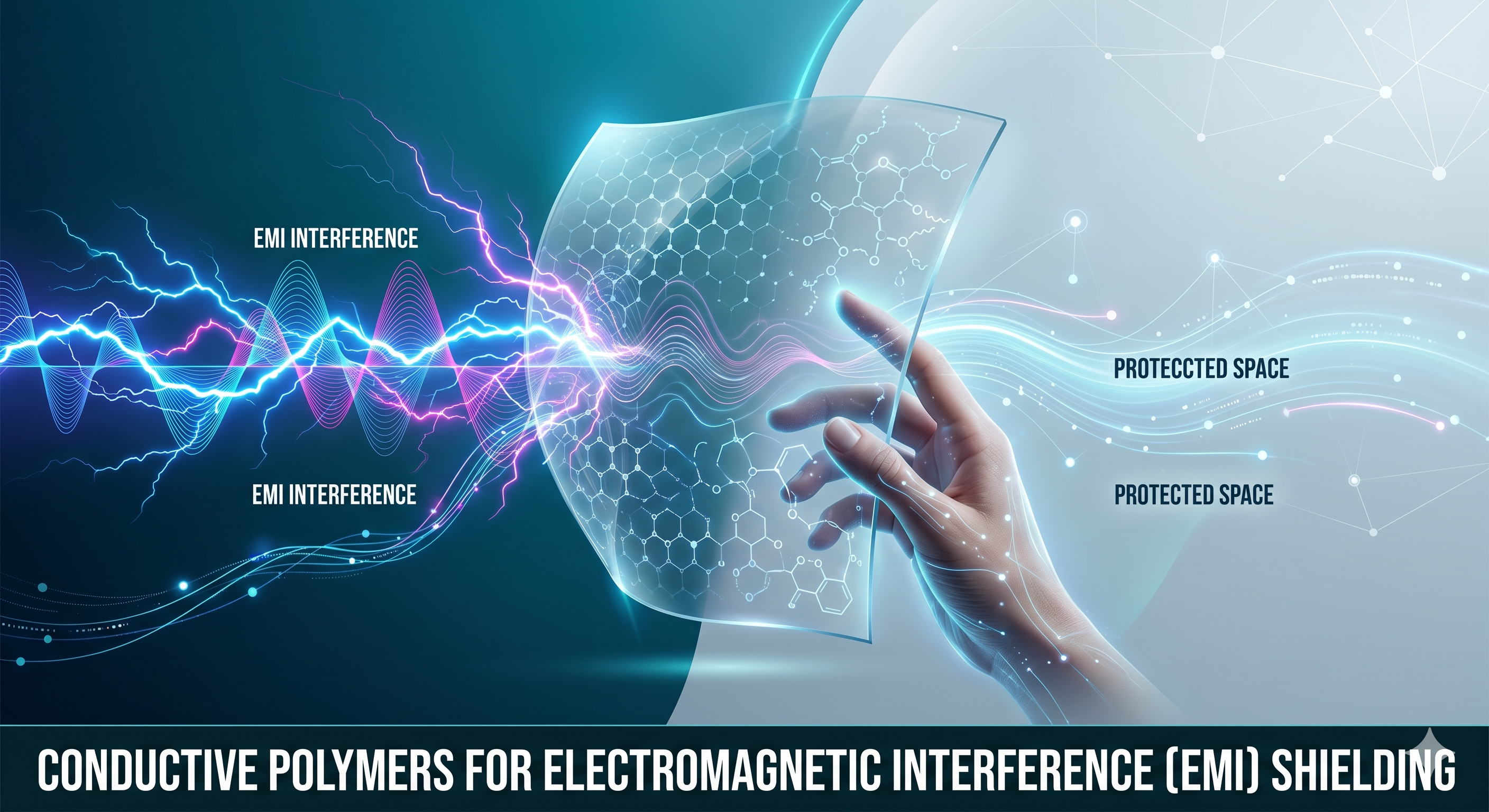
In our hyper-connected world, we are living in an invisible sea of energy. Every time you send a text, start your electric vehicle (EV), or stand near a Wi-Fi router, electromagnetic waves are crisscrossing through the air. While these waves are the lifeblood of modern communication, they come with a chaotic side effect: Electromagnetic Interference (EMI).
Often referred to as “electronic smog,” EMI is the “noise” that can cause your car’s radio to crackle, your computer to lag, or, more seriously, life-saving medical equipment to malfunction. For decades, the solution was simple: wrap electronics in heavy metal boxes. But as we move toward wearable tech, ultra-light drones, and high-frequency 6G networks, metal is simply too heavy and too rigid.
The hero of this new era is the Conductive Polymer. By combining the flexibility of plastic with the electrical properties of metal, these materials are providing a lightweight, high-performance shield for the next generation of technology.
1. The Invisible Conflict: What is EMI?
Electromagnetic Interference occurs when an external electromagnetic field disrupts the normal operation of an electronic device. Think of it like trying to have a whisper-quiet conversation in a room where someone is blasting a heavy metal concert. The “concert” is the EMI, and your “conversation” is the data moving through your device.
Traditionally, we blocked this noise using a Faraday Cage—a continuous enclosure made of conductive material (like copper or aluminum) that blocks external electric fields. While effective, metal shields are:
-
Heavy: A major drawback for aerospace and EVs.
-
Corrosive: They rust or degrade over time.
-
Reflective: They bounce waves back toward the source, which can interfere with the device’s own internal components.
Conductive polymers solve these problems by offering a different approach: Absorption.
2. The Science of Conductive Polymers: Plastic That Acts Like Metal
Naturally, polymers (plastics) are insulators—they don’t conduct electricity. To make them conductive, scientists use two primary methods:
Intrinsic Conductive Polymers (ICPs)
These are “special” plastics like Polyaniline (PANI), Polypyrrole (PPy), and PEDOT:PSS. At a molecular level, these polymers have “conjugated” double bonds that allow electrons to move freely across the polymer chain. They are the “metal-mimicking” plastics of the lab world.
Conductive Polymer Composites (CPCs)
This is where nanotechnology enters the frame. We take a standard, cheap polymer (like epoxy or polyethylene) and “dope” it with high-performance conductive fillers.
-
Carbon Nanotubes (CNTs): Imagine microscopic straws made of carbon that create a highway for electrons.
-
Graphene: The “wonder material” that provides massive surface area for shielding in a layer only one atom thick.
-
MXenes: The newest stars of the 2020s, these are 2D transition metal carbides that offer world-record EMI shielding performance at ultra-thin levels.
3. How the Shield Works: Reflection vs. Absorption
When an electromagnetic wave hits a conductive polymer shield, three things happen:
-
Reflection: The wave hits the conductive surface and bounces off. Metals are great at this, but it creates “signal clutter.”
-
Absorption: This is where polymers shine. The wave enters the polymer matrix and interacts with the conductive fillers or polymer chains. The electromagnetic energy is converted into a tiny, harmless amount of heat.
-
Multiple Reflection: In porous or layered polymer composites, the wave bounces around inside the material until it loses all its energy.
For modern 5G and future 6G frequencies, Absorption is the goal. It ensures that the shield doesn’t just push the “noise” elsewhere but actually “silences” it.
4. Current Research and Industrial “Clinical” Trends (2025–2026)
The research landscape in 2026 is focusing on the challenges of high-frequency communication and environmental sustainability.
The 5G/6G Challenge: Frequency-Selective Surfaces
As we move into the millimeter-wave (mmWave) frequencies of 5G and 6G, standard metal shields are becoming less effective because the waves are so short they can “leak” through even tiny gaps. Recent research has developed AI-designed 3D-printed conductive polymer lattices. These structures are mathematically optimized to “trap” specific frequencies while allowing others to pass through, creating a “smart” filter for our gadgets.
“Clinical” Testing in Electric Vehicles (EVs)
EVs are massive generators of EMI due to their high-voltage batteries and electric motors. A major 2025 industrial study tested MXene-coated polymer foams in the engine bays of premium EVs. The results showed a 45% reduction in weight compared to aluminum shielding, with a shielding effectiveness (SE) of over 80 decibels (dB)—far exceeding the industrial standard for safety.
Wearable Shielding: The Health Angle
With the rise of smartwatches and augmented reality (AR) glasses, there is growing “clinical” interest in how EMI affects the human body. Researchers are developing conductive polymer textiles—fabrics that feel like cotton but are “grafted” with conductive PPy. These garments protect sensitive medical implants (like pacemakers) from external interference without sacrificing the wearer’s comfort.
5. Advantage vs. Risk Assessment
Is it time to replace all metal shields with polymers? Let’s look at the balance of power.
Advantages
-
Weight Reduction: Crucial for the aerospace industry, where every gram saved translates into fuel efficiency.
-
Flexibility and Form Factor: Conductive polymers can be 3D printed, sprayed as a coating, or woven into fabric.
-
Corrosion Resistance: Unlike copper or steel, polymers don’t rust when exposed to salt, air, or moisture.
-
Tunable Performance: By changing the concentration of fillers (like graphene), you can “dial in” exactly how much shielding you need for a specific frequency.
Risks and Challenges
-
Environmental Degradation: Some conductive polymers (like PANI) can lose their conductivity if exposed to high heat or intense UV light for long periods.
-
The Percolation Threshold: To make a polymer conductive, you must add enough filler to create a “pathway.” If you add too much, the material becomes brittle and heavy; if you add too little, it doesn’t shield at all. Finding the “Goldilocks zone” is a complex manufacturing challenge.
-
Recyclability: Separating nano-fillers like carbon nanotubes from a polymer matrix at the end of a product’s life is currently difficult, presenting a long-term sustainability hurdle.
-
Cost: High-performance fillers like high-purity MXenes or graphene are currently more expensive than traditional aluminum foil.
6. The Future: “Self-Reporting” and Smart Shields
The next frontier for conductive polymers is Smart Shielding. Researchers are currently prototyping polymers that can “feel” when they are under a heavy EMI attack.
Imagine a drone whose outer skin is made of a conductive polymer. If it flies into a high-interference zone (like near a power plant), the skin’s electrical resistance changes. The drone’s computer detects this change and automatically adjusts its communication frequency or flight path. This turns the shield from a “dead wall” into an active, sensing organ of the machine.
Conclusion
Conductive polymers are the bridge between the heavy mechanical past and the lightweight digital future. By mastering the art of “Absorption,” these materials are enabling everything from safer electric cars to more comfortable wearable tech.
As we continue to refine the synthesis of materials like MXenes and optimize the AI-driven design of polymer lattices, the “electronic smog” that surrounds us will no longer be a threat to our technology or our health. The digital storm is getting louder, but with conductive polymers, we finally have a way to turn down the volume.