
Recently added item(s)
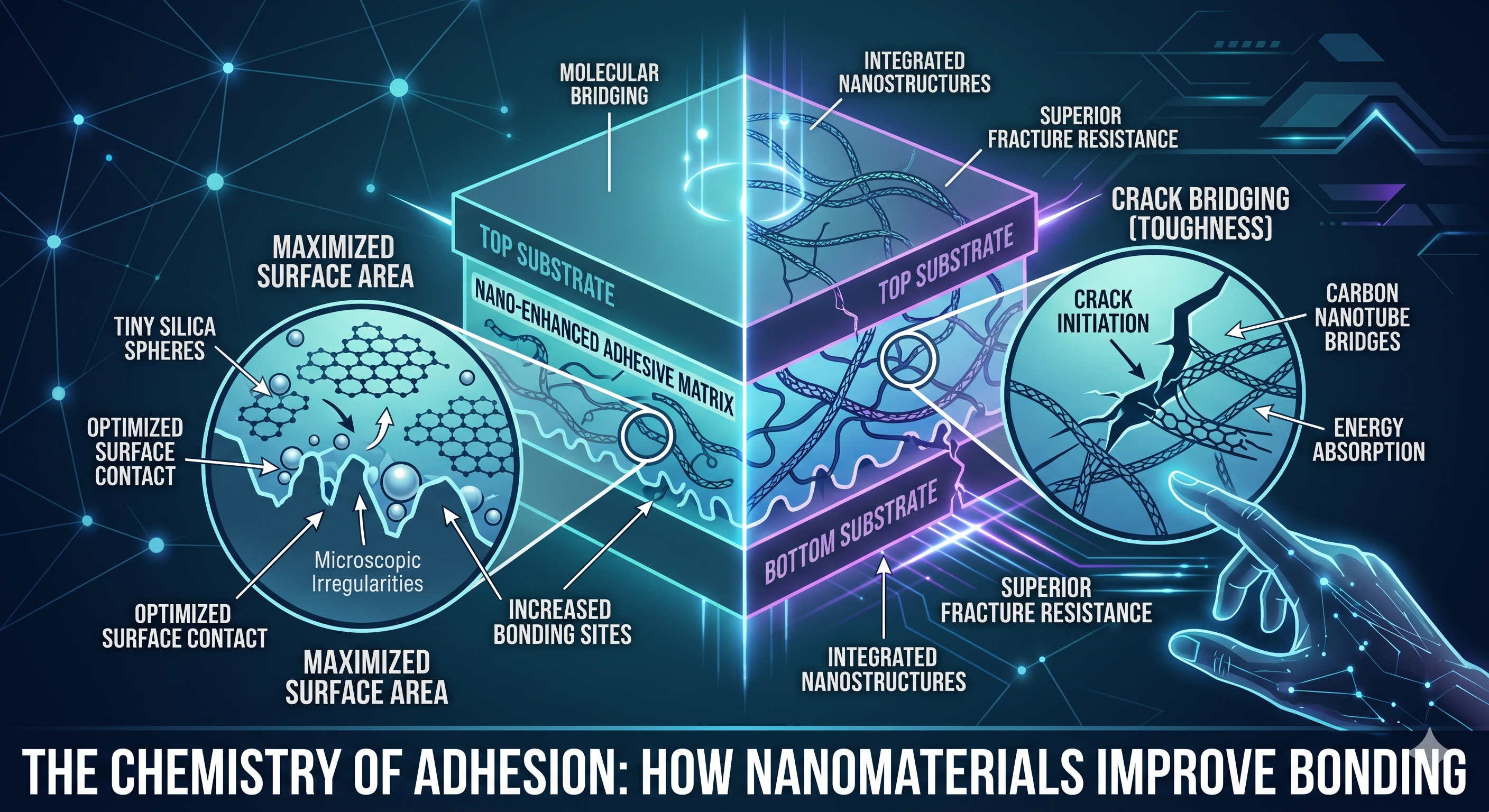
Adhesion science is the invisible hero of the modern industrial world. From the screens of our smartphones to the fuselages of aircraft flying at 30,000 feet, and even the dental fillings in our mouths, everything depends on the integrity of a bond. However, traditional adhesives have reached their physical limits in high-stress environments and extreme temperatures. This is where nanotechnology steps in, redefining the chemistry of adhesion at the molecular level.
In this detailed exploration of The Chemistry of Adhesion: How Nanomaterials Improve Bonding, we will examine how the smallest building blocks of matter create monumental strength, supported by current research and a comprehensive risk-advantage analysis.
1. The Fundamentals of Adhesion: Why Things Stick
To understand the impact of nanomaterials, we must first look at the two pillars of bonding: Adhesion (the attraction between two different surfaces) and Cohesion (the internal strength of the adhesive itself).
Historically, bonding occurs through three primary mechanisms:
-
Mechanical Interlocking: The adhesive flows into surface pores, like a microscopic hook-and-loop system.
-
Chemical Bonding: The formation of covalent, ionic, or hydrogen bonds between the surface and the adhesive.
-
Dispersive Bonding: Atomic-level attractions, primarily Van der Waals forces.
Nanomaterials revolutionize all three. Because these particles are measured in nanometers (one-billionth of a meter), they can infiltrate microscopic cracks and irregularities that traditional fillers are too “bulky” to reach. This increases the effective contact area by thousands of times, turning a weak interface into a structural fortress.
2. The Nano Revolution: The Surface Area Paradox
The primary reason nanomaterials are so valuable in bonding is the surface-area-to-volume ratio. As a material’s size decreases, a much larger percentage of its atoms reside on its surface.
Imagine a solid cube of material. If you break that cube into millions of nanometer-sized particles, the total volume remains the same, but the total surface area increases exponentially. Since adhesion is a surface phenomenon, more surface area means more “docking stations” for chemical bonds. This “nanochemistry” effect allows engineers to double the performance of an adhesive using only a tiny amount of nano-additive (often as little as 1-2% by weight).
3. Key Nanomaterials Improving Modern Bonds
In both laboratory research and industrial applications, several nanomaterials have emerged as leaders in the field:
Carbon Nanotubes (CNTs)
These cylindrical carbon structures are among the strongest materials known to man. When dispersed into an adhesive matrix, they act as “molecular bridges.” If a micro-crack begins to form, the CNTs span the gap, holding the material together and absorbing the energy that would otherwise lead to a total bond failure.
Graphene and Graphene Oxide (GO)
As a two-dimensional (2D) material, graphene offers an incredible surface area for bonding. Graphene Oxide, in particular, is highly effective because it contains oxygen-rich functional groups that are eager to form chemical bonds with both metals and polymers. It acts as a perfect intermediary, stitching together dissimilar materials that usually refuse to stick.
Nano-Silica and Nano-Clays
Commonly used in epoxy and polyurethane systems, nano-silica improves the “viscoelastic” properties of the bond. This makes the adhesive more resistant to impacts. Nano-clays, on the other hand, create a “tortuous path” (a labyrinth effect) that prevents moisture and gases from reaching the bond line, drastically increasing corrosion resistance.
4. Mechanisms of Nano-Enhancement: Beyond Simple Filling
Nanomaterials do not just act as physical “rocks” in a glue; they are active chemical participants.
-
Crack Bridging: Nano-fibers span the mouth of a crack, requiring significantly more force to pull the crack apart. This is vital for “fracture toughness” in aerospace composites.
-
Energy Dissipation: Under impact, nanomaterials allow the polymer chains to move and slide in a way that absorbs energy, preventing the bond from shattering like glass.
-
The “Interphase” Zone: Nanomaterials create a new region between the adhesive and the substrate known as the “interphase.” This zone is neither purely adhesive nor purely substrate; it is a hybrid layer that blends the best properties of both, ensuring a smooth transition of stress.
5. Current Research and Industrial “Clinical” Case Studies (2024–2026)
The last two years have seen a surge in practical applications of nano-adhesive technology.
Dental and Medical Advancements
In dentistry, new clinical studies on “bio-active” composite resins have shown that adhesives containing nano-hydroxyapatite and nano-silver do more than just hold a filling in place. They actually encourage the tooth to remineralize while providing an antimicrobial shield that prevents secondary cavities. This is extending the average lifespan of dental work from 5 years to over 12 years.
Aerospace and Structural Weighting
NASA and private aerospace firms are currently testing Functionalized CNT-reinforced epoxies. By using these nano-adhesives, they can replace heavy rivets and bolts with bonded joints. This reduces aircraft weight by up to 20%, leading to massive fuel savings and a lower carbon footprint. These bonds are being tested to survive the extreme temperature swings of space, from -150 Celsius to +200 Celsius.
Bio-Mimetics: The Gecko and the Mussel
Researchers have recently successfully synthesized “Nano-Mussel” adhesives. By mimicking the proteins mussels use to stick to rocks in crashing waves, and reinforcing them with nanostructures, they have created adhesives that can be applied underwater and reach full strength in seconds. This technology is being deployed for the autonomous repair of underwater pipelines and fiber-optic cables.
6. Advantage vs. Risk Assessment: A Balanced View
While the shift to nano-enhanced bonding is inevitable, it requires a sophisticated understanding of the trade-offs.
Advantages
-
Lightweighting: Eliminates the need for heavy mechanical fasteners like screws and perches.
-
Superior Strength: Resists peeling, shearing, and tension far beyond traditional capabilities.
-
Added Functionality: Adhesives can be made electrically conductive (for electronics) or thermally conductive (to dissipate heat).
-
Environmental Barrier: Protects the bond line from the “silent killers” of adhesion: humidity, UV radiation, and salt.
Risks and Challenges
-
Agglomeration (Clumping): Nanomaterials have a natural tendency to stick to each other. If they are not perfectly dispersed, they create “weak spots” rather than reinforcements. High-shear mixing and stabilization chemicals are required, increasing complexity.
-
Health and Safety: Handling nano-powders in a factory setting requires advanced filtration and strict safety protocols to prevent inhalation.
-
Cost: High-purity nanomaterials remain expensive to produce, though the low concentrations required (1%) often offset this in the long run.
-
Recycling Hurdles: Separating nano-composites at the end of a product’s life is a complex chemical challenge that the industry is still working to solve.
7. The Future: Sensing and Self-Healing Bonds
The next frontier for adhesion is “Living Bonds.” By utilizing the electrical conductivity of carbon nanotubes, scientists are creating adhesives that act as their own sensors.
Imagine an airplane wing where the adhesive “feels” the stress. If a bond begins to fatigue, the electrical resistance of the adhesive changes, sending a signal to the cockpit before a failure occurs. Furthermore, we are seeing the rise of Self-Healing Adhesives containing nanokapsules. When a crack forms, the capsules burst, releasing a fresh healing agent that seals the crack automatically.
Conclusion
The chemistry of adhesion has evolved from a simple matter of “stickiness” to a high-stakes discipline of molecular engineering. Nanomaterials are the key to this transition, providing the “Strength Without Weight” that modern entrepreneurs and engineers demand. By mastering the interface between materials, we are not just building better products—we are creating a more resilient, efficient, and sustainable world.
As we look toward 2030, the “immortal bond” is becoming less of a dream and more of a laboratory reality. For those in the industrial sector, the message is clear: the future is held together by nanotechnology.