
Recently added item(s)
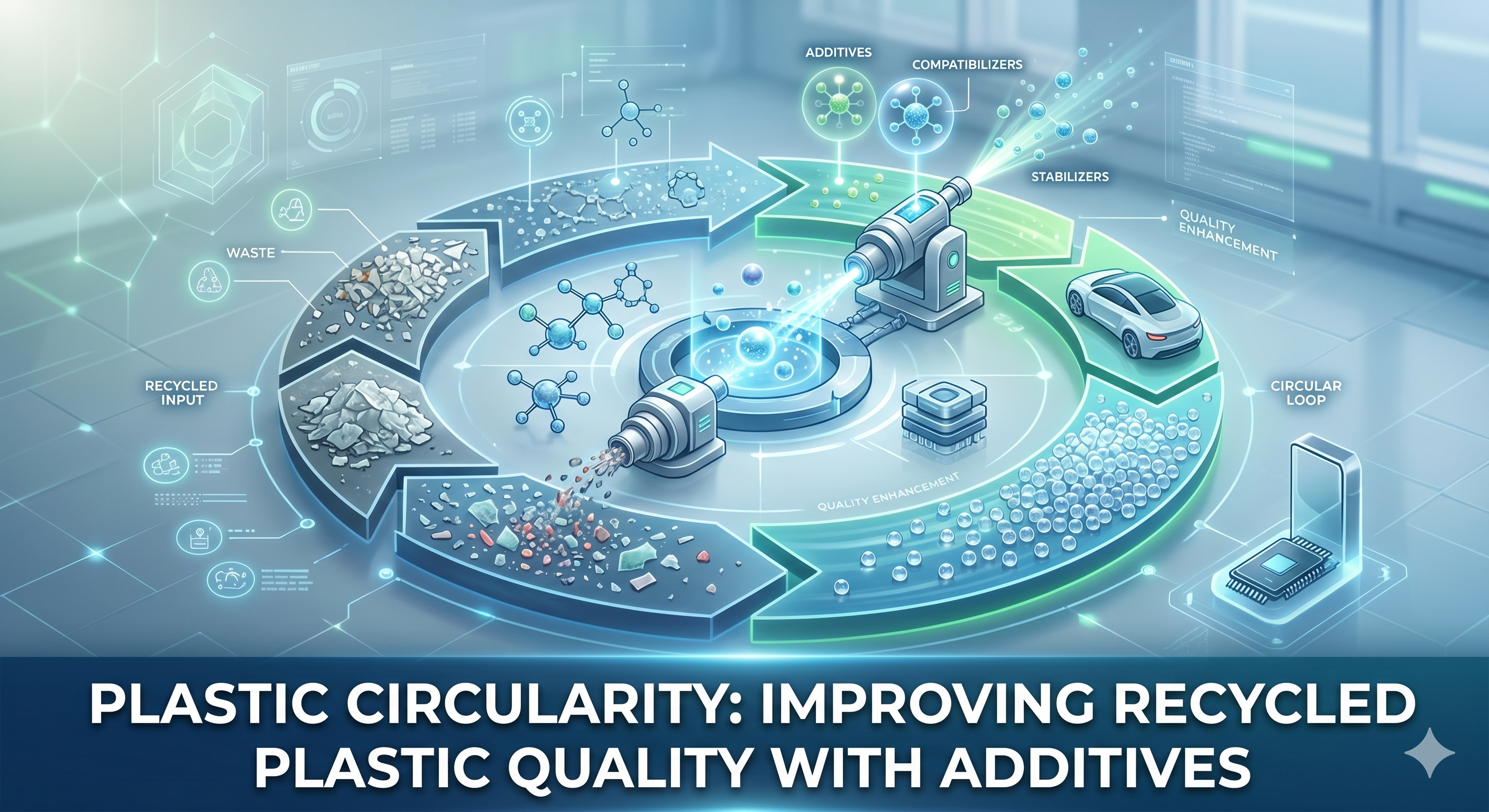
The global plastic crisis has shifted from a looming threat to a present-day reality, forcing industries to rethink the lifecycle of polymers. For decades, the “linear economy”—take, make, dispose—dominated. Today, the focus is on Plastic Circularity, a model where plastic never becomes waste but rather circles back into the production loop. However, a significant hurdle remains: recycled plastic often lacks the structural integrity, color, and performance of virgin resin.
This is where the science of additives becomes the bridge between low-grade waste and high-performance material. By utilizing sophisticated chemical and nanotechnology-based additives, we can “upcycle” plastic, restoring its molecular properties and making it suitable for even the most demanding applications.
The Degradation Dilemma: Why Recycling Isn’t Always Simple
When plastic is recycled, it undergoes several “lives.” Each time a polymer like Polyethylene (PE) or Polypropylene (PP) is melted and re-extruded, it suffers from thermal-mechanical degradation. The high heat and physical shear of the recycling machinery break the long polymer chains into shorter fragments.
The Mechanics of Decay
-
Chain Scission: The long, sturdy molecular chains snap, leading to a loss in tensile strength and impact resistance.
-
Oxidation: Exposure to oxygen at high temperatures creates “free radicals” that attack the polymer structure, causing yellowing and brittleness.
-
Contamination: In post-consumer waste, different types of plastics (like PE and PP) often get mixed. Since these polymers are chemically “immiscible” (they don’t mix, like oil and water), the resulting material is weak and prone to delamination.
Without intervention, recycled plastic is often “downcycled” into low-value items like park benches or trash bags. To achieve true circularity, we must restore the polymer to its original—or even superior—state.
The Additive Toolbox: Restoring Polymer Health
To improve the quality of recycled plastics, various additives are introduced during the compounding stage. These aren’t just fillers; they are functional chemicals designed to repair and protect.
1. Antioxidants (The Preservatives)
Antioxidants are the first line of defense. They neutralize free radicals and prevent the “autoxidation” cycle that occurs during the melting process.
-
Primary Antioxidants (Phenolic): These work by “trapping” radicals to stop the degradation.
-
Secondary Antioxidants (Phosphites): These decompose hydroperoxides before they can cause further damage to the polymer chains. By using a blend of both, recyclers can ensure that the plastic maintains its color and mechanical properties through multiple heat cycles.
2. Chain Extenders (The Molecular Staples)
If chain scission has already occurred, chain extenders act as a chemical “glue.” These molecules have functional groups (like epoxies or anhydrides) that react with the broken ends of polymer chains, reconnecting them. This increases the molecular weight and restores the melt strength, making the recycled plastic suitable for processes like blow molding or film extrusion.
3. Compatibilizers (The Peacekeepers)
One of the biggest challenges in circularity is mixed plastic waste. A compatibilizer is a “bridge” molecule. One end of the molecule likes PE, and the other likes PP. By sitting at the interface of these two different plastics, it reduces surface tension and creates a stable, uniform blend. This prevents the plastic from cracking or peeling under stress.
The Role of Nanotechnology in High-Performance Recycling
In recent years, the integration of nanomaterials has revolutionized the quality of recycled polymers. Nanotechnology allows us to enhance plastics at a scale previously thought impossible, providing reinforcements that traditional additives cannot match.
Graphene and Carbon Nanotubes (CNTs)
Adding minute amounts of graphene or carbon nanotubes to recycled plastic can drastically improve its thermal and electrical conductivity, as well as its mechanical stiffness. Research indicates that even a 0.1% loading of graphene can compensate for the strength lost during three or four recycling cycles.
Nano-Clays and Fillers
Nano-clays are used to improve the gas barrier properties of recycled PET or PE. This is vital for the food and beverage industry, where recycled bottles must prevent oxygen from entering and carbonation from escaping. These nano-additives create a “tortuous path,” making it difficult for gas molecules to permeate the material.
Recent Research and Industrial Pilot Studies
The field of plastic circularity is moving fast, with 2024 and 2025 seeing major breakthroughs in “Smart Additives.”
Case Study: Upcycling Polypropylene with “Vitrimers”
Recent laboratory trials have explored the use of vitrimers—a class of plastics that behave like glass when heated. By adding vitrimer-based chemical cross-linkers to recycled PP, researchers managed to create a material that is as strong as a thermoset (like epoxy) but can still be melted and recycled again. This “mending” at the molecular level allows for infinite recycling without loss of quality.
Research on De-inking and De-odorizing Additives
A study published in early 2026 focused on the aesthetic recovery of post-consumer plastic. One of the main reasons recycled plastic is shunned for high-end packaging is the smell and the gray/brown color. New “Scavenger Additives” are being trialed that chemically bind to odor-causing volatile organic compounds (VOCs), effectively stripping the “trash smell” from the recycled pellets.
Advantage vs. Risk: A Balanced Evaluation
While additives are essential for circularity, their use must be managed carefully to avoid unintended consequences.
The Advantages
-
Economic Viability: Additives allow recyclers to sell their pellets at a premium, as they can compete with virgin plastic in terms of performance.
-
Reduced Carbon Footprint: Producing virgin plastic is energy-intensive. Upcycling existing plastic using additives consumes significantly less energy and keeps carbon locked in the material.
-
Design Flexibility: With impact modifiers and UV stabilizers, recycled plastic can be used in outdoor automotive parts or high-stress construction materials.
The Risks and Challenges
-
Chemical Complexity: Adding more chemicals to a plastic can make the next round of recycling more difficult. If the additives are not compatible with future recycling streams, they may become a legacy contaminant.
-
Regulatory Hurdles: For food-contact applications (like rPET bottles), additives must pass rigorous safety tests. There is a risk that some legacy additives in older plastic could migrate into food.
-
Cost vs. Benefit: High-performance nano-additives like graphene are still relatively expensive. Finding the right “dosage” that provides performance without making the recycled plastic too expensive is a constant balancing act.
The Future: Design for Recycling (DfR)
The ultimate goal of plastic circularity is to move toward Design for Recycling. This means manufacturers should include “stabilizer packages” in the virgin plastic that are specifically designed to survive the first use and remain active during the second and third recycling steps.
We are seeing a shift from “reactive” recycling (fixing broken plastic) to “proactive” circularity (building plastic to be recycled). Digital watermarking and AI-driven sorting are now being paired with “Additive Tracers”—chemicals that tell a sorting machine exactly what additives are inside the plastic, allowing for more precise compounding.
Conclusion
Improving the quality of recycled plastic is no longer just a laboratory curiosity; it is a multi-billion dollar industrial necessity. Through the strategic use of antioxidants, compatibilizers, and cutting-edge nanotechnology, we can transform brittle, discolored waste into high-value engineering materials.
As we refine these chemical “toolkits,” the gap between virgin and recycled plastic will continue to close. The future of the industry lies in our ability to treat plastic waste not as a burden, but as a sophisticated raw material that simply needs the right chemistry to be reborn.