
Recently added item(s)
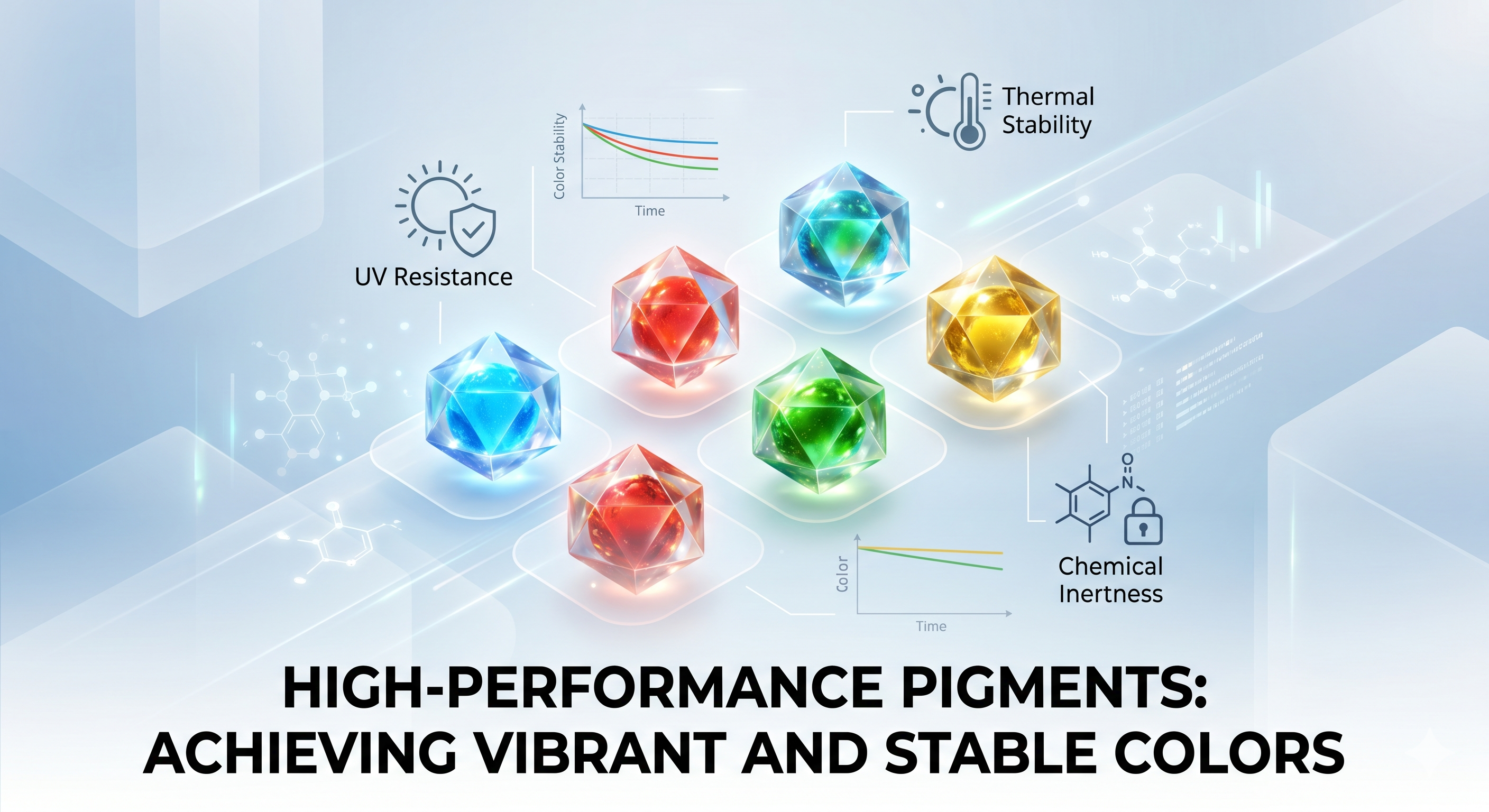
Color is the most immediate way we perceive the world. From the deep crimson of a luxury sports car to the calming teal of a modern skyscraper, color defines our aesthetic experience. However, creating colors that are both vibrant and enduring is an immense scientific challenge. Standard pigments often fail under the pressure of UV radiation, extreme heat, or corrosive environments. Enter High-Performance Pigments (HPPs)—the elite class of colorants engineered to survive where others fade.
In the world of material science, HPPs are not just “paints.” They are sophisticated chemical structures designed at the molecular level to provide maximum stability and visual impact. As we move through 2026, the demand for these materials is skyrocketing, driven by the needs of the automotive, aerospace, and renewable energy sectors.
The Molecular Architecture: What Makes a Pigment “High Performance”?
At its core, a pigment is a substance that changes the color of reflected or transmitted light as the result of wavelength-selective absorption. While standard pigments (like basic carbon black or simple earth tones) have been used for millennia, HPPs are a modern marvel.
The performance of a pigment is dictated by its crystalline structure and molecular bonding. For organic HPPs, the secret lies in “conjugated systems”—large networks of alternating single and double bonds that allow electrons to move freely. This structure doesn’t just produce deep color; it acts as a heat sink, dissipating the energy from UV photons before they can break the chemical bonds of the pigment.
For inorganic HPPs, the focus is on Complex Inorganic Color Pigments (CICPs). These are created by calcining metal oxides at temperatures exceeding 800°C. The result is a rock-solid mineral structure where the color-producing metal ions are locked into a stable lattice. These pigments are effectively “eternal,” resisting acids, alkalis, and temperatures that would melt lead.
The Pillars of Stability: Light, Heat, and Weather
To earn the “High Performance” label, a pigment must pass a gauntlet of tests known in the industry as the Three Pillars of Stability:
-
Lightfastness: This measures a pigment’s resistance to fading when exposed to light. UV rays are high-energy particles that can “bleach” standard dyes. HPPs are designed to absorb this energy and release it as harmless heat.
-
Thermal Stability: Essential for plastics and powder coatings. If a pigment decomposes at 200°C, it cannot be used in modern manufacturing. HPPs often remain stable up to 300°C or higher.
-
Chemical Resistance: In industrial environments, coatings are exposed to “acid rain,” detergents, and salt. HPPs like Phthalocyanine Blues are famous for their ability to remain unchanged even after decades of exposure to harsh marine environments.
Current Research Frontiers: 2025-2026 Breakthroughs
The pigment industry is currently undergoing a “Quiet Revolution,” moving away from heavy metals and toward “Smart” and “Sustainable” colorants.
1. AI-Driven Discovery
In 2025, researchers at major chemical institutes began using Machine Learning (ML) to predict the stability of new organic molecules before they are ever synthesized in a lab. This has led to the discovery of “Hybrid Pigments”—organic molecules encapsulated within inorganic shells. This provides the legendary brilliance of organic colors with the indestructible nature of inorganic ones.
2. The Quest for “Cool” Colors
With global temperatures rising, “Cool Pigments” have become a massive research focus. These are HPPs designed to reflect Near-Infrared (NIR) radiation. While they look like standard dark colors (like navy blue or black) to the human eye, they reflect the heat-carrying part of the sun’s spectrum. Buildings and cars coated in these pigments stay significantly cooler, reducing energy consumption for air conditioning.
3. Structural Color (Bio-Inspiration)
Taking a cue from the wings of a Blue Morpho butterfly, scientists are developing pigments that don’t use chemicals for color at all. Instead, they use nanostructures to interfere with light waves. These “pigment-less” colors are theoretically impossible to fade because there is no chemical bond to break.
Clinical and Safety Perspectives: The Human Impact
While we don’t “consume” industrial pigments, their safety is a matter of significant clinical and dermatological study. This is particularly relevant for pigments used in:
-
Cosmetics and Tattoo Inks: HPPs must be non-toxic and non-migratory.
-
Medical Devices: Color-coded surgical tools must withstand sterilization without leaching chemicals.
Toxicological Assessments
Recent clinical reviews (2024-2025) have focused on the “bio-persistence” of certain nanoparticles used in HPPs. For example, while Bismuth Vanadate (Yellow 184) is a safer alternative to toxic Lead Chromates, researchers are still monitoring its long-term environmental impact.
In the realm of Dermatology, studies on tattoo inks have pushed the industry toward HPPs that are free from “Primary Aromatic Amines” (PAAs), which are known carcinogens. High-performance organic pigments, though more expensive, are significantly more stable within the skin, reducing the risk of the pigment breaking down into harmful sub-components over time.
Advantage-Risk Evaluation
For manufacturers and designers, choosing an HPP is a balance of performance and economics.
| Feature | The Advantage (The Pro) | The Risk/Challenge (The Con) |
| Durability | Lasts 20+ years without significant color shift or fading. | High durability makes the material harder to “strip” or recycle. |
| Brilliance | Achieves “high chroma” (saturation) that standard pigments cannot match. | Achieving this brilliance often requires complex, multi-step synthesis. |
| Sustainability | Reduces the need for repainting, saving resources over time. | Some HPPs rely on rare-earth elements or energy-intensive calcination. |
| Safety | Modern HPPs are largely heavy-metal free (Lead/Cadmium free). | Nano-scale particles require specialized handling to prevent inhalation during manufacturing. |
| Cost | Provides higher value and premium branding for high-end products. | Can be 5 to 10 times more expensive than standard “commodity” pigments. |
The Sustainability Shift: Replacing the “Dirty” Classics
Historically, the most stable colors were the most toxic. Red and Yellow pigments often relied on Lead, Cadmium, and Chrome. In 2026, the regulatory pressure from bodies like REACH (Europe) and the EPA (USA) has effectively banned these in most consumer applications.
The challenge for HPPs has been to replicate the “hiding power” (opacity) of lead-based paints using safer chemistry. Benzimidazolone and Isoindoline pigments are now filling this gap. They offer the same “pop” of color without the neurological risks associated with heavy metals.
Key Insight: The shift to sustainable HPPs is not just about safety; it’s about life-cycle management. A pigment that prevents a metal bridge from rusting for 50 years is inherently more “green” than a cheaper pigment that requires the bridge to be repainted every 10 years.
Future Outlook: The “Digital” Colorant
As we look toward the 2030s, the line between pigments and electronics is blurring. Research into Electrochromic Pigments—which change color when a small electric current is applied—is moving from the lab to architectural glass and automotive “smart skins.” This allows a building to change from a heat-absorbing black in the winter to a heat-reflecting white in the summer, all via the pigment layer.
Conclusion
High-Performance Pigments are the unsung heroes of the modern world. They protect our infrastructure, enhance our safety through high-visibility coatings, and bring beauty to our daily lives. While the science behind them is complex—involving quantum chemistry, crystallography, and advanced toxicology—the result is simple: a world that remains vibrant and stable, no matter what the environment throws at it.
As technology advances, the focus will continue to shift toward “Functionality.” We no longer want a pigment that just looks red; we want a red that reflects heat, resists bacteria, and is made from carbon-neutral sources. In the lab and on the factory floor, the quest for the perfect color continues.