
Recently added item(s)
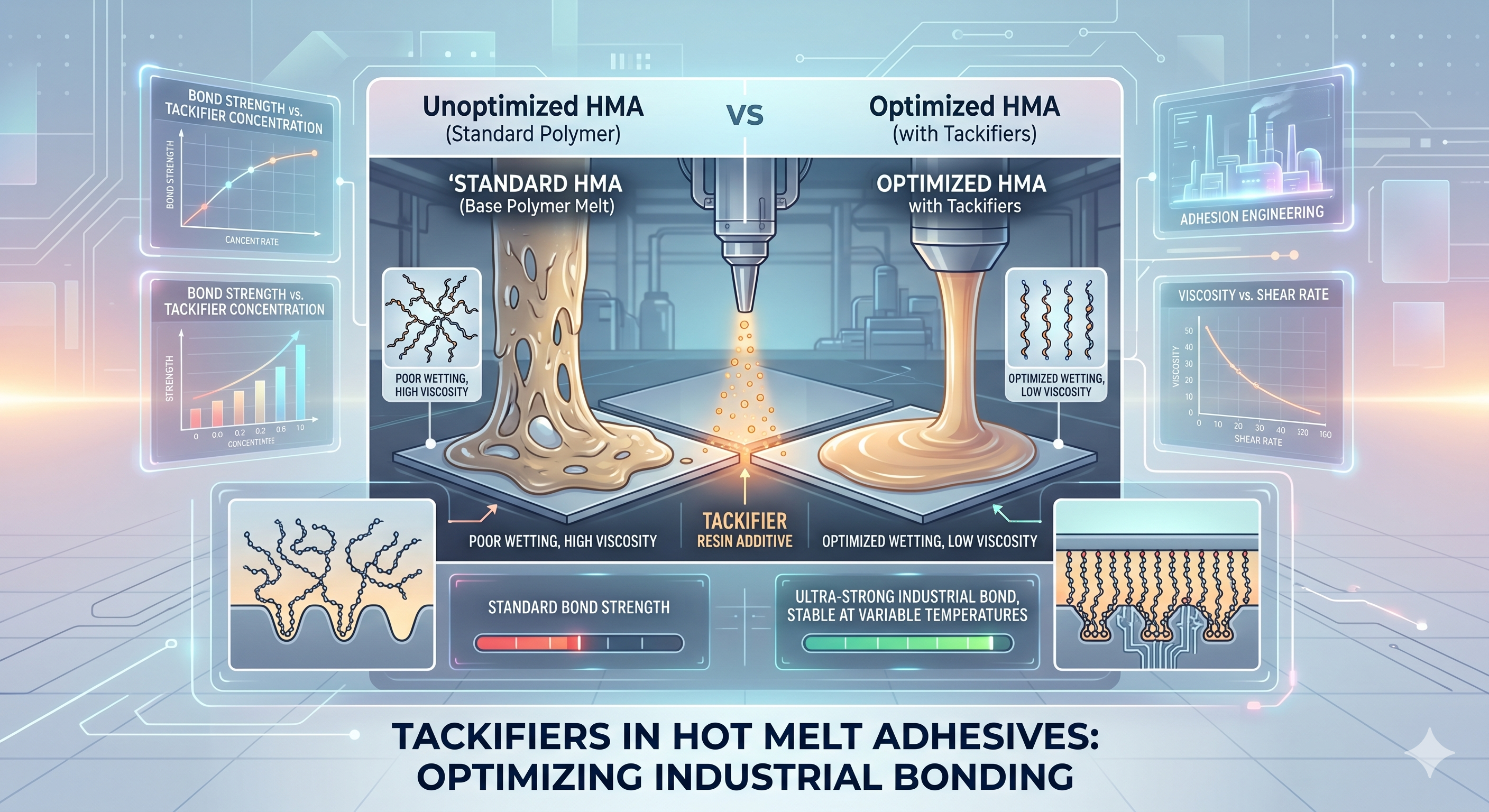
In the high-speed world of modern manufacturing, things move fast. An Amazon box is sealed in milliseconds; a car door panel is bonded in seconds; a diaper is assembled at speeds that the human eye can barely follow. Behind this incredible pace is a class of materials known as Hot Melt Adhesives (HMA). But while the base polymer provides the strength, it is a specialized group of additives known as Tackifiers that provide the “soul” of the bond.
Tackifiers are low-molecular-weight resins that transform a stiff plastic into a functional adhesive. Without them, most hot melts would simply sit on a surface like a bead of cooled wax—solid, but entirely unattached. This article explores the sophisticated science of tackification, current research into sustainable alternatives, and the critical balance between performance and safety in industrial bonding.
The Anatomy of a Hot Melt Adhesive
To understand the tackifier, we must first look at the three-pillar structure of a standard Hot Melt Adhesive:
-
The Base Polymer (30–40%): This is the backbone. Usually made of Ethylene-Vinyl Acetate (EVA), Polyolefins, or Styrenic Block Copolymers (SBC), the polymer provides the mechanical strength and toughness.
-
The Wax (20–30%): The wax controls the “open time” (how long the glue stays sticky) and the “set time” (how fast it hardens). It also reduces the viscosity so the glue can be pumped through industrial nozzles.
-
The Tackifier (30–40%): This is the “stickiness” agent. It allows the adhesive to “wet” the surface—meaning it forces the liquid glue to flow into the microscopic valleys of the material it is trying to bond.
The Physics of “Tack”: How it Works at the Molecular Level
Why is a tackifier necessary? The answer lies in Viscoelasticity. A good adhesive must behave like a liquid when applied (to flow into the surface) and like a solid once bonded (to hold weight).
Tackifiers work by modifying the Glass Transition Temperature (Tg) of the polymer. When a tackifier is mixed with a polymer, it breaks up the tightly packed polymer chains. This makes the material softer and more “dilated” at room temperature.
Scientifically, this is governed by the Dahlquist Criterion. This rule states that for a material to be “tacky,” its elastic modulus must be below a certain threshold (roughly $3 \times 10^5$ Pa). Tackifiers lower the modulus of the polymer blend, allowing it to deform easily under light pressure. This deformation is what allows the adhesive to create an instantaneous bond, or “tack.”
Types of Tackifiers: Natural vs. Synthetic
Industrial designers choose tackifiers based on the “polarity” of the surface they are bonding. Like dissolves like; therefore, a polar tackifier bonds best to a polar surface (like glass or wood).
1. Rosin Resins (The Natural Choice)
Derived from pine trees (either as gum rosin or tall oil rosin from the paper industry), these are the oldest tackifiers. They are highly polar and offer excellent “aggressive tack.” Because they are bio-based, they are currently seeing a resurgence in “green” packaging initiatives.
2. Terpene Resins
Also derived from natural sources like citrus peels or pine needles, these offer high thermal stability and are often used in premium pressure-sensitive adhesives (PSAs).
3. Hydrocarbon Resins (The Synthetic Powerhouses)
Derived from petroleum, these are categorized by their carbon chain length:
-
C5 Resins (Aliphatic): Best for non-polar substrates like Polyethylene (PE) or Polypropylene (PP). They are the standard for diapers and simple packaging.
-
C9 Resins (Aromatic): These are stiffer and have higher Tg. They are used when high heat resistance is required, such as in automotive interiors.
-
Hydrogenated Resins: These are C5 or C9 resins that have been treated with hydrogen to remove double bonds. This makes them “Water White” (completely clear) and extremely stable against UV light and oxygen.
Current Research: The 2025-2026 Frontier
The adhesive industry is currently undergoing a massive transformation driven by the “Circular Economy” and the push for decarbonization.
Bio-Based Breakthroughs: Lignin and Cellulose
Recent research published in Green Chemistry (2025) has focused on Lignin, a byproduct of the wood pulping industry that is usually burned for fuel. Scientists have successfully modified lignin to act as a high-performance tackifier. Unlike traditional rosins, lignin-based tackifiers offer inherent flame retardancy and antioxidant properties, potentially eliminating the need for further chemical additives.
Nanotechnology Integration
In the realm of high-tech bonding, research into Carbon Nanotube (CNT) reinforced tackifiers is gaining traction. By dispersing a tiny amount of CNTs into the tackifier resin, manufacturers can create “conductive adhesives.” These are used in the assembly of flexible electronics and EV battery sensors, where the bond must not only hold but also transmit data or dissipate static electricity.
“De-bonding” on Command
A major hurdle in recycling is that adhesives make it hard to separate different materials (like a plastic label from a glass bottle). New research into Stimuli-Responsive Tackifiers allows a bond to “switch off.” When exposed to a specific UV wavelength or a narrow temperature range during recycling, the tackifier loses its grip, allowing for clean separation of materials.
Clinical and Safety Perspectives: Occupational Health
While tackifiers are generally considered “inert” once cooled, the industrial application process involves high heat, which presents specific clinical concerns.
1. Respiratory Health (The Fume Factor)
When HMAs are heated to 160°C–190°C, the low-molecular-weight components of the tackifiers can volatilize. Clinical studies on factory workers have shown that prolonged exposure to rosin fumes can lead to occupational asthma or “Colophony Sensitization.” Modern facilities now use high-purity hydrogenated resins to minimize these “Volatile Organic Compounds” (VOCs).
2. Dermatological Sensitivity
Rosin esters are known skin sensitizers. In the medical adhesive industry (bandages and wearable sensors), clinical trials are mandatory to ensure that the tackifier does not migrate into the skin and cause contact dermatitis. The shift toward medical-grade synthetic tackifiers has significantly reduced the incidence of skin irritation in patients with long-term wearable devices.
Advantage-Risk Assessment for Industrial Use
Choosing the right tackifier is a balance of performance, cost, and safety.
| Feature | The Advantage (The Pro) | The Risk / Challenge (The Con) |
| Bond Speed | Enables scond-interval bonding for high-speed lines. | High-tack formulas can “string” or “tail,” clogging nozzles. |
| Sustainability | Natural rosins offer a low carbon footprint. | Natural resins are prone to oxidation and “yellowing” over time. |
| Cost Efficiency | Tackifiers are often cheaper than base polymers, reducing total cost. | Market volatility in petroleum (for C5/C9) affects pricing. |
| Versatility | Can be “tuned” to bond to almost any surface (PE, Metal, Glass). | Potential migration (leaching) into food or skin if poorly formulated. |
| Thermal Stability | Hydrogenated resins can stay in a hot tank for days without charring. | Over-stabilization can make the adhesive too brittle at low temperatures. |
Industrial Applications: Where Tackifiers Shine
-
Automotive: Tackifiers with high heat resistance (C9) ensure that your car’s headliner doesn’t peel off when the vehicle is parked in the 50°C summer sun.
-
Packaging: High-tack EVA-based adhesives ensure that frozen food boxes stay sealed at -30°C.
-
Hygiene: In baby diapers, “low-odor” hydrogenated tackifiers provide a strong bond while ensuring no chemical smells or skin irritants reach the infant.
The Future: Smart Bonding
As we look toward 2030, the “tackifier” will become more than just a sticky resin. We are moving toward Adaptive Adhesives. These are formulations where the tackifier can change its properties based on the environment—becoming more rigid in high-vibration settings or more flexible in high-impact scenarios.
The integration of AI in formulation (Predictive Material Modeling) is also allowing companies to “digitally twin” an adhesive. This means a company can predict exactly how a tackifier will behave over 20 years of environmental stress before a single drop of glue is produced.
Conclusion
Tackifiers are the silent enablers of the modern industrial world. They bridge the gap between a raw polymer and a functional product. As the industry moves toward greener chemistry and smarter materials, the science of tackification will remain at the heart of how we hold our world together. For the manufacturer, the goal is clear: finding that perfect molecular balance where the bond is strong enough to last a lifetime, yet smart enough to let go when the time is right.