
Recently added item(s)
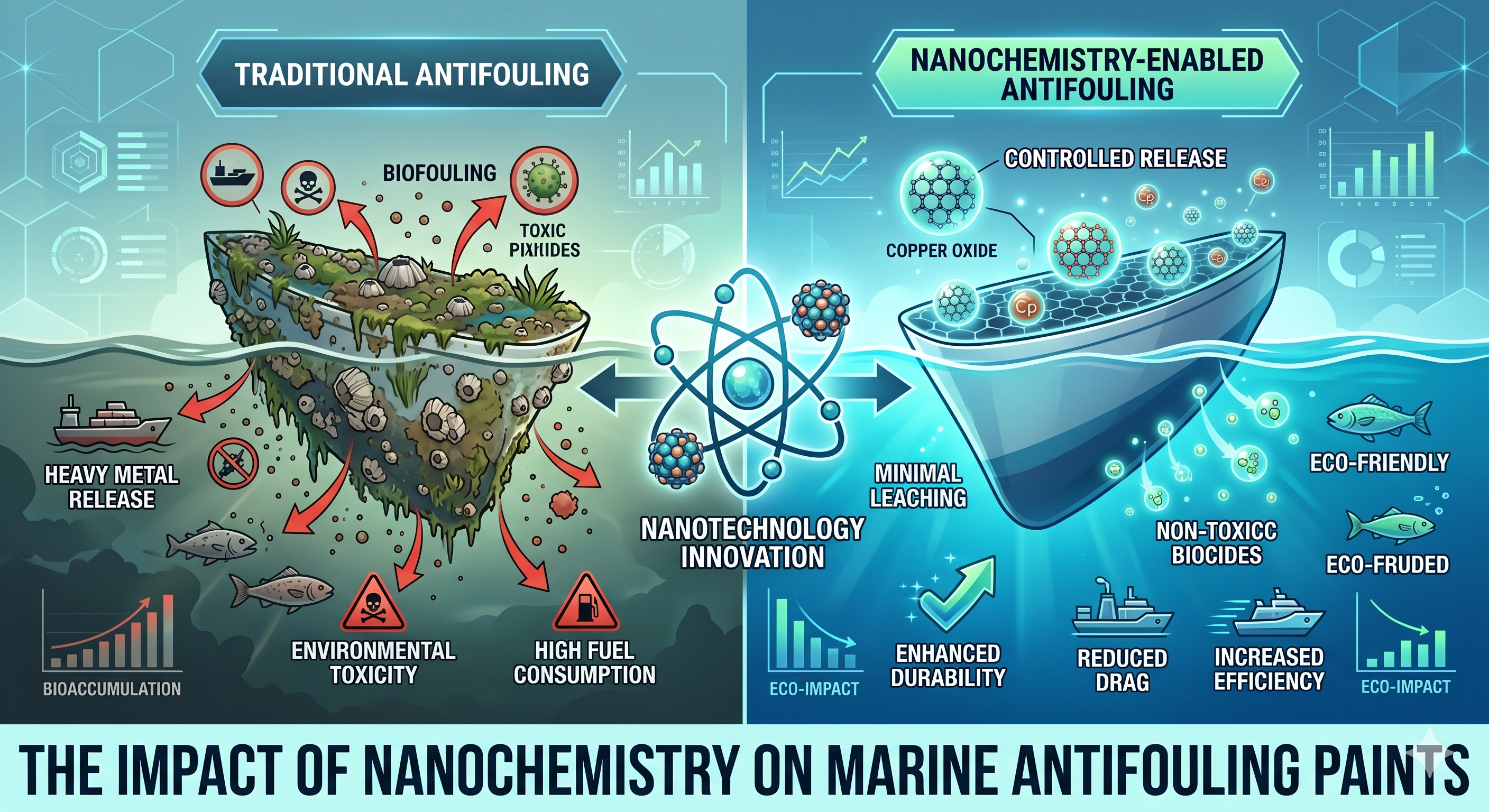
For as long as humanity has sailed the seas, we have been at war with an invisible and relentless enemy: biofouling. From the wooden hulls of ancient triremes to the massive steel plates of modern supertankers, the accumulation of microorganisms, algae, plants, and animals like barnacles on submerged surfaces has been a multi-billion-dollar headache.
Biofouling isn’t just an aesthetic issue. It increases hydrodynamic drag by up to 60%, leading to a staggering 40% increase in fuel consumption and greenhouse gas emissions. For decades, the solution was “toxic force”—paints laden with heavy metals that killed anything trying to attach. However, these toxins devastated marine ecosystems. Today, the tide is turning. Nanochemistry is leading a revolution, offering coatings that are more effective, more durable, and significantly more environmentally friendly.
The Ghost of Maritime Past: Why Traditional Paints Failed
To understand the impact of nanochemistry, we must look at what came before. In the mid-20th century, the industry relied on Tributyltin (TBT). It was incredibly effective at stopping biofouling, but it was an ecological disaster. TBT caused “imposex” in marine snails (females developing male characteristics) and entered the food chain, affecting everything from oysters to whales.
By the time the International Maritime Organization (IMO) banned TBT in 2008, the world was desperate for an alternative. Traditional copper-based paints filled the gap, but they still rely on the constant “leaching” of copper ions into the water, which can accumulate in harbors and damage non-target marine life. The challenge for 2026 is clear: How do we keep a hull clean without poisoning the ocean?
Nanochemistry: The New Frontier of Surface Engineering
Nanochemistry operates at the scale of 1 to 100 nanometers—where the rules of physics and chemistry begin to change. By manipulating matter at this level, scientists are creating “smart” surfaces that don’t just kill biofoulers; they make the hull physically impossible to stick to.
1. Nanoparticle Biocides (Controlled Release)
Rather than saturating paint with large amounts of copper or zinc, nanochemistry allows for the use of Copper Oxide (Cu2O) or Zinc Oxide (ZnO) nanoparticles. Because these particles have a massive surface-area-to-volume ratio, they are far more potent than their bulk counterparts.
-
The “Smart Release” Mechanism: Modern nano-coatings encapsulate these particles in “nanocapsules” or polymer matrices. These capsules act as tiny reservoirs that release the biocide only when triggered by specific environmental factors like pH changes or the presence of specific enzymes from a barnacle’s “glue.” This drastically reduces the total amount of heavy metal released into the sea.
2. Photocatalytic Nano-Coatings (The Power of Light)
One of the most exciting developments in 2025 and 2026 is the use of Titanium Dioxide (TiO2) nanoparticles. When exposed to sunlight (even in the upper layers of the ocean), TiO2 acts as a photocatalyst. It creates “Reactive Oxygen Species” (ROS) on the surface of the hull. These ROS molecules break down the organic “bio-glue” that bacteria and algae use to attach themselves. Effectively, the sun helps the ship clean itself.
3. Graphene and Carbon Nanotubes (The Mechanical Barrier)
Graphene, the one-atom-thick layer of carbon, is making waves in maritime tech. When integrated into an epoxy coating, graphene creates a “tortuous path” for water and corrosive ions. It makes the paint incredibly hard and slick. At the nano-scale, graphene sheets act like microscopic razors to settling larvae, or more commonly, provide such a smooth surface that the “glue” of a barnacle simply cannot find a grip.
Biomimicry: Learning from the Masters of the Sea
Perhaps the most sophisticated application of nanochemistry is not in what the paint contains, but in how it is shaped. This is known as Topographical Antifouling.
Nature has already solved the fouling problem. Sharks and whales move slowly enough to be fouled, yet their skin remains clean. Under a microscope, shark skin is covered in “dermal denticles”—tiny, rib-like structures. Nanotechnology allows us to replicate this texture.
Using nano-imprint lithography, scientists can create paints that, once dried, have a surface texture so specific that it physically prevents the settlement of spores and larvae. If a barnacle larva is 100 microns wide, and the surface has nano-ridges spaced 50 microns apart, the larva simply cannot “sit” down and attach its glue. This is 100% non-toxic, relying entirely on physics rather than chemistry.
Current Research (2025–2026): The Era of Self-Healing and Dynamic Surfaces
The latest peer-reviewed studies in ACS Applied Materials & Interfaces have introduced the concept of Dynamic Nano-Surfaces.
Dynamic Hydrogels
Researchers are developing coatings that include “nano-hydrogels.” These materials can absorb water and swell, creating a soft, jelly-like boundary layer. To a barnacle, the ship doesn’t feel like a solid surface; it feels like a liquid. When the ship moves, the shear force of the water easily washes away any “hitchhikers.”
Self-Healing Nano-Coatings
A major issue with any paint is scratching. A single scratch in an antifouling coating provides a “beachhead” for barnacles to begin colonizing. New research into Microvascular Nanowires within the paint allows the coating to “bleed” a healing agent when scratched. The nano-capsules rupture, filling the gap and re-establishing the antifouling barrier within minutes.
Ecological and “Clinical” Impact: Assessing the Risks
In the context of marine science, “clinical” studies refer to the controlled ecological impact assessments of these new materials. While nanochemistry offers a path away from TBT and high-level copper leaching, it is not without its own set of questions.
The Toxicity of the “Nano” Scale
A 2025 study on coral reef health raised concerns about the “bio-availability” of nanoparticles. Because they are so small, ZnO or Ag (silver) nanoparticles can be ingested by filter-feeders like mussels and clams. Once inside the organism, these particles can cross cell membranes more easily than traditional chemicals.
Advantage vs. Risk Assessment
| Feature | Advantage (The “Pro”) | Risk / Challenge (The “Con”) |
| Fuel Efficiency | Can reduce fuel consumption by up to 40% through drag reduction. | High initial cost of nano-engineered coatings compared to traditional paint. |
| Durability | Nano-reinforced epoxies last 5–7 years, compared to 2–3 years for traditional coats. | Complex application requirements (temperature/humidity control). |
| Environmental | Drastically reduces heavy metal leaching into the ocean. | Unknown long-term effects of nanoparticle accumulation in deep-sea sediments. |
| Non-Toxic Options | Topographical (texture-based) coatings use zero poisons. | Textured surfaces can be difficult to clean if they do eventually get fouled. |
| Regulatory Compliance | Meets the strictest IMO and REACH standards for 2026. | Lack of standardized testing for “nano-leaching” across different maritime jurisdictions. |
The Human Element: Safety in Manufacturing
For the professionals working in the production of these advanced materials, nanochemistry introduces new safety protocols. Handling dry “nanopowders” (like graphene or nano-copper) requires high-level respiratory protection and specialized filtration systems to prevent inhalation. However, once these particles are “wetted” into a paint or resin matrix, the risk of inhalation is eliminated, making the final application relatively safe for shipyard workers, provided standard PPE is used.
The Future: A Carbon-Neutral Maritime Industry
The impact of nanochemistry on marine paints goes far beyond keeping hulls clean. It is a vital pillar of the global strategy to reach “Net Zero” in shipping. By reducing the drag of the global fleet, we are effectively removing millions of tons of $CO_2$ from the atmosphere every year.
We are moving toward a future where a ship’s hull is a “living” interface—a nano-engineered skin that senses its environment, heals its wounds, and glides through the water with the efficiency of a shark. The transition from “poisoning the sea” to “engineering the surface” is one of the greatest success stories of modern material science.
Conclusion
The evolution of marine antifouling paints from toxic TBT to sophisticated nanochemistry represents a maturation of our relationship with the ocean. We no longer seek to dominate the marine environment through chemical warfare; instead, we are using the precise tools of nanochemistry to coexist more efficiently. While we must remain vigilant about the ecological footprint of nanoparticles, the current data suggests that the benefits—both economic and environmental—far outweigh the risks. In the quiet war beneath the waves, nanochemistry has finally given us the upper hand.