
Recently added item(s)
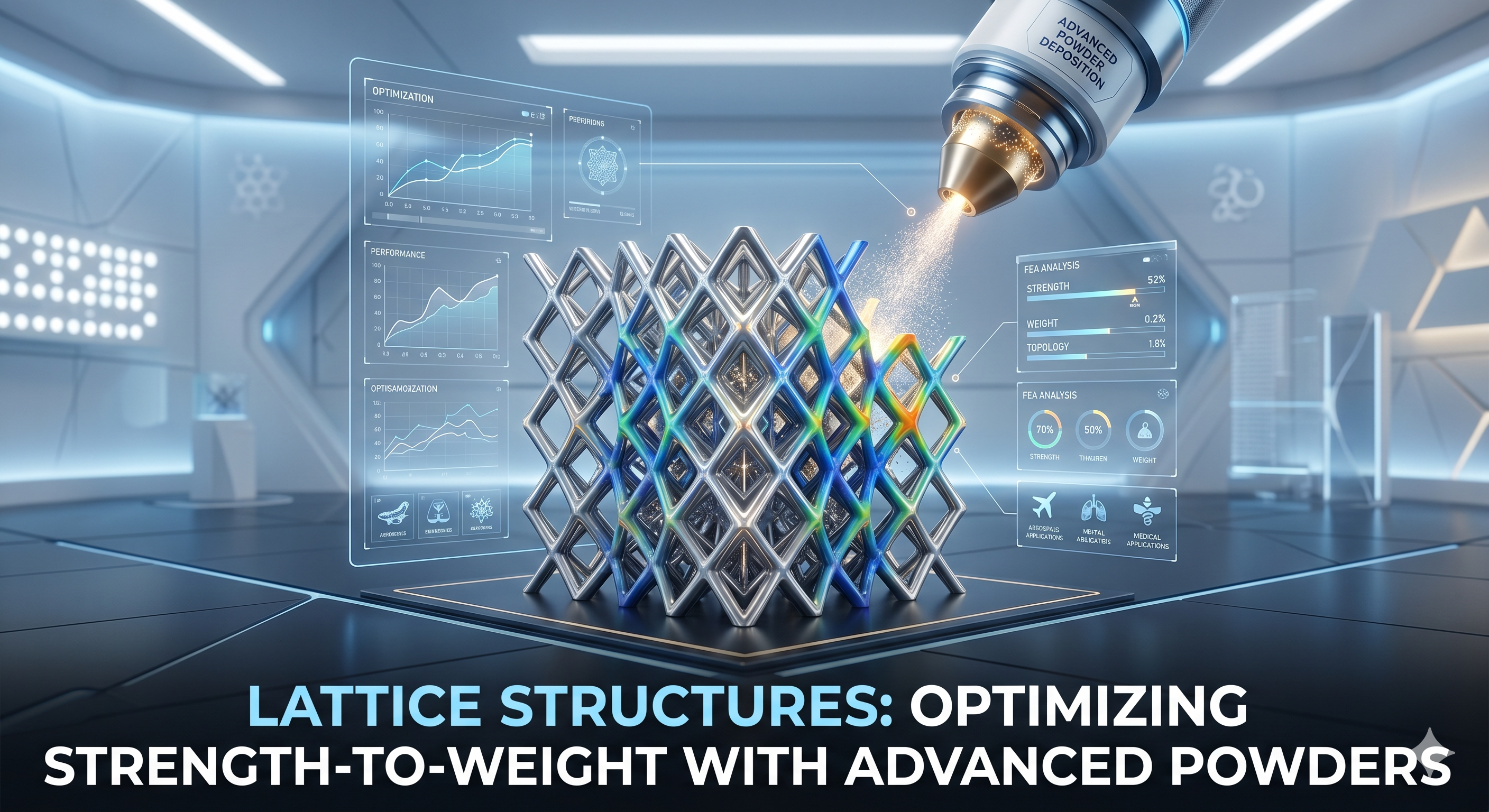
In the history of engineering, the quest has always been to do more with less. From the arched stone bridges of Rome to the hollowed-out bones of a bird, the principle remains the same: arrange material only where it is needed to maximize strength while minimizing mass. Today, we are entering a new era of this philosophy. By combining Lattice Structures with Advanced Material Powders, 3D printing is enabling us to manufacture objects that were once considered mathematically possible but physically unbuildable.
As of 2026, the convergence of AI-driven topology optimization and high-purity nanostructured powders has moved lattice engineering from experimental labs to the core of aerospace, automotive, and orthopedic industries. This blog explores the science behind these structures, the latest research in powder metallurgy, and the critical balance of advantages and risks.
1. Defining the Architecture: What Are Lattice Structures?
A lattice is a space-filling unit cell that can be repeated in three dimensions. Unlike a solid block of material, a lattice is mostly empty space. However, because of its geometric arrangement, it can provide structural integrity that rivals solid parts at a fraction of the weight.
The Evolution of Geometry: Beyond the Honeycomb
While traditional honeycombs were revolutionary, they are primarily 2D structures extruded into 3D. Modern additive manufacturing (AM) allows for Triply Periodic Minimal Surfaces (TPMS). These are complex, curved geometries—such as Gyroids, Schwarz P, and Diamond cells—that lack sharp corners, which significantly reduces “stress concentrators.”
In 2026, the focus has shifted toward stochastic lattices (randomized, foam-like structures) and functionally graded lattices, where the density of the lattice changes across a single part. For instance, a rocket engine component might have a dense lattice at the mounting point for strength and a porous lattice at the exterior for cooling.
2. The Role of Advanced Powders: The Ingredients of Strength
The lattice design is only as good as the material it is built from. In 3D printing (specifically Laser Powder Bed Fusion or Electron Beam Melting), the “advanced powders” are the unsung heroes.
Spherical Morphology and Purity
To print a strut as thin as 200 micrometers, the powder must flow perfectly. Advanced powders in 2026 utilize plasma atomization to ensure near-perfect spherical shapes. If a powder particle is irregular, it creates “voids” in the lattice strut, leading to a “snap” under pressure.
Nano-Infused Metal Powders
A major research breakthrough in early 2026 involved ceramic-nanoparticle-coated aluminum powders. By coating aluminum alloy particles with a thin layer of titanium diboride ($TiB_2$), engineers have successfully eliminated “hot cracking” during the rapid cooling phase of 3D printing. This allows for the use of high-strength alloys like the 7000-series aluminum in complex lattice forms that were previously too brittle to print.
3. 2025-2026 Research: AI and Generative Optimization
The most significant research trend this year is the integration of Generative AI in lattice design. Historically, an engineer had to manually select a lattice type. Now, AI algorithms perform “Field-Driven Design.”
Recent Study: The “Adaptive Density” Breakthrough
A study published in February 2026 in the Journal of Additive Manufacturing demonstrated an AI model that could simulate 10 million load cases in minutes. The result was a “Bio-mimetic Bone Lattice” for a hip implant. The AI didn’t just pick a lattice; it grew the struts in the direction of the patient’s specific walking gait, achieving a 60% reduction in weight while increasing fatigue life by 300%.
Multi-Scale Modeling
Current research is also tackling the “Micro-to-Macro” gap. Scientists are now able to model how a single grain of metal within a 200-micron lattice strut will react to heat. This level of detail ensures that when we print a massive aerospace wing-rib, we know the “nano-health” of every single intersection.
4. Clinical Studies: Lattices in Human Medicine
The medical field is perhaps the most advanced user of lattice structures. The primary goal here is not just weight reduction, but osseointegration—the process by which bone grows into an implant.
Orthopedic Implants and “Stress Shielding”
Solid titanium implants are much stiffer than human bone. This causes “stress shielding,” where the implant takes all the load, and the surrounding bone withers away due to lack of use.
-
2026 Clinical Trial Data: A clinical study involving 120 spinal fusion patients used 3D-printed Titanium-6Al-4V ELI lattice cages. The results showed that the lattice cages, which mimicked the “Young’s Modulus” (stiffness) of human trabecular bone, resulted in 40% faster healing times compared to solid PCL or titanium spacers.
-
Bio-active Powders: New clinical trials are testing lattices printed with “Bio-glass” infused powders, which chemically signal the body to produce new bone cells inside the lattice voids.
5. Advantage vs. Risk: A Rigorous Assessment
While the “Cool Factor” of lattices is high, the engineering reality requires a cold, hard look at the trade-offs.
The Advantages
-
Extreme Lightweighting: In the EV industry, replacing solid brackets with lattice-optimized parts has led to a range increase of up to 5% by reducing “unsprung mass.”
-
Energy Absorption: Lattices are the ultimate “crumple zones.” They can be designed to collapse in a specific sequence, making them ideal for helmet liners and battery protection in cars.
-
Thermal Management: Lattices provide a massive surface-area-to-volume ratio. This makes them perfect for “compact heat exchangers” in high-performance computing and jet engines.
The Risks and Challenges
-
Powder Entrapment: One of the biggest “silent killers” in lattice manufacturing is trapped powder. If the lattice cells are too small or poorly designed, the un-melted powder remains inside. In a medical implant, this could lead to an embolism; in aerospace, it adds “dead weight.”
-
Surface Roughness: 3D-printed struts are inherently rough. This roughness acts as a series of tiny notches where cracks can start. In 2026, Chemical Vapor Polishing is often required to “smooth” the internal lattice, adding significantly to the cost.
-
Inspection (Metrology): How do you check for a crack inside a 10,000-cell lattice? Traditional X-rays are often insufficient. Companies must use High-Resolution Micro-CT scanning, which is slow and expensive.
6. Industrial Implementation: Aerospace and Defense
In the defense sector, the focus is on Hypersonic Flight. At Mach 5+, components face extreme heat. Traditional solid materials expand and warp. Lattice structures, however, allow for “transpiration cooling”—where a cooling fluid is pumped through the lattice structure itself.
In April 2026, a major aerospace firm successfully tested a 3D-printed lattice combustion chamber for a rocket. By using Inconel 718 (a nickel-superalloy powder), they were able to integrate cooling channels directly into the structural lattice, reducing the part count from 50 separate pieces to a single printed unit.
7. The Future: Digital Materials and 4D Printing
Looking beyond 2026, the next step is 4D Printing, where the lattice is printed with “Shape Memory Alloy” powders. These lattices could potentially expand or contract in response to temperature changes, effectively allowing a satellite to “unfold” itself in space or a medical stent to “expand” in a blood vessel without mechanical intervention.
We are also seeing the rise of Digital Materials, where different powders are mixed during the print. Imagine a lattice where the core of each strut is high-strength steel, but the outer shell is corrosion-resistant nickel.
Conclusion
Lattice structures represent the ultimate synergy between mathematics and material science. By moving away from “monolithic” thinking and embracing the complexity of cellular design, we are creating a world where machines are lighter, implants are more “human,” and energy is used more efficiently. The challenges of inspection and powder removal are significant, but with the rapid advancement of AI and post-processing technologies in 2026, the “Lattice Revolution” is no longer a future prospect—it is the current standard of excellence.