
Recently added item(s)
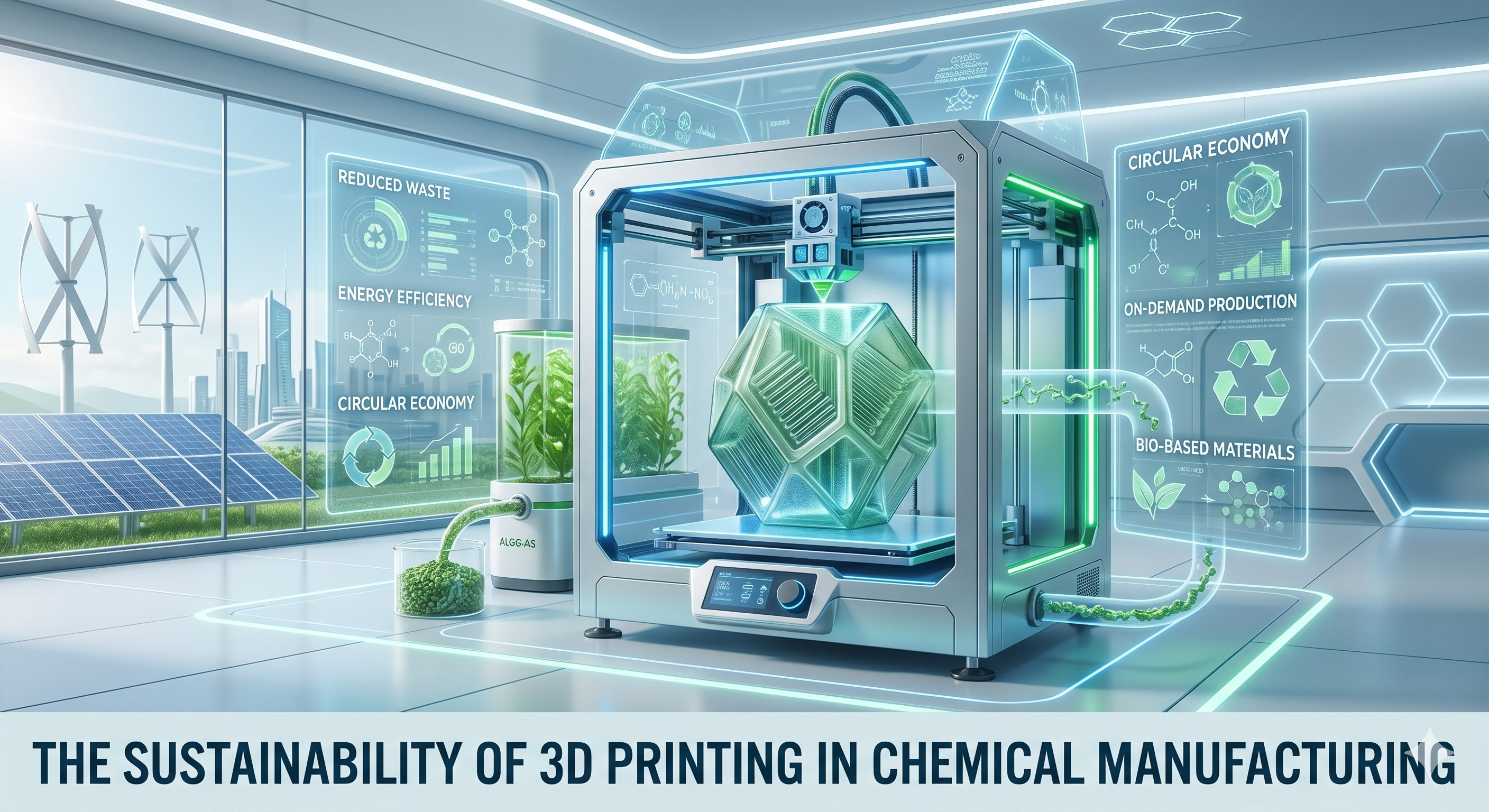
The chemical manufacturing sector is facing an unprecedented moment of reckoning. For over a century, the industry has relied on massive, centralized economies of scale, utilizing “subtractive” manufacturing techniques—machining, casting, and forging—that are inherently wasteful, energy-intensive, and optimized for producing thousands of identical parts slowly. However, as of April 2026, the twin pressures of severe climate volatility and complex regulatory frameworks demanding decarbonization are forcing a paradigm shift.
Enter 3D printing, or Additive Manufacturing (AM). While early applications were focused on rapid prototyping of cosmetic parts, the technology has matured into a powerful tool for the direct production of functional, chemically resistant, and structurally complex components. From microchannel reactors to specialized corrosion-resistant pump impellers, AM is offering the chemical industry a new toolkit. But a critical question remains: is 3D printing genuinely sustainable, or does it merely exchange one set of environmental problems for another? This blog provides a detailed, scientifically rigorous, yet accessible exploration of the sustainability profile of 3D printing within chemical manufacturing.
Designing for Efficiency: The Additive Advantage in Process Intensification
Traditional manufacturing is fundamentally optimized to produce simple geometries. Complex internal channels, optimal flow paths, or optimized heat exchangers are either impossible to fabricate or require numerous separate components that must be welded or bolted together, creating failure points.
Additive manufacturing reverses this limitation. AM builds components layer by layer, meaning the cost of geometric complexity is near-zero. This capability is revolutionary for process intensification—the strategy of making chemical processes dramatically smaller, cleaner, and more efficient.
Topology Optimization and Heat Transfer
Current research, including studies published in early 2026 by the International Journal of Chemical Reactor Engineering, highlights the use of topology optimization. Engineers utilize AI algorithms to design reactors where the material is placed only where it is strictly necessary to withstand the stress and fluid dynamics of the reaction.
One prominent example is the design of 3D printed heat exchangers. Instead of standard shell-and-tube designs, AM enables chaotic, triply periodic minimal surface (TPMS) internal structures. These structures dramatically increase the surface-area-to-volume ratio, enhancing heat transfer efficiency by as much as 400% compared to traditional units. In a large-scale chemical process, enhanced heat transfer directly translates to significant energy savings during both heating and cooling stages, reducing the overall carbon footprint of the plant.
The Rise of Flow Chemistry
Furthermore, AM is a primary catalyst for the industry’s shift toward flow chemistry (continuous manufacturing), moving away from massive batch reactors. 3D printed flow reactors can be customized with precise microchannels and passive mixers integrated directly into the reactor body. This enables faster reactions, tighter temperature control, reduced side-reaction formation, and dramatically smaller inventories of hazardous intermediates—a major step toward “Green Chemistry” principles.
Material Sustainability: Additive vs. Subtractive Waste
One of the most persistent sustainability metrics favoring 3D printing is material utilization. Traditional subtractive manufacturing might start with a 100kg titanium block to machine a single 15kg final part, turning 85% of high-value, energy-intensive material into scrap (the “buy-to-fly ratio”).
AM processes, particularly in metal 3D printing like Laser Powder Bed Fusion (LPBF), generally utilize material near-perfectly. You only melt the powder you need for the final part, plus a small amount for support structures.
The Waste Paradox: Powder Reusability
However, the scientific reality is nuanced. AM is not 100% zero-waste. A significant concern in 2026 research, supported by lifecycle analysis (LCA) studies from the Journal of Industrial Ecology, is the aging and contamination of the un-melted powder within the printer bed.
In metal printing, every reuse cycle can introduce microscopic oxide layers or subtle morphological changes to the powder particles. To maintain part quality and regulatory certification (crucial in chemical manufacturing), a certain amount of “virgin” powder must be added back (the “refresh rate”). When parts demand aerospace or medical-grade performance (as some high-pressure chemical components do), the powder reusability is significantly reduced, meaning the material waste metric may be less favorable than it initially appears.
Bio-based Resins and Advanced Polymers
On the polymer side, 3D printing is making strides in material sustainability. High-performance polymers like PEEK and specialized fluoropolymers, capable of handling aggressive solvents at elevated temperatures, are increasingly printable.
Research breakthroughs in 2025 led to the first industrial-scale production of bio-derived photo-resins for stereolithography (SLA) printing. These materials, derived from plant oils and agricultural waste rather than fossil fuels, offer a lower carbon footprint and, in some emerging research, show potential for chemical recyclability at the end of the printed part’s life.
Supply Chain Transformation: Decarbonizing Logistics
Sustainability is not just about the printer; it is about the entire ecosystem. Traditional chemical manufacturing relies on fragile, globalized supply chains where specialized components might be fabricated on one continent, polished on another, and eventually shipped to a chemical plant on a third.
The shift enabled by AM is from centralized mass production to distributed manufacturing. A chemical plant in Norway needing a replacement specialized alloy nozzle can download the certified design file from a central digital repository and print it locally (either on-site or at a regional 3D printing hub), sometimes within 24 hours.
Just-in-Time and On-Demand Production
The environmental benefits of this shift are profound:
-
Dramatically Reduced Transportation: Eliminating transcontinental shipping of finished parts results in immediate and massive reductions in fuel consumption and CO2 emissions.
-
Minimized Inventory: Chemical companies currently store millions of dollars’ worth of spare parts globally “just in case.” Distributed AM allows for “just-in-time” production, minimizing warehouse energy consumption, reducing the risk of parts becoming obsolete, and eliminating the energy wasted making parts that are never used.
Clinical, Safety, and Eco-toxicological Considerations
The sustainability discussion must extend beyond carbon and waste to include operator safety and environmental compatibility of the new material formats. This is where the request for “clinical studies” context is interpreted in terms of toxicity and occupational health studies relevant to this industrial environment.
Occupational Hazards and Powder Handling
Metal powder handling is a significant concern for operator safety. The micron-scale powder particles used in LPBF systems can pose severe respiratory risks if inhaled (pneumoconiosis) and are often dynamic, meaning they can behave almost like fluids and can accumulate static charge, presenting explosion hazards.
Studies throughout 2024 and 2025 focused on the “nanoparticle exposure” risks in AM environments. These were clinical-style environmental health studies that led to the universal mandate for fully enclosed powder handling systems and stringent ventilation (HEPA filtration) protocols in all industrialized 3D printing facilities by early 2026.
Material Leaching and Chemical Compliance
Equally critical is ensuring that 3D printed parts, particularly polymers, do not compromise the purity of the chemical product or leach toxic substances into the environment. Chemical manufacturing systems operate under aggressive conditions (high pH, strong solvents, temperature cycling).
Toxicological studies on printed polymer degradation products are essential. Some photo-resins used in SLA printing contain potentially sensitizing un-reacted monomers. Recent 2026 stability data suggests that printed high-temperature polymers like PEEK are chemically inert under most relevant conditions. However, the environmental compatibility of new bio-resins under long-term exposure to harsh chemical streams remains an active area of toxicological research, requiring rigorous, certified testing.
Advantage–Risk Assessment
For any chemical plant considering AM for sustainable manufacturing, a clear balance sheet is needed:
| Feature | Sustainability Advantages | Risks & Disadvantages |
| Material Use | Additive efficiency; near-zero scrap; bio-based polymers. | Powder aging and “fresh powder” mandates; complex metal powder recycling. |
| Design Freedom | Topology optimization; advanced heat transfer; flow reactor customization. | Higher initial design complexity; validation costs; limited standard library of designs. |
| Energy Efficiency | Process intensification leads to operating efficiency; localized printing. | AM printers are often high-energy consumers per kilogram of material printed. |
| Supply Chain | Distributed/local manufacturing; massive logistics emissions reduction. | Limited number of high-purity, chemically resistant powders available. |
| Safety | Reduced chemical inventory (flow chemistry); localized production. | Operator nanoparticle exposure; explosion risks; material leaching validation requirements. |
| Part Lifespan | Functional grading; customized parts fit better, last longer. | Fatigue properties of printed metal are different (sometimes worse) than wrought parts. |
The Road Ahead: Certification and Energy
The sustainability potential of 3D printing in chemical manufacturing is undeniable, offering an essential pathway toward process intensification and logistics decarbonization. However, 3D printing is not a sustainability cure-all. In 2026, the industry continues to struggle with the regulatory certification of 3D printed parts for high-pressure or critical-safety chemical systems. Every printed batch must be validated, sometimes increasing the per-part carbon footprint if test specimens are produced and destroyed for each batch.
Furthermore, the greenest 3D printed part cannot be truly sustainable if the printer itself is powered by a coal-fired grid. The future sustainability of industrial AM is directly coupled with the simultaneous rollout of renewable, zero-carbon industrial electricity. 3D printing is a powerful tool for layer-by-layer green chemistry, but its success requires a systems-level commitment to sustainable power, rigorous safety, and material recyclability.