
Recently added item(s)
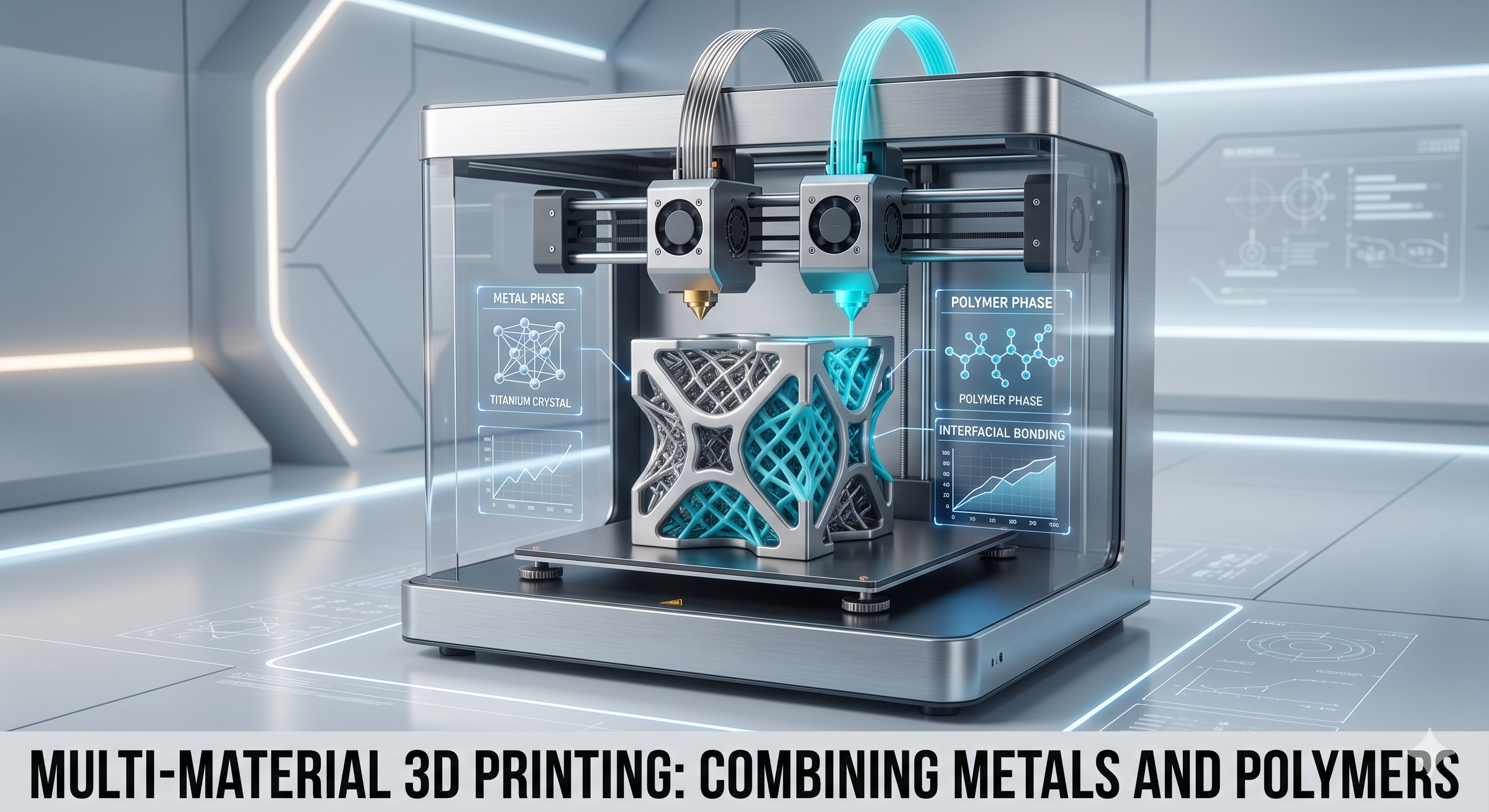
The history of manufacturing has largely been a saga of single materials. We carve from wood, melt from metal, or mold from plastic. When an object requires conductive properties and flexibility, or load-bearing strength and lightweighting, we are forced into assembly lines—using bolts, adhesives, and screws to join distinct components. Today, additive manufacturing, popularly known as 3D printing, is tearing down this historical boundary. We are moving beyond printing complex geometries to printing complex material systems.
The ultimate frontier of this revolution is the seamless combination of metals and polymers within a single monolithic build. This concept promises to unlock unprecedented functionalities, allowing engineers to program mechanical, electrical, and thermal properties spatially throughout a part, layer by layer. The dichotomy is extreme: metals are strong, conductive, and heat-resistant, but heavy and rigid; polymers are lightweight, flexible, insulating, and often biocompatible, but possess low melting points. Integrating them is the “Holy Grail” of additive manufacturing—a scientifically taxing endeavor that is finally beginning to yield to innovative engineering.
The Core Challenge: A Tale of Two Physicists
Integrating metal and polymer in a single build is incredibly difficult due to fundamental mismatches in their physical and chemical properties.
1. Thermal Expansion Coefficients (CTE)
This is the most critical hurdle. All materials expand when heated and contract when cooled, but they do so at different rates. Metals have tightly packed crystalline structures with high melting points; when they contract upon cooling, they pull with immense force. Polymers have loose, molecular chain structures; they contract significantly more but are much softer.
When a multi-material build cools down from printing temperatures, the metal section tries to “shrink” the polymer section at a rate the polymer cannot match. This difference in thermal contraction generates massive “residual stresses” at the interface. This almost invariably leads to delamination—the polymer layer peeling off the metal substrate—or cracks propagating through the interface.
2. Melting Point Mismatch
The temperatures required to print quality metal parts, often well above 1000°C for titanium or aluminum alloys, are enough to instantly vaporize or turn most engineering polymers (which melt at 1500°C) into ash.
We cannot simply use traditional metal printing heads (lasers, electron beams) and polymer printing heads (extruders, photopolymer vats) concurrently without an intermediate solution. We either need to process the metal at much lower temperatures or find ways to protect the polymer during the high-temperature processing of the metal.
3. Surface Chemistry and Adhesion
Metals typically have high surface energy and polar surfaces, making them relatively easy to stick to if the material can flow and wet the surface. Polymers, however, have low surface energy and are often chemically non-polar. They don’t naturally “bond” to metal surfaces without specific compatibilizers or surface treatments to increase surface energy.
Overcoming the Barrier: Breakthroughs in Hybrid Technologies
Engineers are developing multi-pronged strategies to solve these bonding and processing mismatches. As highlighted in a 2026 review published in Frontiers in Mechanical Engineering, “Advances in multi-material polymer 3D printing depositions,” this field is seeing exponential growth in sophisticated hardware and software infrastructure to handle material transitions.
1. Mechanical Interlocking: Bonding by Design
One of the most effective and universally applicable approaches is to stop fighting the chemistry and start utilizing geometry. Instead of relying on a chemical bond, engineers design the interface with micro-scale or macro-scale features—dovetails, hooks, interpenetrating lattices—where the softer, melting polymer flows into the metal structure and solidifies, creating a robust mechanical “lock”.
Laser surface texturing of the metal component prior to polymer extrusion is often used to increase the surface area and create micro-interlocking features. This doesn’t rely on chemical adhesion but creates a physically resilient bond that can manage residual stress.
2. Emerging Process Innovation: 2025-2026 Research Insights
To address the melting point mismatch, researchers are pioneering “low-temperature” metal combinations and “universal” binder systems.
-
Low-Temperature Metal Solder Extrusion: A noteworthy industrial research effort is the Pompey project at the Fraunhofer Institute for Machine Tools and Forming Technology (IWU). This project is developing a hybrid system that extrusion-prints standard thermoplastics alongside “low-melting solder joints.” This allows for the integration of conductive metallic tracks (such as Bismuth-Tin alloys) into polymer bodies for embedding electronic functionality directly during the print.
-
The “Universal Binder” System: A breakthrough occurred at the Karlsruhe Institute of Technology (KIT) in early 2026 with their CeraMMAM project. KIT developed an innovative universal binder system that enables high-performance components to be produced from multiple distinct materials—including combinations of ceramics and metals—using vat photopolymerization (a 3D printing technique using light-cured resins). While primarily ceramic/metal-focused, the technique utilizes photosensitive resins (polymers) as a transport mechanism, demonstrating a pathway to cure metal particles within a polymer matrix in a single process step.
3. Intermediate Compatibilizers
Chemical bonding is sometimes achieved using compatibilizer layers. This involves inserting a thin layer of a third material between the metal and the primary polymer. This third material must be chemically designed to have one component that bonds well to the polar metal surface and another that bonds well to the non-polar polymer surface. This is analogous to a bridge material.
Pre-Clinical Studies and Clinical Intent in Medicine
Multi-material 3D printing holds its most tantalizing promises in the field of customized medical implants. The human anatomy is inherently a multi-material system (soft tissue integrated with stiff bone). A monolithic single-material implant, whether stiff titanium or relatively compliant PEEK (polyetheretherketone), cannot perfectly mimic this hierarchical interface.
While true monochromatic multi-material printing of load-bearing metal integrated with tissue-guiding polymer scaffolds is still largely in pre-clinical phases, its intent is clear, and the necessary sub-technologies are maturing.
1. Bone-Mimetic Scaffolds
Standard single-material metal implants are too stiff and cause “stress shielding,” where the implant takes all the load, causing the surrounding bone to atrophy. Single-material polymeric implants are generally too compliant for load-bearing zones.
Current pre-clinical studies focus on hybrid scaffolds: a porous metallic core for load-bearing and a biocompatible polymeric shell (like PCL, polycaprolactone) printed directly onto the metal. The polymeric shell can be loaded with drug delivery mechanisms or biological cues to actively guide new tissue growth, while the metal core provides structural stability.
2. Multi-Functional Orthotics and Prosthetics
Custom orthotics are another promising area. The goal is to print a lightweight, flexible polymer socket that is custom-fitted to the patient, with conductive metal tracks printed directly onto it for integrated sensor systems. These sensors could monitor pressure, temperature, or muscle signals (EMG) without requiring bulky, separate wire harnesses, allowing for cleaner, smarter, and more comfortable prosthetics.
Risk vs. Reward: An Assessment of the Hybrid Shift
Multi-material printing of metal and polymer is not just a technological capability; it’s an engineering paradigm shift. We must balance its revolutionary advantages against significant technical and economic risks.
| Category | Advantage | Risk & Challenge |
| Performance | Spatially programmable properties (tailored stiff/soft zones, embedded conductivity). Lightweighting by replacing metal with polymer where possible. | Interface failure is the primary failure mode (delamination, cracking). Managing residual thermal stress is complex. |
| Manufacturing | Reduced assembly steps (lower labor costs, fewer bolts/adhesives). Simplified supply chain. Less material waste. | Increased process complexity (requiring multi-axis machines, custom print heads). Slower overall print speed due to material transitions. |
| Design | Design-driven multifunctional monolithic fabrication. Hierarchical structure capability. | Fragmentation of studied metal-polymer pairs hinders establishment of universal design trends. Need for entirely new simulation software. |
| Economic | Cost-reduction in complex systems by integrating functionality. | Extremely high initial cost of multi-material machines. Complex surface preparation methods can increase per-part cost. |
| Regulatory (Medical) | Highly tailored, patient-specific implants. Multi-functional orthotics. | Certification of multi-material implants with distinct degradation rates and bonding reliability is unchartered regulatory territory. |
Conclusion: Engineering the Unimaginable Future
We are witnessing the infancy of the “Age of Spatial Material Programming”. Multi-material 3D printing of metal and polymer is a taxing challenge, but the potential rewards are too massive to ignore. By shifting bonding strategies from pure chemistry to geometric mechanical interlocking and pioneering new hybrid manufacturing systems, we are overcoming the thermal and adhesion mismatches that have long barred this combination.
The future of engineering is no longer limited to assembly lines joining separate parts. It lies in monolithic structures where strength, flexibility, conductivity, and biocompatibility flow seamlessly into one another, mimicking the complex material gradients of the natural world. From smart, lightweight aerospace components to bio-active customized medical implants, we are engineering the unimagined future, layer by hybrid layer.