Recently added item(s)
The dawn of industrial 3D printing, or additive manufacturing (AM), has promised a world where complexity is free, and digital designs become physical realities at the touch of a button. However, as of April 2026, the industry has realized that while the machines are capable of extraordinary geometries, they are often limited by the materials they use. For decades, standard metallic powders—such as Grade 5 Titanium (Ti-6Al-4V) or 316L Stainless Steel—have dominated the landscape. These alloys were designed for 20th-century processes like casting and forging, not for the extreme solidification rates (up to 10^6 K/s) experienced under a 3D printer’s laser.
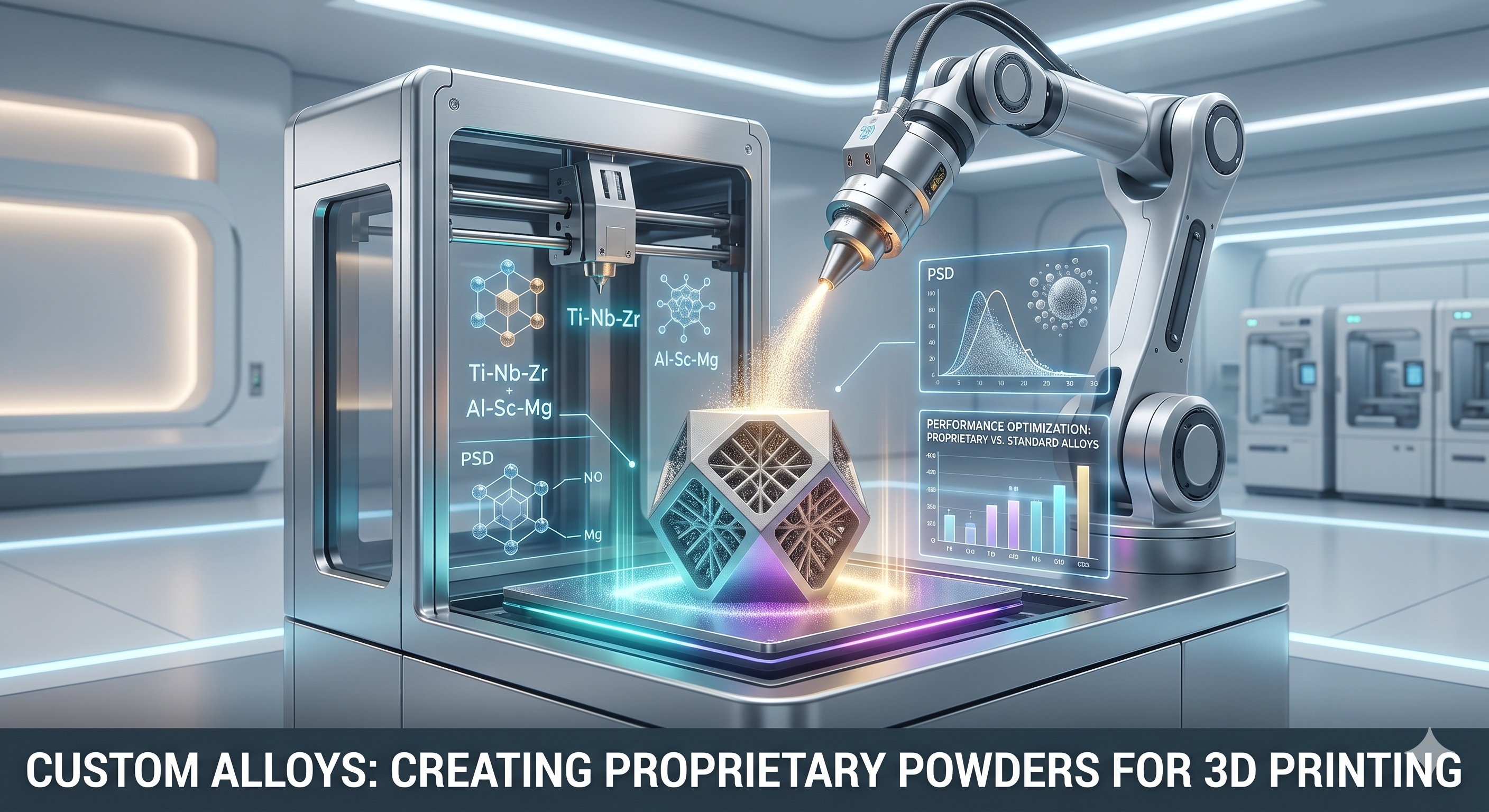
The next frontier of manufacturing is not just faster printers; it is the creation of proprietary custom alloys. By engineering materials from the atomic level specifically for additive manufacturing, companies are unlocking performance characteristics previously thought impossible, such as fivefold strength increases in aluminum or metallic implants that mimic the elasticity of human bone. This blog explores the science behind proprietary powder creation, latest breakthroughs in aerospace and medical sectors, and the balance of risk in adopting these revolutionary materials.
1. The Science of the Melt Pool: Why We Need New Alloys
To understand why custom alloys are necessary, we must understand the environment inside a metal 3D printer. Whether using Laser Powder Bed Fusion (L-PBF) or Directed Energy Deposition (DED), a high-powered laser or electron beam melts a tiny area of powder, creating a melt pool that solidifies almost instantly as the beam moves on.
Standard alloys, when exposed to this rapid heating and cooling cycle, often suffer from:
-
Hot Cracking: The rapid solidification causes some elements to solidify faster than others, leading to shrinkage and tears within the material.
-
Anisotropy: The crystal structures grow vertically, in the direction of the print, making the part stronger in one axis than another.
-
Microstructural Defects: Unwanted phases or structures can form, degrading the material’s fatigue strength or corrosion resistance.
By designing custom alloys, material scientists can introduce elements that control the grain growth, stabilize desired phases, or use the rapid solidification to their advantage, creating unique microstructures that cannot be achieved by casting.
2. Aerospace Breakthroughs: Making Aluminum Stronger than Steel
The aerospace industry has been the most aggressive adopter of proprietary powders, driven by the constant need for lightweighting. Aluminum is the obvious candidate, but traditional high-strength aluminum alloys (like the 7000 series used in wing structures) are notorious for hot cracking during 3D printing.
The Rise of Nanoparticle Functionalization
A pivotal breakthrough came from researchers at HRL Laboratories and later popularized by Nature and Nature Communications. They developed a proprietary technique called Nanoparticle Functionalization. Standard, gas-atomized aluminum powder is coated with a microscopic layer of zirconium-based nanoparticles. As the laser melts the powder, these nanoparticles act as “nucleation sites,” promoting the growth of fine, spherical crystal grains rather than long, weak column grains.
Recent 2025-2026 Research
As of 2026, scaled production of these “print-safe” high-strength aluminums is mainstreamafying. Proprietary alloys such as Scalmalloy® (a scandium-magnesium-aluminum alloy developed by APWORKS, an Airbus company) are seeing widespread use. Scalmalloy utilizes scandium to create very fine grains during solidification, resulting in an aluminum part that is lightweight yet possesses tensile strength exceeding some steels (550-600 MPa).
3. The Medical Revolution: Customized Biomechanics
The medical sector is using custom alloys not just for strength, but to improve biocompatibility and biomechanics.
The Elasticity Mismatch Problem
Traditional orthopedic implants (hips, knees) are made from Grade 5 Titanium. While Grades 5 is biocompatible, it is significantly stiffer than human trabecular bone. This causes stress shielding: the stiff titanium implant takes all the mechanical load, and the surrounding bone, no longer needed, begins to atrophy and dissolve. This can lead to implant loosening and painful revision surgeries.
Custom Alloys Mimicking Bone
Clinical preparatory trials and biomechanical studies, including data published throughout 2025 and early 2026 on Ti-Nb-Zr (Titanium-Niobium-Zirconium) and Ti-Nb-Mo-Zr systems, are showing extraordinary promise. These custom \beta-type titanium alloys are designed from the ground up for low stiffness (low Young’s Modulus).
While Grade 5 Titanium has an elastic modulus of ~110 GPa, new proprietary β-Ti-Nb-Zr alloys can achieve moduli between 40-60 GPa, much closer to that of trabecular bone (10-30 GPa). Clinical outcomes reported from short-term dental implant validations confirm functionally viable, mechanically robust implants that promote healthy bone remodeling without stress shielding.
4. The Path to Creation: Atomization and Powder Quality
Once a unique alloy chemistry is modeled (often using AI and computational materials modeling), it must be turned into powder. The process is known as atomization.
-
Melting: The proprietary ingot is melted, sometimes under vacuum.
-
Disintegration: A high-pressure stream of inert gas (Argon or Nitrogen) is used to disintegrate the molten metal stream.
-
Solidification: The molten droplets solidify into spherical particles as they fall.
The quality of this powder is paramount. For high-stakes applications, the powder must be:
-
Spherical: Required for good flowability in the printer bed.
-
Free of Inclusions/Porosity: Tiny voids inside the powder particles will translate to voids in the final printed part.
-
Certified Purity: Strict control over oxygen, nitrogen, and carbon content is crucial.
5. Advantage vs. Risk: A Critical Assessment
Adopting proprietary powders offers revolutionary rewards but entails significant engineering and economic risks.
The Advantages
-
Programmable Performance: Materials can be tailored to be exceptionally strong, elastic, chemically resistant, or thermally stable, specifically where needed in the part.
-
Monolithic Consolidation: Entire systems, such as heat exchangers, can be printed as a single monolithic unit from a material optimal for heat transfer.
-
Competitive Advantage: A company with a proprietary powder that halves the weight of a rocket engine bracket has an immediate market edge.
The Risks and Challenges
-
Supply Chain Volatility: If a component is certified to use only one specific vendor’s proprietary powder, the entire production line is vulnerable to supply chain disruptions.
-
Cost: Gas atomization is expensive, and proprietary powers can cost 3-5 times more than standard alloys due to R&D costs and low production volumes.
-
Certification Hurtles: Certifying a new material for flight-critical or patient-implantable parts is mathematically taxing. It requires extensive destructive and non-destructive testing (NDT) across multiple print batches to establish statistical certainty.
Conclusion
The evolution of additive manufacturing has proven that a one-size-fits-all approach to materials is insufficient for the demands of 21st-century engineering. The ability to create proprietary, custom alloys from scratch is the engine that will drive 3D printing from a prototyping curiosity to a standard of excellence for production-grade, functional components. Whether it is a Scandium-Aluminum alloy for the next generation of spacecraft or a Titanium-Niobium dental implant that fuses harmoniously with the jawbone, proprietary materials are crafted at the atomic level to engineer a future where materials are as customized as the designs they materialize.