
Recently added item(s)
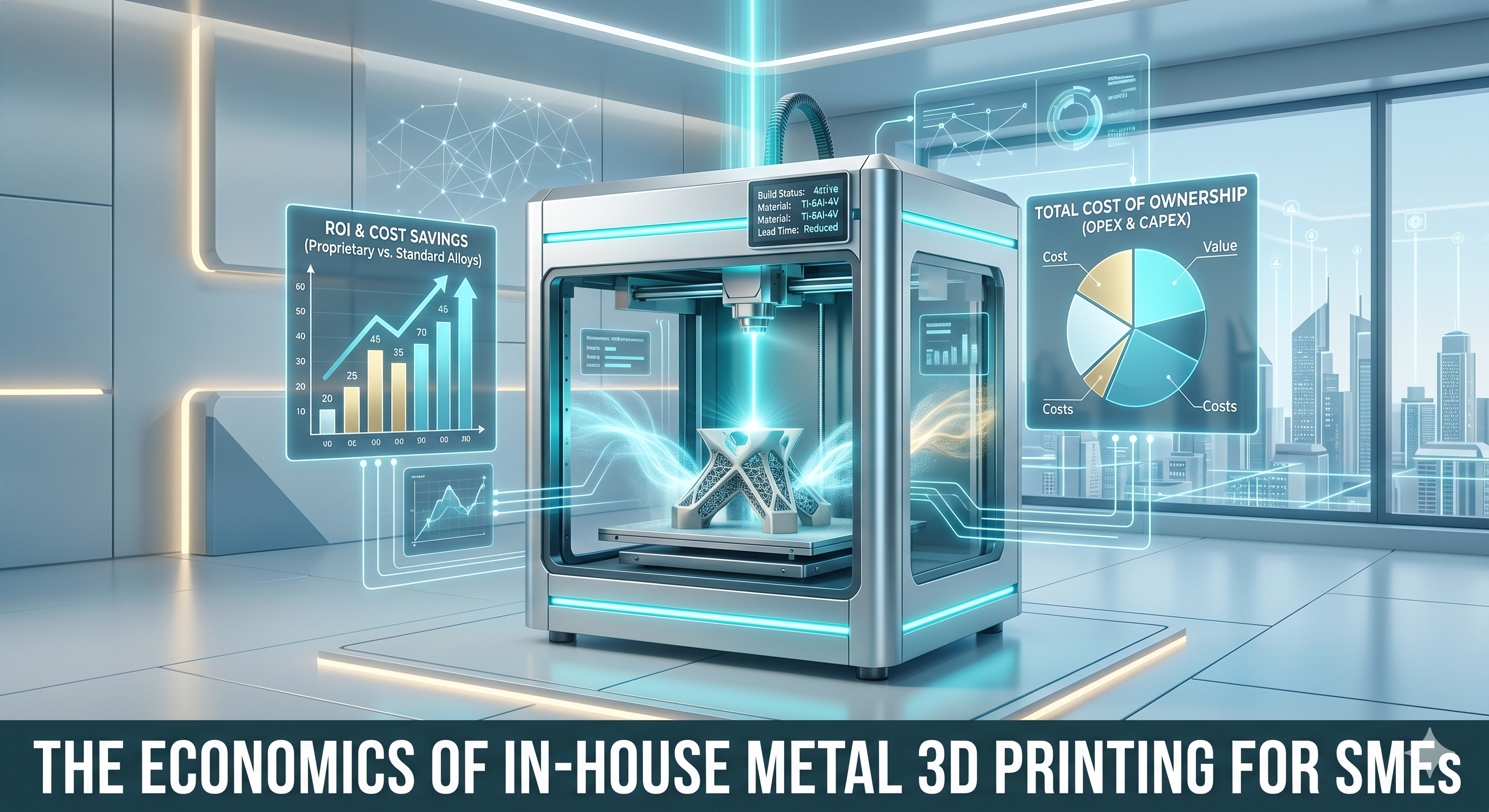
For decades, metal additive manufacturing (AM) was the exclusive playground of Fortune 500 giants. Companies like GE Aviation and Siemens had the deep pockets required to install multi-million dollar machines, build specialized facilities, and hire teams of Ph.D. material scientists. However, as we move through April 2026, the narrative has shifted. Small and Medium-sized Enterprises (SMEs) are now standing at a crossroads: Should they continue to outsource their metal parts to service bureaus, or is it finally time to bring metal 3D printing in-house?
The decision is no longer just a technical one—it is a complex economic equation. This blog explores the Total Cost of Ownership (TCO), the hidden operational risks, and the strategic ROI of in-house metal AM for the modern SME.
1. The 2026 Entry Landscape: Breaking the CAPEX Barrier
The primary barrier to entry has always been the initial Capital Expenditure (CAPEX). In the early 2020s, a reliable industrial Powder Bed Fusion (PBF) system rarely cost less than $500,000. By 2026, two distinct paths have emerged for SMEs:
The “Office-Friendly” Path: Bound Metal Deposition (BMD)
BMD and Metal Fused Filament Fabrication (MFFF) systems have seen a price collapse. These machines don’t use loose powders; they use metal-infused plastic filaments.
-
Cost: Between $60,000 and $150,000.
-
Economic Advantage: They don’t require the intense safety infrastructure of powder systems (no explosion-proof rooms).
-
The Catch: Parts shrink significantly during the furnace debinding and sintering phase, requiring advanced software to predict the final geometry.
The Mid-Range Industrial Path: Compact L-PBF
Recent research in late 2025 has led to the rise of “Compact Laser Powder Bed Fusion” (L-PBF) systems. These are smaller-format industrial machines designed for the SME shop floor.
-
Cost: Between 200,000 and 350,000.
-
Economic Advantage: They offer the same material properties as the million-dollar machines but in a smaller build volume (approx. 100mm to 150mm cubes).
2. Operational Expenditure (OPEX): The “Inkjet Printer” Trap
One of the most frequent mistakes SMEs make is focusing solely on the machine’s price tag. In metal AM, the “ink” (the metal powder or filament) is where the long-term economics are won or lost.
Material Costs
As of 2026, standard 316L Stainless Steel powder costs approx. $80–$120 per kg, while Aerospace-grade Titanium (Ti-6Al-4V) can command $250–$500 per kg. For an SME, the “buy-to-fly” ratio is crucial. While traditional CNC machining might waste 80% of a titanium block as chips, AM uses nearly 95% of the powder. However, the energy required to melt that powder is significant, adding to the per-part cost.
The Facility Hidden Costs
Metal powders are reactive and potentially explosive. Bringing metal PBF in-house requires:
-
Inert Gas Infrastructure: Constant streams of Argon or Nitrogen.
-
Specialized HVAC: To prevent nanoparticle inhalation.
-
Post-Processing Equipment: A 3D printer only makes a “near-net-shape.” You still need wire EDMs or bandsaws to remove parts from the build plate and CNC mills to finish critical surfaces.
3. Strategic Advantages: Beyond the Per-Part Cost
If you look strictly at the cost of a single bolt, CNC machining will almost always win. The economic case for an SME to bring metal AM in-house is built on strategic value, not just unit price.
Lead Time Reduction
Outsourcing a metal part to a service bureau in 2026 typically involves a 3-to-5 week lead time. For an SME sub-contractor, being able to print a replacement tool or a functional prototype in 48 hours can be the difference between winning a contract and losing it.
Intellectual Property (IP) Protection
In a globalized economy, sending a revolutionary CAD file to an external vendor is always a risk. Keeping the printer in-house ensures that proprietary “secret sauce” designs never leave the company’s local network.
Design Freedom and Part Consolidation
AM allows for “topology optimization.” An SME can replace an assembly of 10 parts (requiring 10 different inventories and 10 sets of labor) with a single, complex 3D-printed component. The economic saving here isn’t in the material—it’s in the elimination of assembly labor and inventory management.
4. Clinical and Specialized Case Studies
The medical and dental SME sectors provide the most compelling ROI data for in-house AM as of 2025-2026.
Clinical Study: Custom Orthopedic Implants
A 2025 multi-center study analyzed SMEs in the medical device space. Small clinics that installed in-house metal AM for custom cranial plates and spinal cages reported a 45% reduction in total surgical preparation costs.
“By printing the implant to fit the patient’s specific CT scan on-site, we eliminated the cost of ‘over-stocking’ generic sizes and reduced surgical time by an average of 20 minutes.”
Dental Labs: The Cobalt-Chrome Shift
SME dental labs have largely moved to in-house L-PBF for cobalt-chrome bridges and partial dentures. The research indicates that one small metal printer can replace three manual technicians, paying for itself in labor savings alone within 14 months.
5. Risk Assessment: Where SMEs Stumble
Despite the allure, the risks are substantial and often underestimated.
The Talent Gap
The “Skills Gap” is the #1 reason for in-house AM failure. You cannot simply hand a metal 3D printer to a traditional machinist and expect success. It requires knowledge of DfAM (Design for Additive Manufacturing)—understanding how to orient parts to manage thermal stresses and minimize supports. If an SME doesn’t invest in training, their “investment” will sit idle.
Certification and Quality Assurance (QA)
For SMEs in aerospace or medical sectors, the machine is only half the battle. You must prove to regulators (FAA, FDA, EASA) that your in-house process is consistent. The cost of Non-Destructive Testing (NDT), such as micro-CT scanning or X-ray inspection, can sometimes exceed the cost of the printer itself.
Health and Safety: Nanoparticle Exposure
A significant body of environmental health research from 2024–2025 has highlighted the risks of nanoparticle exposure during metal powder handling. For an SME, a single workplace injury or a failure to meet OSHA/HSE standards for air quality can result in ruinous fines.
6. The Verdict: Is It Worth It?
The economics of in-house metal 3D printing for SMEs in 2026 boil down to a simple threshold: Complexity and Criticality.
-
DON’T bring it in-house if: You are printing simple parts in high volumes, or if your annual outsourcing spend is less than $100,000.
-
DO bring it in-house if: You deal with highly complex geometries, require “just-in-time” spare parts, or operate in a niche medical/aerospace field where lead time and IP protection are your primary competitive advantages.
Advantage-Risk Summary Table
| Category | Advantage | Risk |
| Financial | Long-term material savings; zero assembly labor. | High CAPEX; high maintenance/gas costs. |
| Operational | 48-hour lead times; supply chain independence. | High failure rates without skilled DfAM engineers. |
| Strategic | IP protection; part consolidation. | Regulatory certification hurdles (FDA/FAA). |
| Health | Localized manufacturing. | Nanoparticle and explosive powder hazards. |
Conclusion
The “Rise of the Micro-Factory” is here. While the path is littered with hidden costs—from Argon gas to specialized labor—the strategic flexibility offered by in-house metal 3D printing is becoming a necessity for SMEs that want to remain relevant in a high-speed, decentralized manufacturing world. By 2030, the SME that cannot “print on demand” may find itself as obsolete as the firm that refused to adopt CNC machining in the 1980s.