
Recently added item(s)
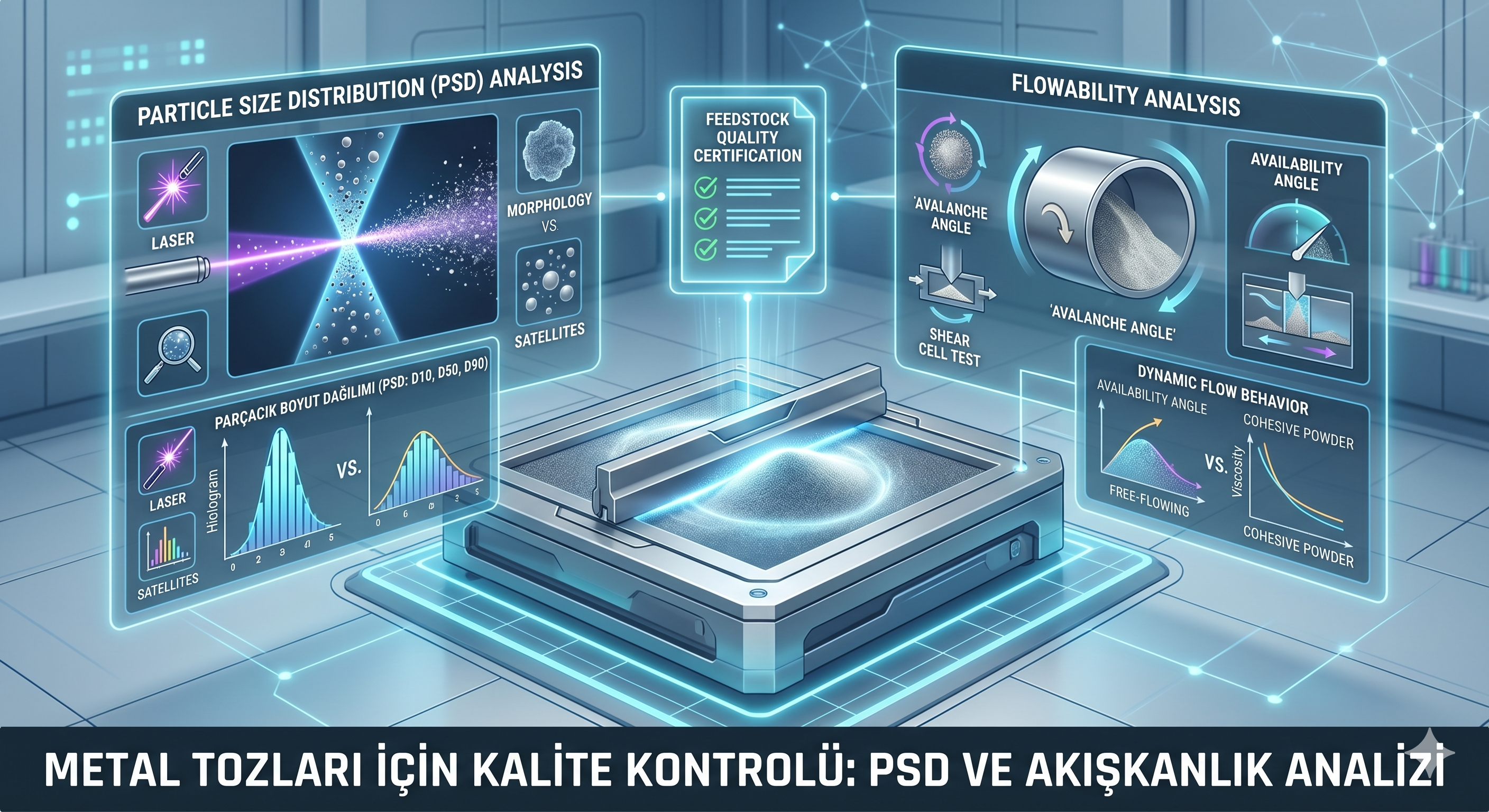
The industrial landscape is undergoing a quiet revolution, fueled by the rapid ascent of Additive Manufacturing (AM)—more commonly known as 3D printing. In sectors ranging from aerospace to personalized medical implants, 3D printers are crafting complex components from metal feedstocks. However, a 3D printer is only as good as the material it uses. If the metal powder feedstock is inconsistent, contaminated, or improperly characterized, the resulting part will fail, potentially with catastrophic consequences in high-stakes applications.
This is where Quality Control (QC) for metal powders becomes paramount. Two of the most critical parameters that dictate powder performance are Particle Size Distribution (PSD) and Flowability. They are the gatekeepers of final product integrity. Rigorous analysis of these properties ensures that the feedstock can spread uniformly into thin layers and sinter or melt predictably, building parts that meet strict engineering standards.
The feedstock problem: Why powders matter
Unlike traditional subtractive manufacturing, where you shave material off a standardized bar of steel or aluminum, AM builds up from nothing, using billions of microscopic metal particles. These powders, typically produced by gas or plasma atomization, are complex granular systems. Each batch can differ in chemistry, morphology (shape), and internal porosity.
In Powder Bed Fusion (PBF), the most dominant metal AM technology, a laser or electron beam melts thin layers of powder. For this process to succeed, the powder must be spread perfectly smooth across the build platform by a recoater blade. If the powder doesn’t flow well, it might clump, drag, or leave voids, creating defects in the final part. The powder also needs to pack densely. If there are too many gaps between particles, the finished component will have lower density and reduced mechanical strength.
QC protocols are designed to manage this complexity, turning unpredictable granular material into a reliable industrial feedstock.
headliner 1: The Spectrum of size—Particle Size Distribution (PSD)
Particle Size Distribution is not just a measure of the “average” size of the particles in a batch; it is a full characterization of the spectrum of sizes present. You might have two powders with the same mean diameter, but one has a narrow range of sizes (highly standardized) while the other has a very broad range (containing both fine dust and oversize “boulders”). They will behave entirely differently in a printer.
PSD is crucial for several reasons:
-
Layer Packing Density: To achieve a fully dense metal part, the particles need to pack tightly. Ideally, a blend of sizes allows smaller particles to fill the gaps between larger ones. A wider PSD often improves packing density but might penalize flowability.
-
Melt Pool Behavior: Smaller particles melt faster than larger ones. If the PSD is too broad, some fine particles might vaporize while larger particles in the same area remain un-melted, causing defects.
-
Flowability Influence: Fine particles (< 15 microns) have a high surface-area-to-volume ratio, making them highly cohesive due to Van der Waals forces. They tend to clump, degrading the flow.
Measurement methodologies
The industry uses several established standards (such as ASTM B822) to determine PSD:
-
Sieving: The oldest and simplest method. Powder is shaken through a stack of meshes with decreasing opening sizes. It is effective for larger particles (> 45 microns) but impractical for AM powders, which often have significant fractions below this size.
-
Laser Diffraction: Currently the industrial standard. A laser beam passes through a dispersed powder sample. Particles diffract or scatter the light at angles inversely proportional to their size. Software analyzes the resulting scattering pattern to calculate the PSD based on volume. It’s fast and automated, though it assumes all particles are perfect spheres.
-
Dynamic Image Analysis (DIA): An increasingly popular method. Powder falls or is conveyed past a high-speed camera. The system takes thousands of images, analyzing each particle for multiple size parameters (width, length, area) and shape factors (sphericity). DIA provides a much more detailed view than laser diffraction, particularly for detecting non-spherical contaminants or agglomerates.
headliner 2: The Art of Moving—Flowability Analysis
Powder flowability is the ability of a material to flow consistently and smoothly, primarily under the influence of gravity. It is not a single inherent property but a complex “rheological” behavioral parameter, dependent on an interplay of size, shape, surface texture, and moisture content.
Good flowability is non-negotiable for AM because it directly dictates the recoating process. If the powder does not spread uniformly, you get uneven layers, localized flaws, dimensional inaccuracies, and poor surface finish.
Factors affecting flow
-
Shape: Spherical particles flow best because they have minimal inter-particle friction. Irregular, satellite-laden, or rod-shaped particles lock together, resisting flow. Gas and plasma atomization aim for high sphericity for this reason.
-
PSD (Fines Fraction): As mentioned, excessive fine particles increase cohesion, making the powder “sticky.” Standard specification for AM powders often limits the fraction below a critical threshold (e.g., < 15 or < 20 microns).
-
Surface Condition: Rough surfaces increase friction. Furthermore, excessive moisture or static charge can cause particles to cling together, degrading flow. This is why powder storage in controlled environments is vital.
Testing flow behavior
The industry struggles with flowability standardization because simple tests don’t always predict PBF machine behavior.
-
Standard Funnel Tests (Hall/Carney Flowmeters): The legacy standard (ASTM B213). You measure the time it takes for 50 grams of powder to flow through a standard funnel with a defined orifice. It is quick, cheap, and gives a “go/no-go” signal for free-flowing powders. However, it fails for more cohesive or recycled powders, giving no useful data when the powder bridges the orifice.
-
Rotating Drum Rheometers (Dynamic Flow): A more advanced and representative technique for AM spreading. A drum containing a fixed volume of powder rotates. A camera records the movement, and software analyzes parameters like the Avalanche Angle—the maximum angle the powder tumbles to before collapsing. A lower angle means easier flow. This dynamic measurement better simulates the shearing action of the recoater blade.
-
Powder Shear Cells: These measure the flow behavior under consolidated stress, which is more applicable to how powder behaves when packed in a hopper or feeder than when being spread in a thin bed.
Recent developments and performance studies
Recent academic research and clinical-preparatory validations (testing finalized devices) have focused on powder recycling—the practice of sieving and reusing unfused powder after a build. This is essential for economic viability but presents a major QC challenge.
Current Research Spotlight: Powder Reuse and its Biological Impact
Studies performed on recycled Titanium (Ti-6Al-4V) powder for orthopedic implants (2024–2025) have provided crucial insight into finished part reliability. Researchers investigated how multiple reuse cycles affect finished medical devices. They found that each recycling step subtly alters the feedstock:
-
Fines Fraction Shift: Repeated sieving can remove some of the cohesive “fines,” slightly improving the flowability but potentially altering packing density.
-
Oxygen Pickup: Molten spatter or hot powder exposed to trace oxygen in the chamber can form oxide layers. This oxygen “pickup” can reduce ductility and fatigue strength in high-performance parts.
-
Contaminant Buildup: Recycled powder can accumulate non-spherical particles (satellites broken off or agglomerates).
Performance studies on finished medical implants manufactured from multiple grades of recycled powder found that while static strength usually remains within acceptable limits, the finished fatigue performance can degrade faster if the recycled powder has significantly changed chemistry (oxygen) or contains localized micro-defects from poor flow. Rigorous PSD and flowability metrics on every recycled batch are becoming standard specification for critical components.
Advancement in Automated Imaging
Another area of development is automated imaging in QC. Newer DIW (Dynamic Image Analysis) systems can scan grams of powder in minutes, automatically classifying and counting non-spherical contaminants or agglomerates that laser diffraction might miss. The industry is pushing toward using these metrics in standard specifications for AM.
advantage-risk evaluation
Rigorous feedstock QC is not just an extra cost; it is a critical investment.
Advantage of Strict QC
-
Part Consistency and Repeatability: By controlling the input feedstock, you gain confidence that Build #1 and Build #100, made six months apart, will have the same dimensions and mechanical properties.
-
Reduced defects: Ensuring good flowability eliminates most layer-level defects (voids, clumps, unevenness), leading to higher build success rates and lower scrap rates.
-
Regulatory Compliance: In aerospace and medical sectors (FAA, FDA compliance), documented, standardized QC data for every batch is mandatory for component certification.
Risk of Inadequate QC
-
Part Failure: Contaminated, damp, or improperly blended powders can introduce hidden flaws, such as internal voids or brittle oxide inclusions, leading to part failure under load.
-
Machine Damage: A cohesive powder that clamps might cause a “recoater crash,” damaging the spreading mechanism, potentially leading to costly repairs and extended downtime.
-
Regulatory rejection: Lack of standardized QC documentation for finished biologically active medical implants can lead to regulatory amber and costly delays or rejection of the medical device for real world exposure scenario.
Conclusion
Feedstock QC is the bedrock of reliable industrial 3D printing. Understanding Particle Size Distribution and Flowability—managing predictable flow and density behavior—turning billions of chaotic granular systems into a reliable औद्योगिक material. While legacy tests like sieving and funnels have their place, the modern industrial standard requires automated laser diffraction, sophisticated Dynamic Image Analysis for shape factors, and dynamic rheometry techniques like rotating drum analysis for spreading behavior.
As new research spotlights the safety impact of recycled powders on finished medical device fatigue life, specifications are becoming stricter, mandating standardized, documented feedstock analysis standard guidelines for réal world scenario réal world scenario. Only by mastering the feedstock will Additive Manufacturing shift from prototyping to the certified production of critical, real-world components.