
Recently added item(s)
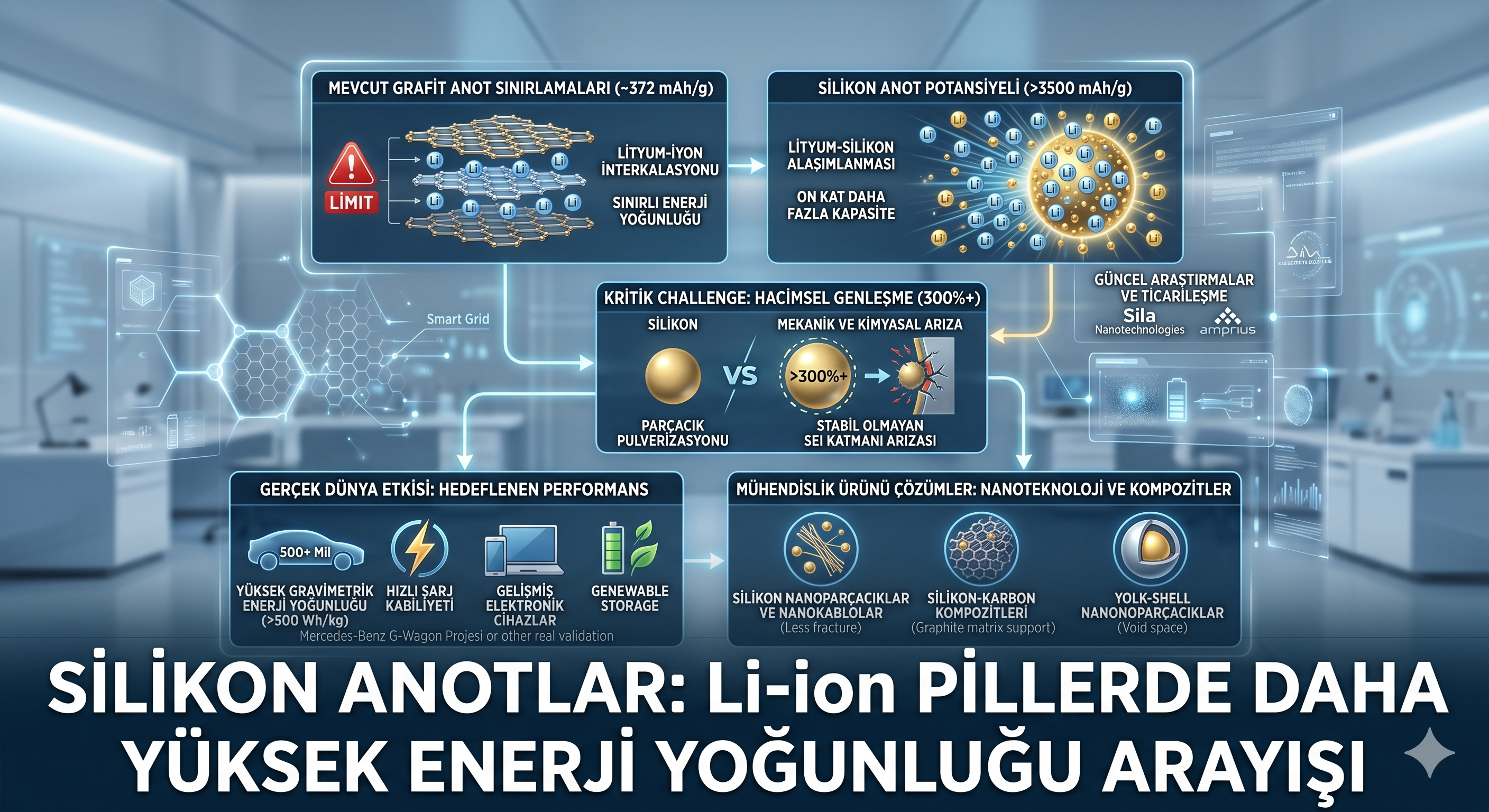
The electric vehicle (EV) revolution is here, but its ultimate success is tethered to a crucial component: the Lithium-ion (Li-ion) battery. While battery technology has improved significantly over the past few decades, we are reaching the physical limitations of current battery chemistry. The bottleneck is not the lithium itself, nor the electric motor, but the materials used to store the ions within the battery.
Currently, standard Li-ion battery anodes are made of graphite. It’s a reliable, inexpensive material that has served us well since the early 1990s. However, graphite anodes are approaching their theoretical capacity limit. To achieve the 500-mile or 1,000-mile range EVs that consumers dream of—and to power advanced consumer electronics without daily charging—we must look beyond graphite.
The search for a replacement has led global research and industry to the 14th element on the periodic table: Silicon. Silicon anodes hold the promise of revolutionizing energy density, but their journey from the lab to the road is one of the toughest engineering challenges of our time.
Defining Energy Density and the Graphite Bottleneck
To understand why silicon is so enticing, we must first understand energy density. There are two main types: Gravimetric energy density (how much energy is stored per kilogram of weight) and Volumetric energy density (how much energy is stored per liter of volume). For consumer electronics, volume is usually the constraint. For transportation, weight is crucial. Current commercial Li-ion cells typically have specific gravimetric energy densities between 250 and 300 Wh/kg. The industry goal is 500 Wh/kg or higher.
The Li-ion battery works on the “rocking chair” principle. During charging, lithium ions migrate from the positive cathode to the negative anode, where they insert themselves into the anode material (intercalation). During discharge (use), they move back to the cathode.
In a graphite anode, it takes six carbon atoms to hold a single lithium ion ($LiC_6$). This chemical formula limits graphite’s theoretical specific capacity to 372 mAh/g. We are now operating very close to this limit. Because the anode takes up considerable weight and volume inside the cell, its low capacity acts as a cap on the total energy the cell can hold, no matter how good the cathode material is.
The Silicon Promise: 10 Times More Capacity
Why Silicon? It boils down to simple atomic math. Unlike graphite, which “hosts” lithium through intercalation, silicon reacts with lithium to form an “alloy.” Instead of six silicon atoms holding one lithium ion, one silicon atom can bind with up to 3.75 lithium ions ($Li_{15}Si_4$ or $Li_{3.75}Si$).
This difference yields a theoretical specific capacity for silicon anodes of roughly 3,579 mAh/g—nearly ten times that of graphite.
If we could successfully replace graphite with silicon in the anode of a commercial EV battery cell, this could translate to an immediate 20% to 40% overall cell-level increase in energy density. That is a generational leap. Furthermore, silicon is the second most abundant element in the Earth’s crust (mostly found as sand), making it incredibly cheap and accessible globally, mitigating the geopolitical supply chain issues surrounding nickel, cobalt, and lithium.
Tampering the Beast: The Flaw of Silicon Anodes
With such overwhelming advantages, you might ask why every battery isn’t already silicon-based. The answer is a single, catastrophic engineering problem: Volumetric Expansion.
When graphite intercalates lithium, its volume changes very little, by about 10-12%. However, when silicon alloys with lithium, its structure expands like a balloon. At full lithiation, a solid silicon anode can swell by 300% to 400% of its original volume.
Imagine inflating a soccer ball inside a wire cage that cannot expand. The expansion has two devastating effects:
-
Mechanical Pulverization: As the silicon particles swell and shrink during every charge-discharge cycle, the intense mechanical stress causes them to fracture, crack, and eventually pulverize into tiny, electrically disconnected dust. Once pulverized, they can no longer store lithium, and battery capacity fades rapidly.
-
Unstable SEI Layer: This is the battery killer. The “Solid Electrolyte Interphase” (SEI) is a passive, microscopic passivation layer that naturally forms on the surface of any Li-ion battery anode during the first few charge cycles. It acts as a gatekeeper, allowing Li-ions through but stopping the liquid electrolyte from directly reacting with the anode. For a battery to have a long life, this SEI layer must be stable. In silicon anodes, the constant 300% swelling and shrinking acts like an earthquake that continuously breaks the rigid SEI layer. The electrolyte constantly reaches fresh silicon, consuming active lithium and electrolyte to form new SEI layers. This consumes the battery’s components from within, leading to early failure.
Advanced Engineering Solutions: Making Silicon Behave
This failure mechanism was discovered decades ago. Since then, the scientific community has thrown the most advanced tools of nanotechnology and polymer chemistry at the problem. We are now seeing real progress.
1. Nano-Engineering (Silicon Nanoparticles and Nanowires)
The first breakthrough came from applying nanotechnology. Researchers discovered that as silicon particles get smaller, they become less likely to fracture. If you shrink silicon down to nanoparticles (less than 100 nanometers), they can withstand the stress of full expansion without pulverizing.
Even more advanced are silicon nanowires. These one-dimensional nanostructures, often grown directly on the current collector, provide an easy path for electrons and can expand radially outward without breaking or crowding their neighbors. While effective, synthesizing nanowires is complex and expensive.
2. Silicon-Carbon Composites
The most commercially viable solution today is not 100% silicon, but a compromise: blending small amounts of silicon into a stable graphite matrix. In these Silicon-Carbon (Si-C) composites, the graphite acts as a stable conductive skeleton that absorbs some of the expansion stress and provides an electron pathway, while the silicon nanoparticles “boost” the capacity. Many commercial EV batteries today secretly use small amounts (typically <10%) of silicon oxide ($SiO_x$) or Si-C composites to boost range slightly.
3. Hollow and Yolk-Shell Nanostructures
A fascinating recent development in research is the “Yolk-Shell” nanoparticle. Instead of a solid nanoparticle, researchers have created hollow carbon spheres that have a silicon nanoparticle (the yolk) inside. There is a void space between the silicon yolk and the carbon shell. When the silicon lithiates, it expands to fill the void, but the carbon shell remains rigid and intact, protecting the SEI layer on its outer surface. This stabilizes the chemistry but reduces the energy density compared to a solid particle because of the empty space.
4. Advanced Elastomeric Binders
To make an anode, the active material (silicon/graphite) is mixed with a “binder” that acts as glue to stick everything together and to the current collector (copper foil). Standard graphite binders cannot cope with a 300% expansion; they snap, and the silicon particles become disconnected. New research focuses on elastomeric binders—rubber-like polymeric chains that can stretch with the silicon and shrink back during discharge, maintaining electrical contact. Self-healing binders that can repair broken links autonomously are also an active area of research.
Move Out of the Lab: Commercialization and Industry Studies
The transition from lab to “clinical studies” in battery technology—which means pilot production and road testing in prototype vehicles—is accelerating rapidly. There is a “Silicon Valley” of battery startups and established giants racing to solve the remaining cost and stability issues.
Recent Scientific Developments (2024-2025)
-
Argonne National Laboratory: Researchers have made significant strides using specialized electrolyte additives that promote the formation of a more flexible and stable SEI layer specifically on silicon, extending cycle life.
-
Stanford University (Prof. Yi Cui Group): Prof. Cui’s group, pioneers in silicon anodes, recently demonstrated a technique using a hierarchical structure that combines silicon oxide with conductive hydrogels, achieving ultra-long cycle stability (>1000 cycles) that is close to graphite standards.
Commercial Pilot and Road Trials
It is essential to clarify that “clinical studies” in batteries often refers to rigorous, long-term testing in actual application settings rather than human testing.
-
Sila Nanotechnologies: Founded by former Tesla engineers, Sila has commercialized a Si-C composite material called “Titan Silicon.” In 2024, they announced that Titan Silicon would be used in the forthcoming Mercedes-Benz electric G-Wagon, marking the first major commercial integration of a high-silicon anode material in a mass-produced, high-performance vehicle. Road testing and safety validation have been extensive.
-
Amprius Technologies: Utilizing silicon nanowire technology, Amprius has already delivered battery cells with gravimetric energy densities over 450 Wh/kg to specialized customers (drones, defense). Their current pilot-production “clinical studies” are focused on decreasing manufacturing costs to make this technology viable for standard passenger EVs.
-
Tesla: Tesla’s 4680 cell has reportedly used differing generations of silicon oxide blends. Tesla’s manufacturing studies (real-world validation tests) focus on finding the exact ratio of silicon blend that optimizes range boost against production yield and lifespan costs.
Advantage vs. Risk Assessment of Silicon Anodes
Silicon anodes are not a guaranteed slam-dunk; they represent a high-reward, high-difficulty engineering endeavor.
| Assessment Category | Key Advantages | Major Risks and Challenges |
| Performance (Cell-Level) | Significant Energy Density Increase: Potential for 20-40% overall boost. Translate to 500+ mile EV ranges or phones that last 2 days. | Stability & Lifespan: Volume expansion currently limits total cycles compared to the absolute stability of graphite. Cycle life might not meet standard EV requirements initially. |
| Material/Supply Chain | Abundance & Accessibility: Silicon is ubiquitous, eliminating geopolitical constraints faced by nickel/cobalt. It is exceptionally cheap in bulk. | Purity Constraints: High-purity nanotechnology (nanoparticles/wires) is required, which is costly and negates some of the “cheap silicon” advantage. |
| Manufacturing | Fast-Charging Potential: Silicon’s lithiation mechanism can theoretically support faster ion transport, enabling faster charging than intercalation. | Complex Manufacturing: Need for nano-synthesis, specialized binders, new electrolytes, and precise environmental control increases production cost and reduces initial yield. |
| Safety | Lower Risk of Li-Dendrites: Silicon operates at a slightly higher voltage than graphite during intercalation, reducing the risk of lithium plating and dangerous short-circuiting dendrites. | Unknown SEI Stability: If the SEI layer breaks and re-forms constantly, it consumes the cell’s active lithium and can create localized heat, though thermal runaway risks are not significantly higher than current technology. |
Future Outlook and Conclusion
Silicon anodes are no longer a theoretical research project; they are the most promising near-term technology that will bridge the gap to truly long-range electric mobility. We are currently in the Si-C composite era, where blended silicon boosts graphite capacity.
The quest is moving towards the next phase: “Si-dominant anodes,” where silicon constitutes 80% or more of the active material. Solving this requires continued advancements in self-healing binders, artificial SEI layers pre-applied in manufacturing, and advanced computational modeling to predict failure modes.
Furthermore, the simultaneous development of solid-state batteries (SSBs) may provide the ultimate home for silicon anodes. SSB’s solid electrolytes are much less reactive with silicon than liquid electrolytes, potentially solving the SEI instability issue entirely and enabling the use of high-capacity solid silicon anodes.
Silicon anodes represent the crucial technological jump. Their journey may be physically taxing, requiring atomic-scale precision, but their successful integration will mark the moment when electric vehicles finally overcome range anxiety once and for all.