
Recently added item(s)
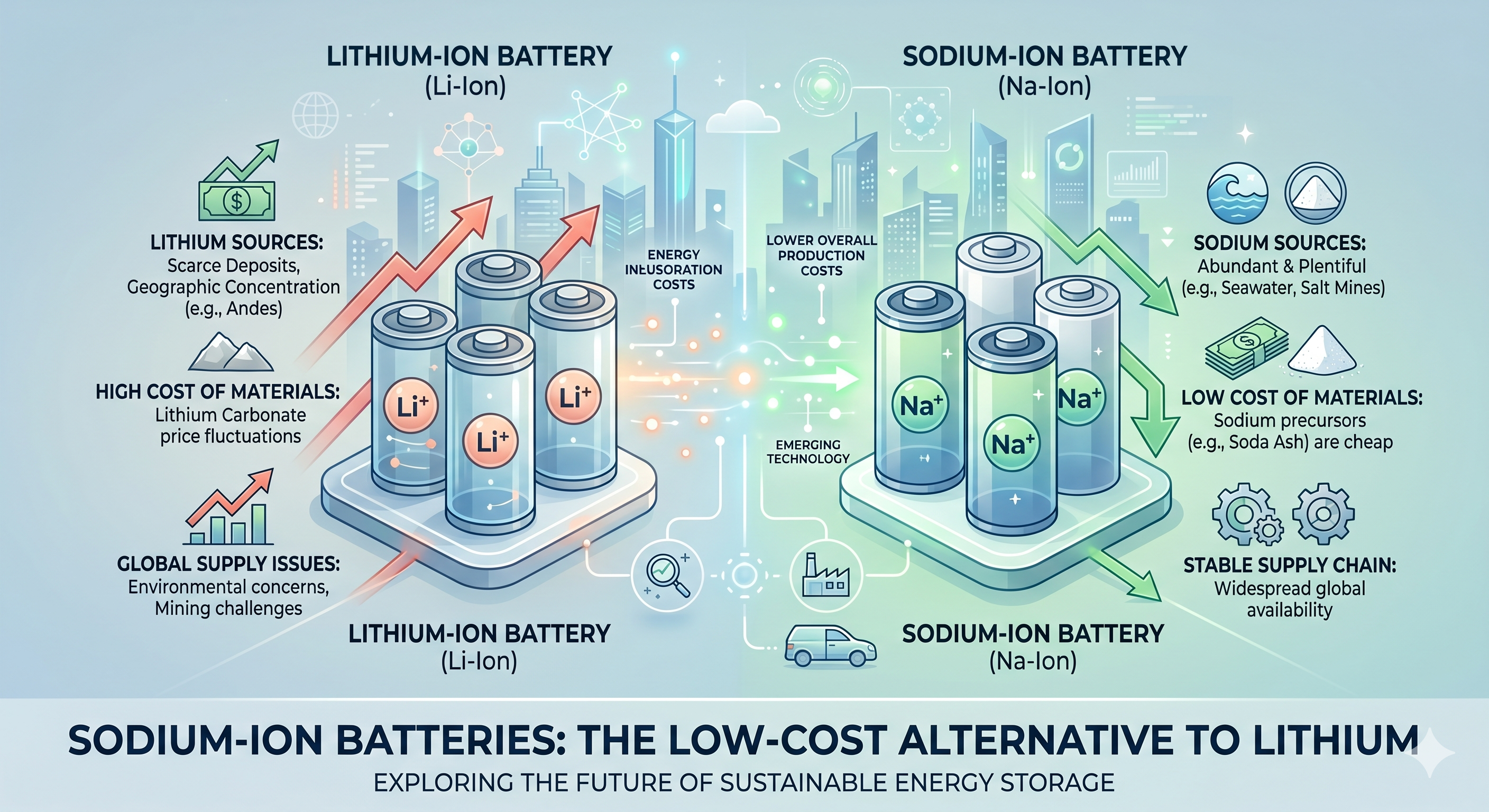
The global transition toward renewable energy and electric mobility is facing a fundamental bottleneck: the availability of raw materials. For decades, lithium-ion (Li-ion) batteries have been the undisputed champions of energy storage, powering everything from smartphones to Tesla vehicles. However, lithium isn’t perfect. It is geographically concentrated, expensive to extract, and subject to volatile pricing swings.
As the demand for energy storage skyrockets, scientists and industrial giants have turned their gaze from the scarce deposits of the Andes and Australian mines to one of the most common substances on Earth: salt. Sodium-ion batteries (SIBs) have emerged not just as a fascinating scientific endeavor, but as a mainstream-ready, low-cost strategic hedge against the lithium shortage.
This blog post explores the science behind sodium-ion technology, details the most recent industrial “clinical” trials and deployment announcements from 2026, and provides a balanced risk-reward assessment of this pivotal shift in energy architecture.
The Rocking Chair Metaphor: How Sodium-Ion Batteries Work
To understand sodium-ion technology, it helps to understand how a standard lithium-ion battery works. Both are types of rechargeable “rocking chair” batteries.
Imagine a literal rocking chair. During charging, energy drives ions (charged atoms) from one electrode (the cathode) to the other (the anode), where they are stored. The chair is “tilted.” When you discharge (use the battery), the ions slide back to the cathode, releasing that stored electrical energy. The chair rocks back.
Sodium-ion batteries operate identically, but they replace the lithium ions with sodium ions. Sodium ($Na+$) is one row below lithium ($Li+$) on the periodic table, meaning they share very similar chemical properties.
The Atomic Trade-Off: Why Size Matters
While the chemistry is similar, the physics is not. Sodium ions are fundamental heavier and larger than lithium ions.
-
Mass: Sodium is roughly three times heavier than lithium (atomic mass of 23 amu vs. 7 amu).
-
Radius: Sodium ions are fatter.
These difference seems trivial until you try to pack thousands of them into a tight space within a battery’s electrodes. This creates the primary technological challenge: SIBs are less space-efficient, resulting in a lower energy density compared to the best lithium-ion counterparts.
The Compelling Case for Sodium: Advantages Over Lithium
If sodium is heavier, larger, and less dense, why is the world investing billions in its deployment? The answer lies in economics, sustainability, and sheer abundance.
1. Inexhaustible and Geographically Diverse
Sodium is the sixth most abundant element in the Earth’s crust and is ubiquitously distributed in oceans and salt deposits worldwide. You can extract sodium from almost anywhere with a smaller environmental footprint than lithium extraction, which requires damaging evaporation ponds or complex hard-rock mining. This diversity creates energy security, decoupling the battery supply chain from geopolitical tensions.
2. Dramatic Cost Potential
The single most attractive feature of SIBs is cost. While Lithium Carbonate pricing has been volatile, peaking at exorbitant highs, sodium precursor materials (like soda ash) are commodities traded at a fraction of the cost. A finalized sodium-ion cell, when manufactured at scale, is projected to be significantly cheaper than a comparable Lithium Iron Phosphate (LFP) cell.
3. Superior Low-Temperature Performance
Unlike standard Li-ion batteries that lose substantial capacity when the temperature drops below freezing, SIBs excel in the cold. Recent research in 2026 confirms that second-generation sodium-ion cells can retain around 90% of their nominal capacity at temperatures as low as -40°C. This makes them ideal for grid storage in Nordic regions or electric vehicles in cold climates.
4. Safety and Thermal Stability
Because sodium chemistry is naturally more thermally stable, SIBs exhibit a reduced risk of thermal runaway (battery fires) compared to standard Nickel-Manganese-Cobalt (NMC) lithium batteries. Their optimized electrolytes also have higher flashpoints.
Breaking Ground: Commercial Trials and Deployment (2026)
For years, sodium-ion was a promising concept relegated to university labs. By 2026, the discussion shifted definitively to factory pilot lines and utility-scale “clinical trials”—industrial-scale deployments that prove durability in real-world scenarios.
CATL and the 60 GWh Grid Storage Breakthrough
The world’s largest battery manufacturer, CATL, has been a central driver of the sodium economy. In April 2026, CATL announced one of the largest sodium-ion contracts to date: a strategic agreement to supply 60 GWh of sodium-ion batteries over three years to HyperStrong, a leader in energy storage system integration.
This contract is crucial because it targets stationary energy storage systems (ESS) at the utility level. In grid storage, energy density is less vital than cycle life, safety, and operational cost over 20 years. CATL’s energy storage sodium-ion cell is a 300+ Ah large-format product that achieves an energy density of about 160 Wh/kg but boasts a cycle life exceeding 15,000 cycles at 80% capacity retention—rivaling premium LFP grid batteries while being significantly cheaper.
BYD and Urban Mobility
CATL’s rival, BYD, confirmed 2026 deployment targets for its third-generation sodium-ion platform. BYD is focusing its initial efforts on low-range urban mobility: city cars, delivery vehicles, and scooters. These applications prioritize cost-efficiency and safety over maximum range, making them perfect candidates for SIB adoption.
Balanced Assessment: Risks and Challenges
Sodium-ion batteries are not a silver bullet that will immediately replace lithium everywhere. Significant scientific and economic roadblocks remain.
The Problem of “Volumetric Expansion” (Cycle Life)
Because sodium ions are larger, they put massive physical stress on the anode structure when they slide in (intercalation) during charging. In some anode materials, this causes the electrode to swell and contract like a lung, but so violently that it cracks the crystal structure after many cycles.
While research into specialized “hard carbon” anodes has partially solved this, balancing volumetric expansion with high reversible capacity remains the “Holy Grail” of SIB research.
Initial Manufacturing Costs
While the raw materials for SIBs are dirt cheap, the initial manufacturing cost of the finalized cell is not—yet. Mass-producing batteries requires immense economies of scale. Lithium manufacturing lines have 20 years of optimization behind them. Achieving the theoretical price advantage requires sodium manufacturers to build massive factories, a risky capital investment when lithium prices are temporarily low.
Risk vs. Reward Evaluation
| Feature | Sodium-Ion Battery (SIB) | Lithium-Ion (LFP) | Lithium-Ion (NMC) | SIB Risk Assessment |
| Abundance | Very High (Sixth in crust) | Very Low (Concentrated) | Low-Medium (Cobalt concerns) | Low Risk |
| Material Cost | Extremely Low (Salt) | High | Very High (Nickel, Cobalt) | Low Risk |
| Energy Density | Low-Medium (~140-160 Wh/kg) | Medium (~170-200 Wh/kg) | High (~250-300+ Wh/kg) | High Technological Risk |
| Cold Weather | Superior (-40°C performance) | Poor (<0°C degradation) | Moderate (-10°C degradation) | Low Risk (Win) |
| Safety | High Thermal Stability | High Thermal Stability | Moderate Thermal Runaway Risk | Low Risk |
| Supply Chain Security | Excellent (Global distribution) | Poor (Andean, Australian focus) | Poor (NMC volatility) | Low Risk |
| Commercial Maturity | Emerging/Scaling (Stationary) | Fully Commercialized (Mobility/Stationary) | Fully Commercialized (High-End Mobility) | Medium Economic Risk |
The Verdict: Coexistence, Not Replacement
Sodium-ion batteries will not replace lithium in premium, long-range electric vehicles or high-performance electronics where weight is the defining constraint. In these sectors, lithium is king.
However, sodium-ion technology is poised to dominate the stationary storage market (grid ESS) and the mass-market urban mobility sector.
By 2030, we will likely see a tiered battery ecosystem. Premium EVs will use optimized lithium or emerging solid-state cells. Standard grid storage and affordable city cars will be “Powered by Salt,” utilizing sodium-ion technology to deliver reliable, safe, and dramatically cheaper energy to the world.