
Recently added item(s)
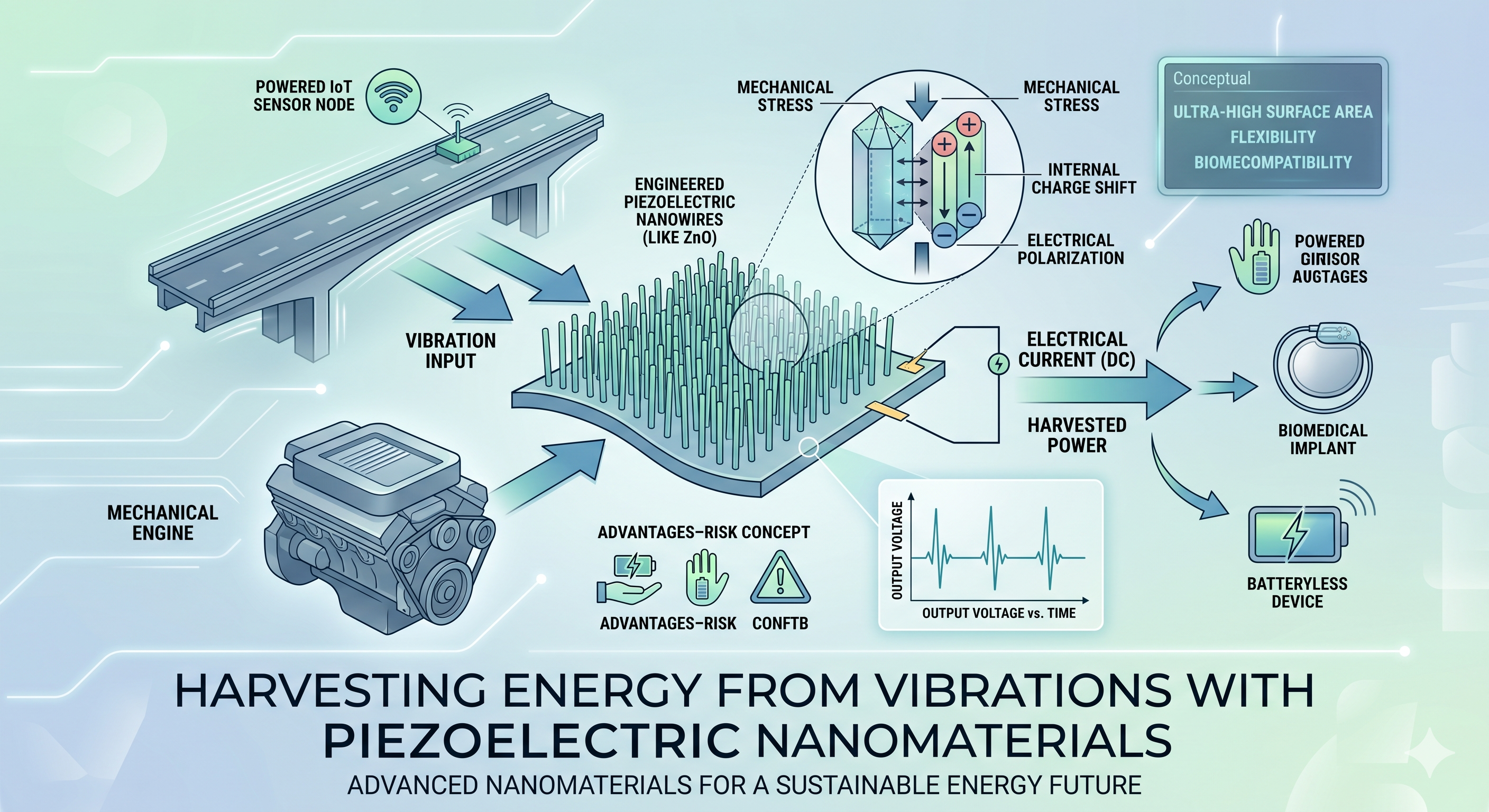
We live in a noisy, trembling world. From the humming of industrial machinery and the traffic shaking a bridge to the gentle rhythm of your own footsteps or heartbeat, our environment is saturated with vibrational energy. Historically, this kinetic energy has been dismissed as useless background noise or, worse, a destructive force to be dampened.
However, a revolutionary shift in materials science is occurring. Engineers are no longer trying to stop these vibrations; they are trying to “harvest” them. At the heart of this technological surge are piezoelectric nanomaterials—microscopic generators that turn physical squeeze and shake into clean electricity.
By merging the ancient science of piezoelectricity with modern nanotechnology, we are unlocking the potential to create a world where devices are eternally self-powered, medical implants never need battery replacements, and infrastructure monitors itself.
The Foundation: What is Piezoelectricity?
The word “piezo” is derived from the Greek word piezein, meaning to squeeze or press. The piezoelectric effect is a unique property found in certain crystalline materials (like quartz, specific ceramics, and some organic tissues).
At the atomic level, these materials have a non-centrosymmetric structure. Imagine the positive and negative charges are perfectly balanced when the material is static. However, when you apply mechanical stress—by squeezing, twisting, or shaking the crystal—you disturb this balance. The charges shift, creating an imbalance between the material’s surfaces. This imbalance results in a voltage potential.
The direct piezoelectric effect turns force into electricity (useful for energy harvesting). The converse effect works in reverse, turning electricity into force (useful for ultra-precise actuators). For the “Hydrogen Economy” bottleneck, we focus solely on the direct effect.
Enter the “Nano”: Why Bulk Materials Aren’t Enough
The concept of piezoelectric energy harvesting is not new. If you have ever owned a BBQ lighter that clicks loudly when pressed, you’ve used a piezoelectric ceramic. However, these traditional bulk ceramics have severe limitations for modern energy harvesting:
-
Brittleness: Like porcelain, they crack easily under high strains or repeated, rapid vibrations.
-
Rigidity: They cannot conform to flexible surfaces, such as human skin, textiles, or curved pipes.
-
Efficiency Limits: On a large scale, the surface area available to react to force is limited.
This is where nanotechnology changes the equation. By manipulating matter at the scale of atoms and molecules, scientists are crafting nanomaterials (nanowires, nanobelts, and thin films) that overcome these bulk barriers.
The Nanomaterial Advantage:
-
Exceptional Flexibility: Piezoelectric materials synthesized as nanowires are remarkably soft and can be bent repeatedly without fracturing.
-
Massive Surface-to-Volume Ratio: A forest of zinc oxide nanowires provides a huge active area to absorb tiny vibration forces, drastically boosting harvesting efficiency.
-
Higher Sensitivity: Nanostructures can respond to minute forces that a bulk ceramic would ignore, such as human pulse or acoustic noise.
Current Research Frontiers in Nanomaterials
The race to develop the perfect piezoelectric nanomaterial is intense, with research divided between inorganic (ceramic-like) and organic (polymer-like) substances.
1. Zinc Oxide (ZnO) and Lead Zirconate Titanate (PZT) Nanowires
ZnO is the most studied material for piezoelectric nanogenerators (PENGs). It is inexpensive and easy to grow into complex arrays of nanowires. ZnO is critically important for biomedical use because it is biocompatible (non-toxic to human tissue).
PZT is the titan of the ceramic world, boasting a very high piezoelectric coefficient (it generates more voltage per unit of force than ZnO). The challenge is that PZT contains lead. Recent research focuses on “encapsulating” PZT nanomaterials within biocompatible polymers to unlock their high efficiency while ensuring safety.
2. PVDF and TrFE Flexible Polymers
Polyvinylidene fluoride (PVDF) is a soft, organic polymer. While not as efficient as ceramics at charge generation, it is incredibly tough and flexible. Research is currently exploring the addition of ceramic “dopants” (like PZT or ZnO nanoparticles) into the PVDF polymer matrix to create hybrids that have organic flexibility and inorganic efficiency.
3. Emerging 2D Nanomaterials
The cutting edge of research involves atomically thin 2D materials like molybdenum disulfide (MoS₂). While primarily known for electronics, recent theoretical and lab studies show that when applied in few-layer nanostructures, these materials exhibit surprising piezoelectric properties that can be “tuned” by stretching them.
Clinical Studies and Biomedical Breakthroughs
This is where science fiction becomes reality. Energy harvesters are not just for industrial bridges; they are destined for the human body. Because standard batteries run out, thousands of patients must undergo invasive replacement surgeries every decade for pacemakers or cochlear implants. Clinicians are aggressively pursuing piezoelectric nanogenerators to create “eternal” medical implants.
Case 1: Self-Powered Pacemakers
Recent pre-clinical studies have successfully demonstrated prototype nanogenerators that harvest kinetic energy from physiological motions. One groundbreaking approach uses a highly flexible ZnO PENG encapsulated in silicon. Implanted onto the beating heart of a canine model, the device successfully generated enough power from the heart’s own contractions to drive a prototype pacing circuit. Clinicians believe this approach could be adapted for human use within the next 10-15 years, eliminating battery revision surgeries.
Case 2: Smart Stents and Bone Healing Stimulators
Research is exploring the integration of PVDF flexible harvesters into blood vessel stents. The pulsation of blood provides a continuous, high-frequency vibration. The harvester can use this to power internal pressure sensors (monitoring blood flow) or even electric stimulation circuits that prevent arterial restenosis (re-clogging). Furthermore, clinical pilots are testing thin piezo films wrapped around fractured bones; when the patient moves, the film generates micro-currents that actively speed up bone repair.
Case 3: Advanced Prosthetics
Clinical trials are also observing the use of PVDF thin films integrated into smart prosthetics. Harvesting the vibration of the foot striking the pavement, the PENG can power the embedded sensors that send feedback signals to the amputee’s nerves, creating a more responsive and “feeling” limb.
Advantage–Risk Assessment for Piezoelectric Nanomaterials
Advantages
-
True Clean Energy: The source is waste vibration. Production is zero-emission.
-
Batteries Not Included: Reduces the reliance on toxic, environmentally damaging chemical batteries and reduces e-waste.
-
Perpetual Operation: As long as there is movement (a bridge humming, a heart beating), the device has power.
-
Enabling New Tech: Critical for the Internet of Things (IoT). It allows sensors to be placed in inaccessible areas (e.g., inside a concrete bridge or deep within the body) without maintenance worries.
Risks and Engineering Challenges
-
Low Output Power: Currently, most nanogenerators produce microwatts or milliwatts. While enough for tiny sensors or pacemakers, they cannot run heavy-duty electronics. The primary challenge is increasing efficiency.
-
Lead Toxicity (PZT): The most efficient materials contain lead. Failure in encapsulation during a biomedical implant could lead to toxic exposure.
-
Fatigue Life: While flexible nanomaterials can bend, any material subjected to billions of rapid vibration cycles will eventually fail. Assessing long-term durability (over 20+ years) is difficult in short lab studies.
-
Fabrication Cost: Creating perfect, structured nanowire arrays requires sophisticated, expensive nanotechnology processes (like cleanroom lithography), making initial production costly.
Conclusion: The Quiet Revolution
We are entering the “Quiet Revolution” of energy. Piezoelectric nanomaterials allow us to seize the enormous amount of energy we currently treat as background noise. While they will not replace solar farms or wind turbines, their ability to deliver localized, perpetual, maintenance-free power is revolutionary for personalized medicine, infrastructure safety, and the ubiquitous IoT network.
The shift from fossil fuels isn’t just about changing how we power our cities; it’s about how we power the technology that keeps us healthy, safe, and connected. The shake in your pocket or the beat of your heart is no longer lost; it is the raw fuel for the future.