
Recently added item(s)
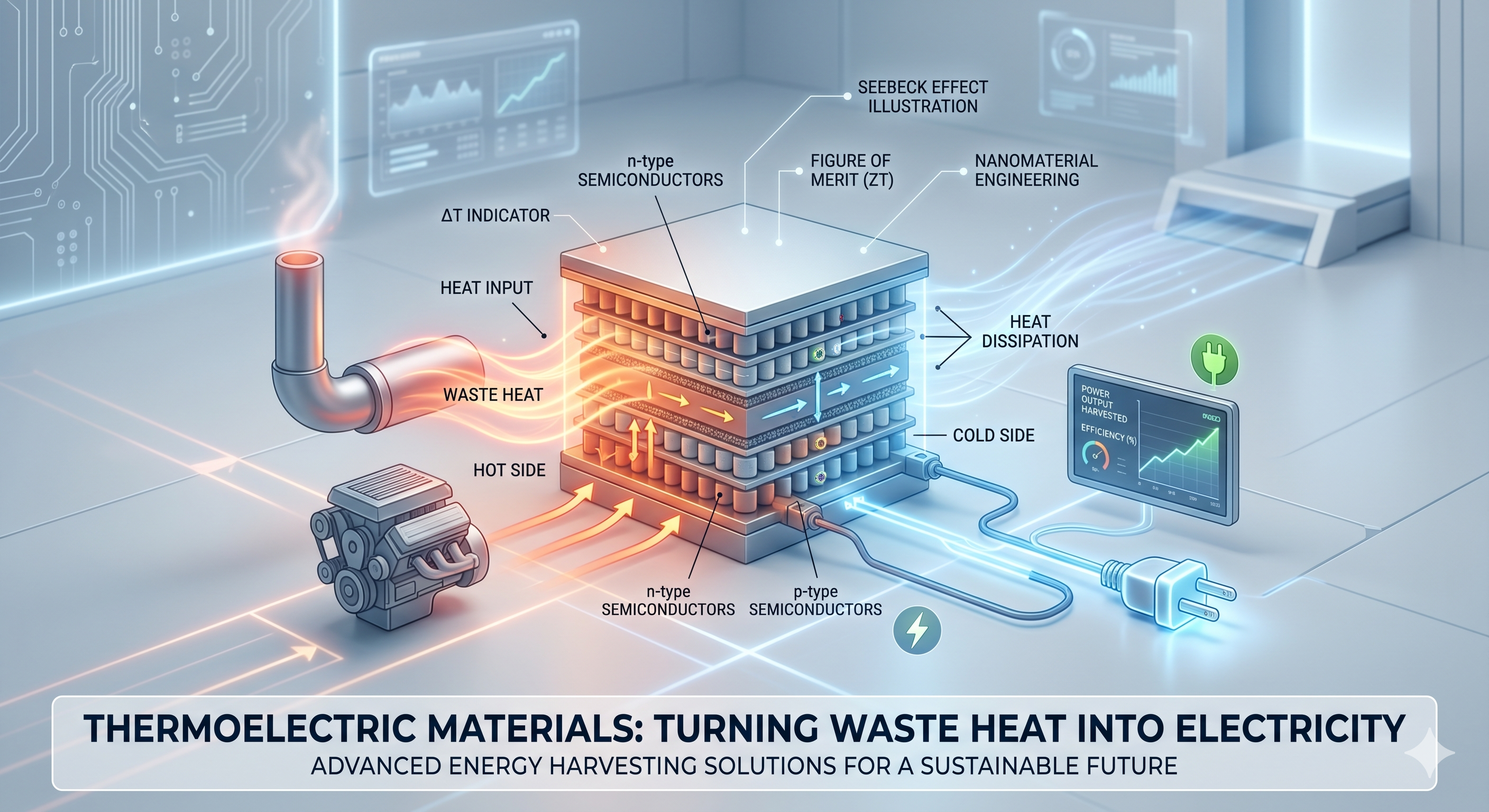
In our energy-hungry world, we are constantly searching for new, clean sources of power. While solar panels and wind turbines dominate the conversation about green energy, there is another, vastly underutilized source of power right in front of us—or rather, all around us. It is heat. Specifically, it is waste heat.
From the scorching exhaust of an automobile to the warmth radiating from a factory machine, or even the subtle heat emanating from the human body, immense amounts of valuable energy are lost every second. In fact, scientists estimate that more than 60 percent of the energy produced by human activity is lost to the atmosphere as waste heat. If we could capture even a small fraction of this lost energy, we could revolutionize the efficiency of our vehicles, industries, and electronic devices.
This is where nanotechnology and advanced materials science step in, specifically in the field of thermoelectric materials. These remarkable substances have the ability to directly convert a temperature difference into electricity, offering a silent, solid-state solution to energy harvesting.
The Magic of the Seebeck Effect: The Science Explained Simply
To understand how thermoelectric materials work, we must travel down to the atomic level. The principle guiding this phenomenon is known as the Seebeck effect, named after the German physicist Thomas Johann Seebeck, who first observed it in the early 19th century.
At its core, the Seebeck effect describes how a temperature difference creates an electrical push. Imagine a block of thermoelectric material. When one end of this material is heated, the electrons inside it gain energy and become excited. Like people crowding near a heater who want more space, these energized electrons begin to drift away from the hot end toward the cooler end.
[Image suggestion: A stylized diagram showing a block of material with ‘Hot End’ on the left and ‘Cold End’ on the right. Arrows show energized electrons (e-) drifting from hot to cold, and a voltage meter showing a charge.]
However, not all materials are good thermoelectrics. Metals, for instance, are good conductors of electricity, but they are also good conductors of heat. If you heat one end of a metal rod, the cold end heats up almost instantly, erasing the temperature difference. A good thermoelectric material must behave like an electrical conductor (allowing electrons to flow easily) but also like a thermal insulator (preventing heat from spreading).
Achieving this “conflict of interest” at the atomic level is the central challenge of thermoelectric research.
The Holy Grail: The Figure of Merit ($ZT$)
To determine how effectively a material converts heat into electricity, scientists use a single, unified scorecard known as the Figure of Merit, abbreviated as $ZT$.
The formula for $ZT$ is a bit complex, but its implications are simple:
-
High $ZT$ requires: High Electrical Conductivity ($\sigma$), High Seebeck Coefficient ($S$), and Low Thermal Conductivity ($\kappa$).
The Seebeck coefficient ($S$) represents how much voltage is produced for every degree of temperature difference. Low Thermal Conductivity ($\kappa$) is the most critical hurdle. We need to scatter the atoms vibrating in a material (which carry heat, called “phonons”) without scattering the electrons (which carry the charge).
For decades, the benchmark $ZT$ for commercial thermoelectric materials was stuck around 1.0. This level of efficiency is only sufficient for niche applications, such as powering sensors in remote locations or cooling wine bottles in small refrigerators. For thermoelectrics to make a real impact in industries or cars, we need a $ZT$ of 2.0 or higher.
Modern Marvels: Key Thermoelectric Materials
Over the past decade, nanotechnology has cracked open new doors, allowing scientists to engineer materials with properties that seem impossible at the bulk scale.
1. Bismuth Telluride (Bi$_2$Te$_3$): The Traditional Workhorse
This remains the standard material for room-temperature applications. It has been used for years in camping refrigerators and small-scale cooling devices. Current research focuses on creating nanoscale structures of Bismuth Telluride to trap phonons more effectively, pushing its $ZT$ beyond 1.5 in laboratory settings.
2. Tin Selenide (SnSe): The Unlikely Record Holder
In 2014, researchers at Northwestern University shocked the material science world by discovering that Tin Selenide (SnSe), a previously overlooked material, possessed an extraordinary thermal insulating property. Its crystal structure allows it to behave almost like an atomic-level hammock, damping down heat-carrying vibrations while allowing electrons to sail through. Recent modifications have pushed the $ZT$ of Tin Selenide towards 3.0 at high temperatures, making it a superstar for industrial waste heat harvesting.
3. Lead Telluride (PbTe) and Skutterudites
These are advanced cage-like structures capable of trapping heavy atoms within their lattices. Think of them as atomic-scale rattle boxes. The trapped atoms rattle around violently, disrupting phonons and drastically reducing heat flow. They are excellent for medium-to-high-temperature waste heat, such as in automotive exhausts.
4. Organic and Polymer Thermoelectrics: The Future of Wearables
While their efficiency ($ZT$ < 1.0) is much lower than their inorganic cousins, polymer thermoelectrics are flexible, non-toxic, and incredibly cheap to produce. They hold immense promise for wearable electronic devices that run on your own body heat.
From the Lab to the Real World: Pilot Studies and Applications
material science doesn’t generally have “clinical trials” in the way medicine does, it has pilot studies and field tests in real-world operational environments. This is where the technology must prove itself outside the controlled environment of a lab.
-
Automotive Exhaust Harvesting (Industrial Pilots): Major car manufacturers have been testing thermoelectric generators (TEGs) integrated into exhaust systems. The temperature difference between the exhaust gas (over 500°C) and the coolant can generate enough power to run the car’s electronics, reducing the load on the alternator and increasing fuel efficiency by 3-5 percent.
-
Space Exploration (Proven Application): Thermoelectrics have actually been the silent partners of deep-space exploration for decades. Space probes like Voyager 1 and the Mars Rovers use Radioisotope Thermoelectric Generators (RTGs). These devices use the heat from decaying radioactive material to create a permanent temperature difference, powering the probe for years, far from any sunlight.
-
Wearable Health Monitors: While not powered by waste heat in the traditional sense, wearable medical sensors that use organic thermoelectrics are in clinical development. These devices can operate without batteries, relying solely on the heat emanating from human skin (specifically the forehead or wrist) to provide continuous heart rate, temperature, or blood glucose monitoring.
The Crucial Assessment: Advantage–Risk Evaluation
Thermoelectric technology is not a perfect solution; it is a vital tool in a broader energy transition. Its strengths and weaknesses must be balanced carefully.
Advantages
-
Solid-State Reliability: Thermoelectric generators have no moving parts. This means they are completely silent, require virtually no maintenance, and have incredibly long lifespans (as proven by the Voyager probes).
-
Unmatched Scalability: TEGs can work at any scale. They can harvest body heat from a wrist to power a watch (microwatts) or industrial waste heat to supplement a factory’s grid (kilowatts).
-
Green Energy Optimization: It allows us to derive more useful power from the fuel we are already burning, optimizing energy efficiency and reducing the total carbon footprint without requiring new fuel.
Risks and Challenges
-
Material Toxicity and Scarcity: Many of the most efficient materials, such as Lead (Pb) or Tellurium (Te), are either toxic or extremely rare and expensive. For global, sustainable scaling, we need alternatives made from abundant, non-toxic elements like Silicon (Si) or Sulfur (S).
-
Manufacturing Complexity and Cost: Synthesizing nanoscale materials or the exotic, cage-like structures of skutterudites requires complex, expensive processing (e.g., spark plasma sintering), which keeps the cost per watt of energy generated high.
-
Low Conversion Efficiency: Commercial TEGs currently have an efficiency of only about 5-8 percent. While high, it is far lower than solar or wind. This low efficiency makes them suitable only for waste heat recovery, not for primary power generation.
Conclusion
Thermoelectric materials are giving us eyes to see the energy we have been wasting for centuries. By nanostructuring atoms to fight a tug-of-war between heat and electricity, researchers are unlocking a new, decentralized source of power.
The path forward is clear: we must move away from scarce and toxic elements and embrace the creation of silicon or polymer-based nanomaterials that are cheap, flexible, and sustainable. While they will not solve the world’s energy crisis on their own, thermoelectrics are an essential puzzle piece. They allow us to capture the invisible energy we already possess, taking us one silent step closer to a truly optimized, carbon-neutral future.