
Recently added item(s)
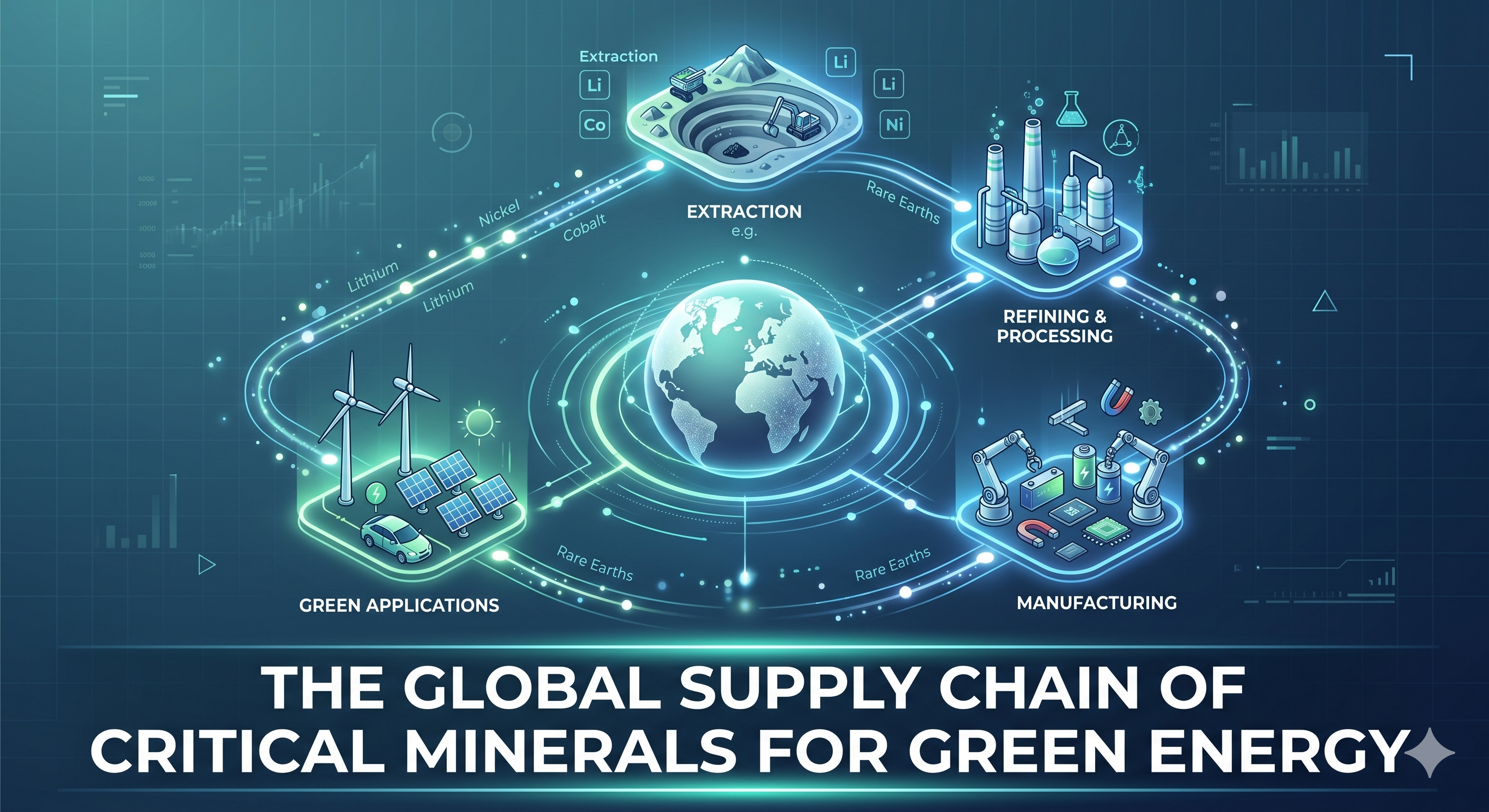
As the world reaches the midpoint of the 2020s, the global energy landscape is undergoing its most profound transformation since the Industrial Revolution. The shift from a fuel-intensive energy system—dominated by coal, oil, and gas—to a material-intensive one is no longer a future projection; it is the current reality of 2026. At the heart of this transition lies a complex, high-stakes network of mining, refining, and manufacturing known as the Global Supply Chain of Critical Minerals.
For green energy technologies to function, they require an array of “critical minerals”—a group of elements including lithium, cobalt, nickel, copper, and rare earth elements (REEs). Unlike fossil fuels, which are consumed to produce energy, these minerals are used to build the infrastructure of energy production and storage. They are the “green gold” of the 21st century, but their supply chains are fraught with geopolitical tension, environmental trade-offs, and technical challenges.
1. The Periodic Table of the Energy Transition
To understand the scale of the challenge, one must look at the specific materials required for decarbonization. According to the Global Critical Minerals Outlook 2025, the demand for key minerals continues to skyrocket.
-
Lithium: Essential for lithium-ion batteries in electric vehicles (EVs). Demand is projected to grow fivefold by 2040.
-
Cobalt and Nickel: Critical for the high-energy-density cathodes used in long-range EVs.
-
Copper: Often called the “metal of electrification,” it is indispensable for power grids, wind turbines, and solar panels. Copper markets are expected to remain extremely tight throughout 2026.
-
Rare Earth Elements (REEs): Materials like neodymium and dysprosium are used in the permanent magnets of wind turbines and EV motors.
2. Geopolitics and the Era of “Friend-Shoring”
Historically, the supply chain for these minerals has been highly concentrated. While extraction occurs globally—lithium in the “Lithium Triangle” of South America and Australia, cobalt in the Democratic Republic of Congo (DRC)—the refining and processing stage has been dominated by a few central players. In 2026, we are seeing a strategic pivot toward localization and de-risking.
The US and EU Response
In early 2025, Executive Orders like EO 14154 (Unleashing American Energy) and EO 14241 set the stage for the United States to become a leading producer and processor of non-fuel minerals. By invoking the Defense Production Act, the U.S. government has expedited permitting for domestic mines. Similarly, the European Union’s Critical Raw Materials Act aims to ensure that at least 10% of the EU’s annual consumption for extraction and 40% for processing is met within its borders by 2030.
This shift, often called “friend-shoring,” prioritizes building supply chains within allied nations to prevent disruptions caused by geopolitical conflicts or export bans.
3. Technological Innovation: Reducing Dependency
A critical area of current research involves “material substitution”—the science of building better technology with fewer scarce materials. In 2026, several industrial and material science breakthroughs are reshaping the supply chain:
Sodium-Ion Batteries
One of the most promising developments is the maturation of sodium-ion (Na-ion) battery technology. Unlike lithium-ion, these batteries use sodium—a widely available and inexpensive element found in common salt. While they currently offer lower energy density than premium lithium cells, they are increasingly being deployed for stationary energy storage and low-cost urban EVs, significantly easing the pressure on lithium and cobalt supplies.
Advanced Anodes and Graphene
Research into silicon-graphite anodes is reaching mass production. By incorporating silicon and advanced carbon nanostructures, battery manufacturers are increasing energy density and charging speeds. Furthermore, the use of graphene-enhanced materials is helping to stabilize battery chemistries, allowing for longer lifespans and reducing the frequency with which minerals must be replaced.
4. Advantage–Risk Assessment: The Dual Nature of Mining
Every advancement in green energy carries a footprint. A comprehensive evaluation of the global mineral supply chain must weigh the undeniable benefits against the inherent risks.
The Advantages: Economic and Environmental
-
Decarbonization: Without these minerals, achieving the goals of the Paris Agreement is physically impossible. They enable the transition from carbon-emitting fuels to clean electricity.
-
Energy Independence: Countries that develop domestic or secure supply chains can insulate themselves from the price volatility of the global oil market.
-
Job Creation: The transition is sparking a “mining renaissance,” creating thousands of high-tech jobs in extraction, chemical processing, and battery assembly.
The Risks: Environmental and Social
-
Water Scarcity: Lithium extraction in arid regions like Chile’s Atacama Desert or Nevada’s Thacker Pass requires massive amounts of water, often depleting local aquifers and impacting indigenous communities.
-
Biodiversity Loss: Mining operations can disrupt fragile ecosystems. Industrial reports from early 2026 highlight that as ore quality declines, companies must dig deeper and move more earth, increasing the land-use footprint per ton of mineral.
-
Human Rights Concerns: In the DRC, artisanal and small-scale mining (ASM) for cobalt continues to face scrutiny over labor conditions and child labor, though international efforts for “clean cobalt” certification are gaining traction.
5. The “Urban Mine”: The Critical Role of Recycling
By 2026, the concept of the Circular Economy has moved from theory to industrial practice. Recycling is no longer just about waste management; it is a strategic supply source.
Industrial “Urban Mining” involves recovering high-purity minerals from end-of-life EV batteries and electronic waste. Recent studies show that recycled minerals like nickel and cobalt can have a lower carbon footprint and lower environmental impact than newly mined materials. New hydrometallurgical processes are now capable of recovering over 95% of the valuable metals from battery “black mass,” creating a closed-loop system that reduces the need for new mines.
6. Current Research and Industrial Case Studies
A 2026 report published in Batteries (Volume 12, Issue 4) highlights the emergence of redox-flow batteries using “ionowax” membranes. These systems represent a breakthrough for long-duration grid storage, as they rely on cheaper, more abundant materials than the lithium-heavy batteries found in smartphones.
Another significant study conducted in California’s “Lithium Valley” (Salton Sea) is testing Direct Lithium Extraction (DLE). Unlike traditional evaporation ponds, DLE uses geothermal brine to extract lithium in a matter of hours with a much smaller land and water footprint. If successful at scale, DLE could revolutionize the supply chain by making mining a “byproduct” of renewable geothermal energy production.
7. Conclusion: The Path Forward
The global supply chain of critical minerals is the backbone of the 2026 green economy. While the challenges of geopolitical concentration and environmental impact are significant, they are being met with unprecedented levels of innovation and international policy coordination.
The move toward sodium-ion batteries, advanced carbon materials, and efficient recycling suggests that while our demand for minerals is growing, our reliance on any single, scarce element is decreasing. For businesses and policymakers, the strategy for the rest of the decade is clear: diversify sources, invest in domestic refining, and prioritize the circularity of materials. The energy transition is a marathon, not a sprint, and the minerals we choose today will define the sustainability of our planet for generations to come.