
Recently added item(s)
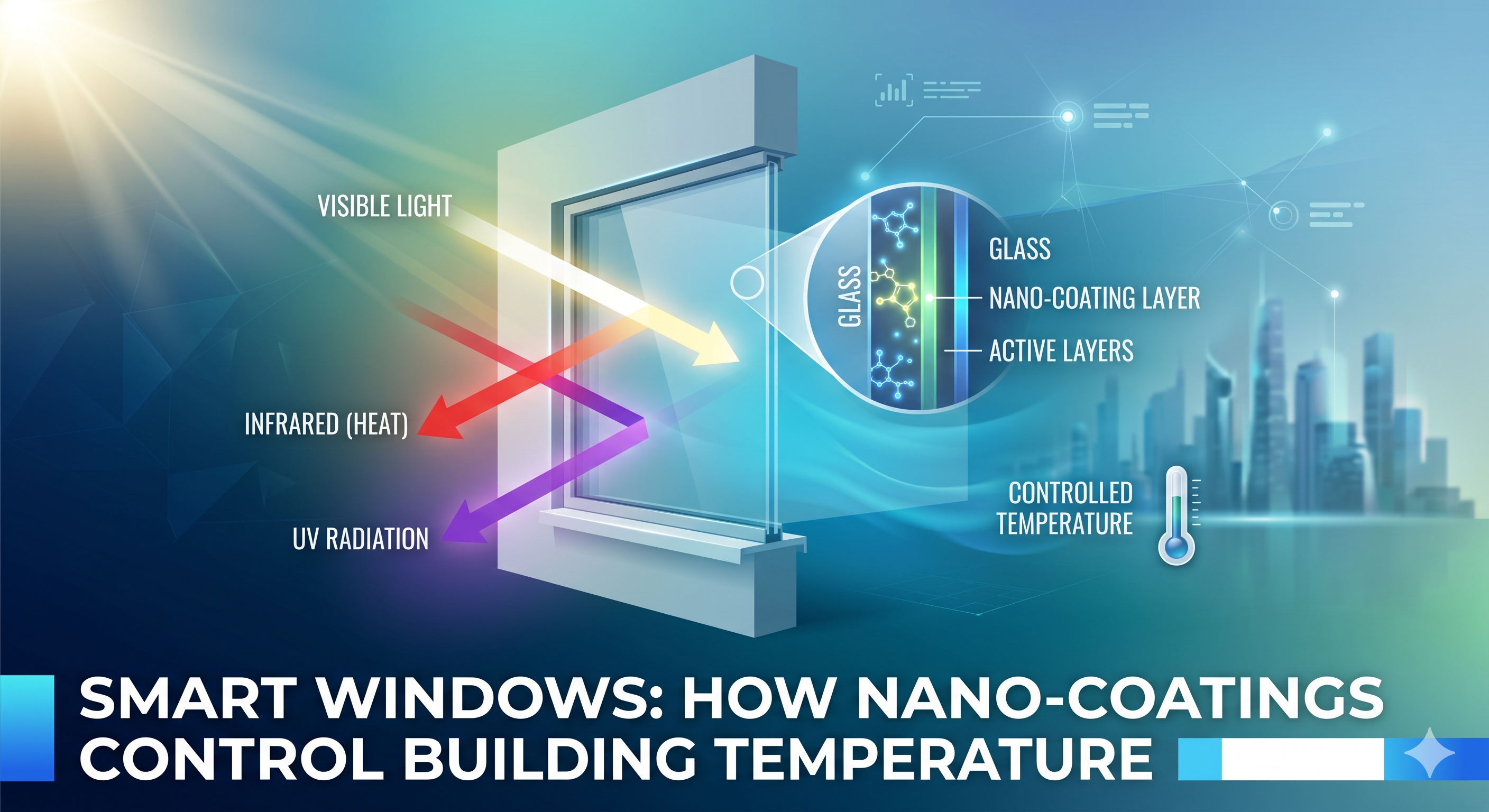
In the architectural world of 2026, the concept of a “wall” is becoming increasingly fluid. For decades, windows were the weakest link in a building’s thermal armor—essentially “holes” in the insulation where expensive heat escaped in the winter and punishing solar radiation poured in during the summer. However, a revolution in material science has turned the glass pane from a passive observer into an active gatekeeper.
Smart Windows, powered by advanced nano-coatings, are no longer a luxury for high-end tech headquarters. They are becoming the standard for sustainable urban development. By manipulating light and heat at the atomic level, these windows allow buildings to “breathe” thermally, drastically reducing our reliance on energy-hungry HVAC systems. This article dives into the physics of nano-coatings, the latest research breakthroughs of 2025-2026, and the critical balance of benefits and risks.
1. The Physics of the “Optical Gatekeeper”
To understand how a window can control temperature, we must first understand the solar spectrum. Sunlight is not just the “white light” we see; it is composed of three primary components:
-
Ultraviolet (UV) Light: Causes fading in furniture and skin damage.
-
Visible Light: What allows us to see and illuminates our rooms.
-
Infrared (IR) Light: Specifically “Near-Infrared” (NIR), which carries about 50% of the sun’s heat energy.
Standard glass lets almost all of this through. A smart window, however, uses a nano-coating—a layer often 1/1000th the thickness of a human hair—to selectively filter these wavelengths. The goal is simple but difficult: maintain transparency (visible light) while blocking or reflecting heat (infrared) depending on the season.
2. The Three Pillars of Smart Window Technology
There are three main ways nano-coatings manage building temperatures. Each has its own chemical “personality” and application.
A. Electrochromic Windows: The Active Switch
Electrochromic windows are the current gold standard for commercial offices. They use a thin film of transition metal oxides (most commonly Tungsten Oxide). When a tiny burst of electricity is applied, ions move within the coating, causing the glass to tint.
-
The 2026 Edge: Modern versions can now “selectively” tint. You can block 90% of the heat while keeping the window 70% transparent, avoiding the “dark office” feeling of older versions.
B. Thermochromic Windows: The Passive Responder
Unlike electrochromic glass, thermochromic windows don’t need wires or sensors. They respond directly to the temperature of the glass itself. The star of this show is Vanadium Dioxide (VO2). At low temperatures, VO2 is a semiconductor and lets heat through. When it reaches a specific “transition temperature,” it undergoes a structural change to become metallic, reflecting infrared heat back outside while staying clear.
C. Photochromic Windows: The Light-Sensitive Shield
Similar to “transition lenses” in eyeglasses, these windows darken in response to light intensity. While excellent for glare control, they are less effective for temperature management because they don’t always distinguish between “bright light” and “hot light.”
3. Cutting-Edge Research: Beyond the Traditional Tint
As we move through 2026, two specific areas of research have moved from the laboratory to industrial pilot programs.
Radiative Cooling Coatings
One of the most exciting breakthroughs in the last 18 months is the integration of Passive Daytime Radiative Cooling (PDRC) into window coatings. These nano-materials don’t just reflect sunlight; they actually emit heat in a specific wavelength (8–13 micrometers) that the Earth’s atmosphere doesn’t absorb. This heat passes straight through the atmosphere and into the cold vacuum of deep space. In 2026, buildings in cities like Phoenix and Dubai are testing these coatings to stay cooler than the ambient air temperature without using a single watt of electricity.
Hydrogel-Based “Liquid Windows”
Research published in early 2026 in Nature Materials has highlighted “Liquid Windows.” These consist of a thin layer of hydrogel sandwiched between glass panes. At a specific temperature, the hydrogel turns opaque, scattering light and absorbing heat. Furthermore, the hydrogel can store this thermal energy and release it slowly as the evening cools, acting as a “thermal battery” for the room.
4. Technical Studies and Performance Metrics
Recent industrial studies have provided concrete data on the impact of these technologies:
-
Energy Savings: A 2025 study by the Global Institute for Sustainable Built Environments found that buildings equipped with advanced VO2 thermochromic windows reduced peak cooling loads by 32% in Mediterranean climates.
-
Occupant Productivity: Research focused on the “Indoor Environmental Quality” (IEQ) showed that workers in smart-window environments reported 18% fewer headaches and significantly higher focus levels due to the elimination of glare and “cold spots” near windows.
-
Visual Comfort: New “Dual-Band” coatings allow for the independent control of visible light and NIR heat. This has solved the primary complaint of the 2010s: that energy-efficient windows made interiors feel “muddy” or “blue.”
5. Advantage–Risk Assessment
The Advantages
-
Massive Decarbonization: Buildings account for nearly 40% of global CO2 emissions. Smart windows are the most effective way to lower a building’s carbon footprint without requiring occupants to change their lifestyle.
-
UV Protection: Nano-coatings block up to 99% of UV rays, extending the life of carpets, artwork, and furniture by decades.
-
Grid Stability: By reducing the “peak demand” for air conditioning at 3:00 PM, smart windows help prevent blackouts during heatwaves.
-
Aesthetics: They eliminate the need for unsightly external shutters or heavy curtains, allowing for the “glass box” architectural style to remain viable in a warming world.
The Risks and Challenges
-
The “Pink” and “Blue” Shift: Some thermochromic materials (like VO2) have a natural yellowish or brownish tint that many architects find unappealing. Achieving “neutral gray” while maintaining efficiency remains a challenge.
-
Durability of Nano-Interfaces: While the glass itself lasts 50 years, the nano-coatings and the electronics (for electrochromic versions) must survive 20+ years of thermal expansion, contraction, and UV bombardment.
-
High Initial Capital (CapEx): Smart windows currently cost 2 to 3 times more than high-performance double-glazing. While the ROI (Return on Investment) is usually 7–10 years, the high upfront cost is a barrier for residential developers.
-
Rare Material Dependency: Materials like Vanadium and Indium (used in Indium Tin Oxide coatings) are subject to the same supply chain risks as the critical minerals used in EV batteries.
6. Integration with the 2026 Smart City
The most significant trend this year is the integration of windows into the Building Management System (BMS) via AI. Modern electrochromic windows are no longer just “on/off.” They are connected to local weather stations and AI predictors.
If the AI knows a heatwave is arriving at 2:00 PM, it will pre-tint the windows at 1:30 PM to “pre-cool” the building, using the thermal mass of the floor to stay ahead of the heat. This proactive approach is a major step toward Net-Zero Energy Buildings.
7. Conclusion: The Window of Opportunity
Smart windows and their nano-coatings represent the perfect marriage of chemistry and architecture. While we have spent the last century trying to fight the environment using mechanical force (HVAC), the 2020s are defined by “responsive design.”
By using Vanadium Dioxide, Tungsten Oxide, and Radiative Cooling films, we are turning our buildings into living organisms that can squint when the sun is too bright and relax when the air is cool. The challenges of cost and material aesthetics are real, but as mass production ramps up throughout 2026, the era of the “dumb window” is rapidly coming to a close. For a world facing a climate crisis, these transparent shields are not just a luxury—they are a necessity.