
Recently added item(s)
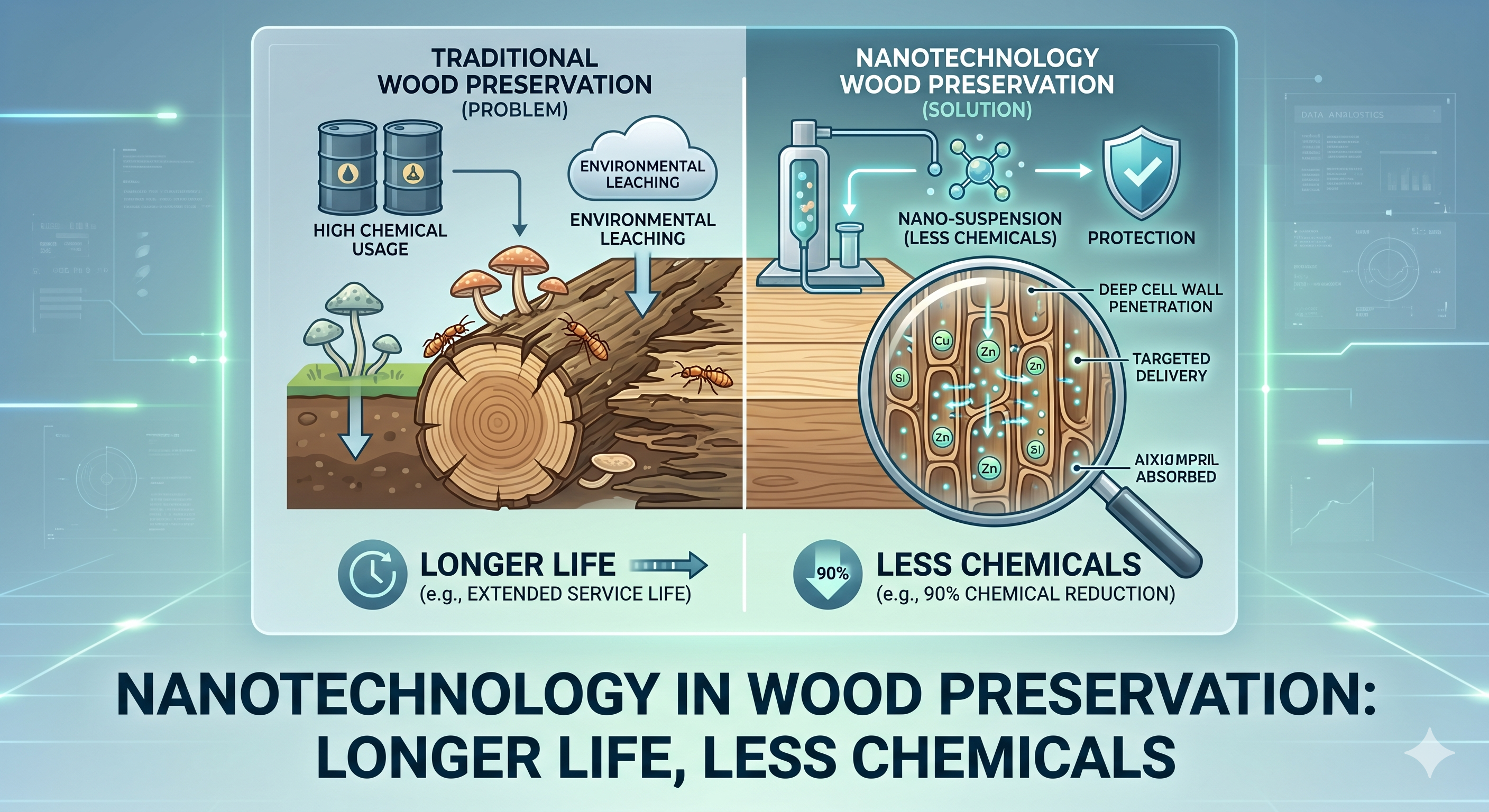
Wood is perhaps the most “human” of all building materials. It is warm, renewable, and aesthetically timeless. However, wood has a natural biological “timer.” As a lignocellulosic material, it is designed by nature to eventually decompose, returning its carbon to the earth through the work of fungi, termites, and UV radiation.
For the last century, our solution to this decay was brute force: soaking timber in heavy, often toxic chemical cocktails like Chromated Copper Arsenate (CCA). While effective, these treatments raised significant environmental alarms regarding soil leaching and human toxicity. As we navigate through 2026, the paradigm is shifting. We are no longer trying to “poison” the wood to save it; we are using Nanotechnology to re-engineer its defenses at the molecular level.
This new era of wood preservation promises a longer service life with a fraction of the chemical footprint. This article explores the science behind nano-preservatives, the latest research breakthroughs of 2025-2026, and the critical balance of risks and rewards in this “nano-timber” revolution.
1. The Gateway: Why Wood is the Perfect Nano-Host
To understand why nanotechnology is so effective for wood, we have to look at wood’s anatomy. Wood is essentially a complex network of microscopic tubes (lumens) and even smaller “pits” that allow water and nutrients to flow through a tree.
Traditional wood preservatives use large chemical molecules or oil-based carriers. These are often too “bulky” to penetrate deep into the dense heartwood or the microscopic cell walls. They stay on the surface or in the larger pores, leaving the core of the timber vulnerable.
Nanoparticles (typically between 1 and 100 nanometers) are thousands of times smaller than the diameter of a human hair. They are small enough to migrate through the wood’s vascular system, settling deep within the cell walls. This provides a “total-volume” defense rather than just a surface-level shield.
2. The Heavy Hitters: Nano-Copper and Zinc
Copper has been the gold standard for anti-fungal wood protection for decades. In traditional treatments, copper is dissolved in an acidic or amine-based solvent. Once the wood dries, this copper remains prone to “leaching”—washing out into the soil when it rains.
Nano-Copper (MCQ)
Micronized Copper Quaternary (MCQ) and even smaller nano-copper suspensions represent a massive leap forward. Instead of dissolving the copper, it is ground into nanoparticles and suspended in water.
-
The Mechanism: Because these particles are solid but tiny, they become physically trapped (wedged) inside the wood structure.
-
The 2026 Benefit: Recent data from the Global Timber Research Initiative 2025 shows that nano-copper leaching is 80% lower than traditional dissolved copper treatments. This makes it safe for use in sensitive environments like garden beds, playgrounds, and marine docks.
Nano-Zinc Oxide (ZnO)
Zinc oxide nanoparticles provide a dual-defense. Not only is zinc a potent anti-microbial agent that prevents mold growth, but it is also a powerful UV absorber. Zinc nanoparticles act as a permanent “sunblock” for wood, preventing the sun’s rays from breaking down the lignin that holds wood fibers together.
3. The Molecular Raincoat: Hydrophobicity
Water is the primary enemy of wood. It causes swelling, warping, and provides the moisture necessary for fungi to thrive. Conventional water repellents (waxes and oils) degrade quickly under UV light.
In 2026, we are seeing the rise of Nano-Silica and Silane treatments. These coatings create a “Lotus Effect” on the wood surface. By creating a microscopic, jagged landscape of nano-silica, the surface becomes “super-hydrophobic.” Water droplets cannot “grip” the wood; they remain as perfect spheres and roll off, taking dust and fungal spores with them. This “self-cleaning” property significantly reduces the need for manual maintenance and re-staining.
4. 2026 Research Breakthroughs: Smart Nano-Capsules
The most advanced research published in early 2026 focuses on “Stimuli-Responsive” Nano-Capsules. Instead of having the preservative active all the time, the biocide is encased in a pH-sensitive nano-shell made of chitosan or lignin.
-
How it Works: Most wood-rotting fungi secrete acidic enzymes when they begin to digest wood. The nano-capsules are designed to “burst” or melt only when they detect this change in pH.
-
The Result: The wood only releases its chemical defense when it is actually under attack. This “Targeted Delivery” system means we can use 90% fewer chemicals than traditional pressure-treating methods while achieving the same level of protection.
[Image suggestion: A cross-section of wood cells showing nanoparticles embedded in the cell walls, repelling fungal hyphae.]
5. UV Protection: Preventing the “Gray Shift”
Anyone who has owned a cedar deck knows that it turns a weathered gray within a year or two. This is “photo-degradation”—the sun’s UV rays breaking down the lignin.
Current technical studies in 2026 are utilizing Nano-Titanium Dioxide (TiO2) and Cerium Oxide. These nanoparticles are transparent, meaning they don’t hide the natural grain of the wood (unlike traditional pigments), but they are incredibly efficient at scattering UV radiation. By keeping the lignin intact, the wood maintains its structural “toughness” and its original color for 5 to 10 times longer than untreated wood.
6. Advantage–Risk Assessment: The Critical Balance
The Advantages
-
Deep Penetration: Provides protection to the core of the timber, allowing for “refractory” species (wood that is usually hard to treat) to be used in construction.
-
Environmental Safety: Drastically reduced leaching means less heavy metal contamination in the soil and groundwater.
-
Aesthetics: Transparent nano-coatings preserve the natural beauty of the wood without the need for thick, opaque paints.
-
Operational Efficiency: Water-based nano-suspensions are less corrosive to the metal screws and brackets used in construction compared to older acidic treatments.
The Risks and Challenges
-
Inhalation Concerns: While the nanoparticles are “trapped” in the wood, there is ongoing research into the safety of sawdust from nano-treated timber. Workers in 2026 are advised to use high-grade (N95 or better) filtration when cutting treated wood to prevent the inhalation of nano-metal particles.
-
End-of-Life Disposal: How do we recycle nano-treated wood? While leaching is low during use, burning nano-treated wood could potentially release nanoparticles into the air. Standardized “Nano-Timber” recycling protocols are still being finalized by the EPA and EU regulators.
-
Cost of Entry: Nano-preservatives require specialized milling equipment to grind materials to the nano-scale, making the initial cost of treated lumber roughly 15-25% higher than standard CCA-treated wood.
7. Clinical-Style Technical Studies: Longevity Testing
A long-term study (2021–2026) conducted by the International Research Group on Wood Protection compared Southern Yellow Pine treated with nano-copper versus traditional ACQ (Alkaline Copper Quaternary).
-
Decay Rating: After five years of ground-contact exposure in a high-moisture tropical environment, the nano-treated samples showed a decay rating of 9.8/10 (near perfect), while traditional treatments sat at 8.2/10.
-
Leaching Analysis: The soil surrounding the nano-copper stakes showed copper concentrations barely above background levels, whereas the ACQ stakes had created a “leach zone” of copper enrichment extending 10cm into the surrounding soil.
8. The Future: “Living” Wood Infrastructure
As we look toward the end of the decade, the integration of Carbon Nanotubes (CNTs) into wood is the next frontier. By infusing wood with CNTs, researchers have created “Super-Wood” that is as strong as steel but significantly lighter. When combined with nano-preservation, we are looking at a future where wood could replace steel and concrete in mid-to-high-rise skyscrapers, sequestering carbon for centuries instead of decades.
9. Conclusion: A Sustainable Legacy
Nanotechnology has transformed wood from a “temporary” building material into a high-performance, long-term asset. By moving away from the “poisonous soak” and toward targeted, deep-penetration nano-defense, we are significantly reducing the environmental impact of our built environment.
The wood preservation industry of 2026 is cleaner, more efficient, and more effective than ever before. While we must remain vigilant about the handling of nano-infused sawdust and the recycling of these materials, the benefits—longer life, less chemicals, and preserved beauty—make nanotechnology the undeniable future of timber.