
Recently added item(s)
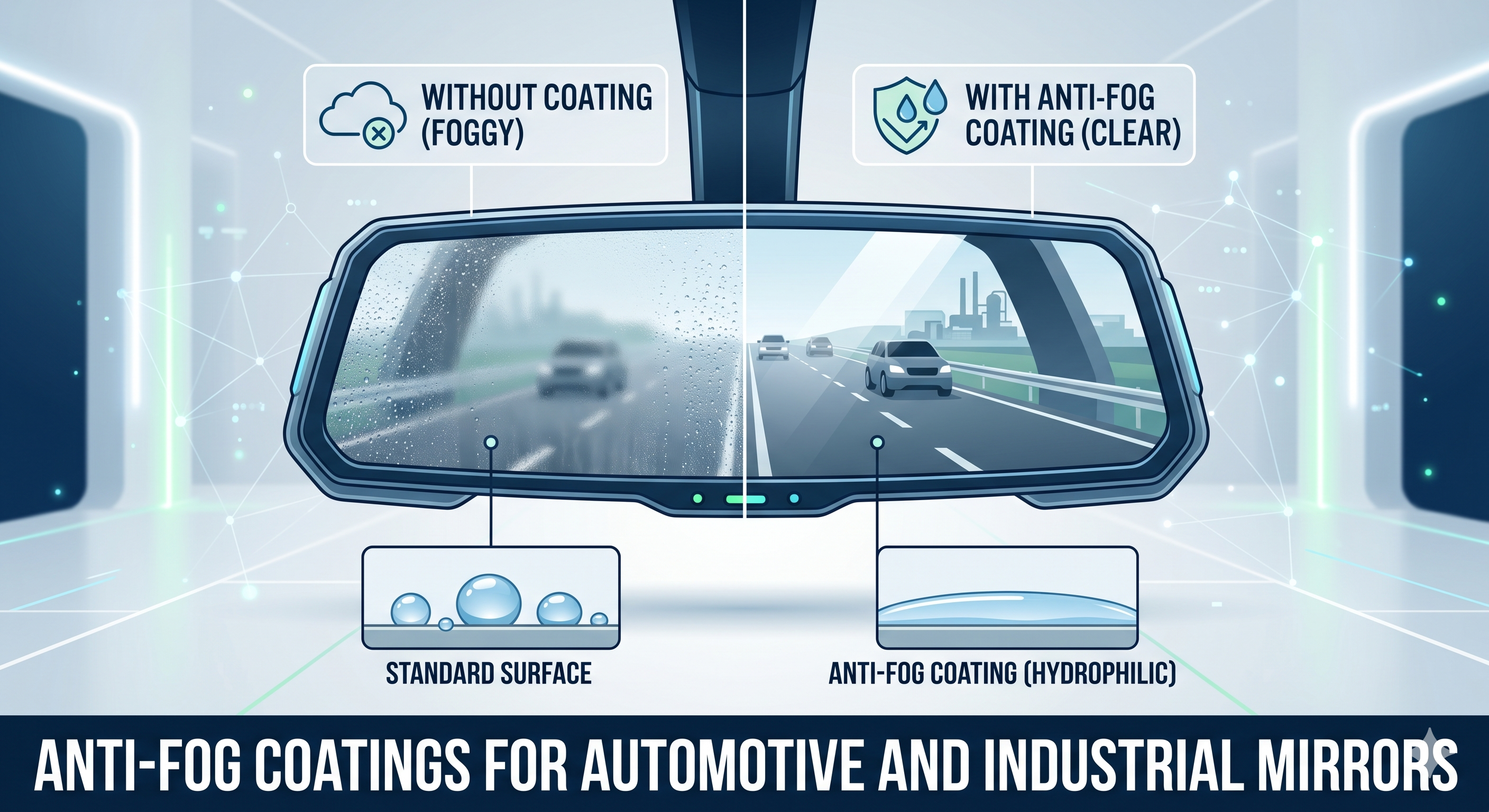
Visibility is the cornerstone of safety in both high-speed transportation and complex industrial environments. Whether it is a driver merging onto a highway on a humid morning or an operator maneuvering a forklift in a temperature-controlled warehouse, the sudden clouding of a mirror can lead to catastrophic results. This phenomenon, known as fogging, is more than just a nuisance—it is a significant engineering challenge.
Through the lens of nanotechnology and advanced material science, the industry has moved beyond simple “wiping” toward sophisticated Anti-Fog Coatings. These coatings are designed to manipulate water at the molecular level, ensuring that mirrors remain crystal clear regardless of environmental shifts.
The Physics of Fogging: Why Mirrors “Disappear”
To understand the solution, we must first understand the problem. Fogging occurs when water vapor in the air comes into contact with a surface that is cooler than the air’s dew point. As the vapor cools, it undergoes a phase change into liquid water.
On a standard glass mirror, water does not spread evenly. Instead, due to high surface tension, it forms millions of microscopic, individual droplets. These droplets act like tiny lenses, scattering light in every direction rather than reflecting it. This scattering (Mie scattering) is what creates the white, opaque “fog” that obscures the reflection.
The goal of an anti-fog coating is to manage these droplets, either by preventing them from forming or by forcing them to merge into a transparent film.
The Two Pillars of Anti-Fog Technology
Modern coatings generally fall into two categories based on their relationship with water: Hydrophilic (water-loving) and Hydrophobic (water-fearing).
1. Hydrophilic Coatings (The Industry Standard)
Most high-performance anti-fog mirrors use hydrophilic technology. These coatings significantly lower the contact angle of water. Instead of forming beads, the water is “attracted” to the surface and spreads out instantly into a thin, continuous layer of liquid. This layer is called a “uniform sheet,” and because it is flat and transparent, it allows light to pass through and reflect off the mirror without distortion.
2. Hydrophobic and Superhydrophobic Coatings
While hydrophilic coatings manage the water that lands on them, superhydrophobic coatings aim to prevent the water from staying at all. By creating a microscopic “mountainous” texture (the Lotus Effect), these surfaces trap air, causing water droplets to remain nearly spherical. Gravity or slight vibration then causes the droplets to roll off before they can accumulate. However, for mirrors, hydrophilic solutions are often preferred because even a few spherical droplets can still cause visual distortion before they roll away.
The Role of Nanotechnology: Silica and Beyond
The leap from “temporary sprays” to “permanent coatings” has been driven by nanotechnology. Today’s most durable coatings are often built using Nano-Silica (SiO_2) and Titanium Dioxide (TiO_2).
Nano-Silica (SiO_2) Structures
Nano-silica particles can be engineered to create a porous, sponge-like structure at the molecular level. This structure has an immense surface area that naturally draws water in and flattens it. Because silica is chemically similar to the glass mirror itself, these coatings can be bonded with extreme strength, making them resistant to cleaning and environmental wear.
Titanium Dioxide (TiO_2) and Photocatalysis
TiO_2 is a “smart” material. When exposed to UV light (sunlight), it undergoes a chemical reaction that makes the surface “super-hydrophilic.” Furthermore, TiO_2 has photocatalytic properties, meaning it can chemically break down organic dirt and oils that land on the mirror. This “self-cleaning” aspect is vital for industrial mirrors where manual cleaning is difficult or dangerous.
Industrial Applications: Beyond the Driver’s Seat
While automotive side-mirrors are the most common application, the industrial sector relies on anti-fog technology for operational continuity.
-
Cold Storage and Logistics: Forklifts moving between giant freezers (at -20°C) and loading docks (at +25°C) experience instant, heavy fogging. Permanent anti-fog coatings on vehicle mirrors and safety aisle mirrors are mandatory to prevent collisions.
-
Manufacturing Plants: In facilities involving steam, high-pressure washing, or chemical reactions, mirrors used for monitoring blind spots or machine internals must remain clear to ensure worker safety.
-
Safety Equipment: While not a mirror, the same technology is applied to industrial face shields and goggles, where a fogged-up lens can lead to a worker removing their protection in a hazardous area.
Automotive Innovation: Smart Mirrors and Durability
In the automotive world, anti-fog coatings must survive a “torture test” of road salt, high-pressure car washes, UV radiation, and temperature extremes ranging from desert heat to arctic cold.
Recent research has focused on Polymeric Hybrid Coatings. These combine the hardness of inorganic silica with the flexibility of organic polymers. This hybrid approach allows the coating to expand and contract with the glass, preventing the “cracking” or “peeling” that plagued early generations of anti-fog treatments.
Furthermore, some premium mirrors now integrate Graphene Oxide. Graphene’s high thermal conductivity allows the mirror to distribute heat more evenly, which, when combined with a hydrophilic coating, provides a dual-action defense: it minimizes the temperature differential while managing any moisture that does settle.
Advantage vs. Risk Assessment
Every engineering solution involves a balance of benefits and potential drawbacks.
The Advantages
-
Immediate Safety: Eliminates the need for a driver or operator to reach out and wipe a mirror while the vehicle is in motion.
-
Reduced Maintenance: Photocatalytic coatings (like TiO_2) keep mirrors cleaner for longer, reducing the labor costs of industrial cleaning.
-
Long-Term Clarity: Unlike temporary “anti-fog wipes,” modern industrial coatings can last for years if maintained correctly.
The Risks and Challenges
-
Abrasion Sensitivity: While silica coatings are hard, they are not invincible. Using the wrong cleaning agent (like abrasive pads or high-pH chemicals) can strip the coating or create micro-scratches that actually hold onto more fog.
-
Cost: Applying high-grade nano-coatings during the manufacturing process increases the initial cost of the mirror assembly.
-
Contamination Overload: If a mirror is covered in heavy oil or thick dust, the hydrophilic properties are “buried.” The coating cannot work if it cannot touch the water vapor.
-
Chemical Stability: Some early anti-fog surfactants were found to be environmentally persistent (PFAS). The industry is now shifting toward “Green Chemistry” and PFAS-free inorganic coatings.
Current Research: The “Self-Healing” Horizon
One of the most exciting areas of current study involves Self-Healing Anti-Fog Coatings. Researchers are developing polymer networks that can “flow” at a microscopic level. If the anti-fog surface is scratched, the surrounding material slowly migrates to fill the gap, restoring the hydrophilic property automatically.
Another breakthrough involves Stimuli-Responsive Coatings. These surfaces can change their properties based on the environment. For example, they might stay “neutral” in dry weather to avoid attracting dust, but instantly transition to “super-hydrophilic” as soon as the humidity crosses a certain threshold.
Maintenance: Protecting Your Investment
For both industrial managers and car owners, protecting these coatings is simple but specific. The golden rule is: Avoid surfactants. Many common glass cleaners contain waxes or “rain repellent” chemicals. These are usually hydrophobic. If you apply a hydrophobic wax on top of a hydrophilic anti-fog coating, you effectively “kill” the anti-fog performance.
The best cleaning method for permanent anti-fog mirrors is usually a soft microfiber cloth and deionized water or a specifically approved pH-neutral cleaner.
Conclusion
The evolution of anti-fog coatings for automotive and industrial mirrors is a testament to the power of material science. By moving away from primitive wipes and toward nano-engineered surfaces, we have significantly reduced one of the most common risks in transportation and industry.
As we look toward an autonomous future, these coatings will become even more critical. Sensors, cameras, and LIDAR systems used in self-driving cars and industrial robots require the same “clear vision” that human eyes do. The nano-coatings protecting today’s mirrors are the same technologies that will ensure the “eyes” of tomorrow’s machines never blink in the fog.