
Recently added item(s)
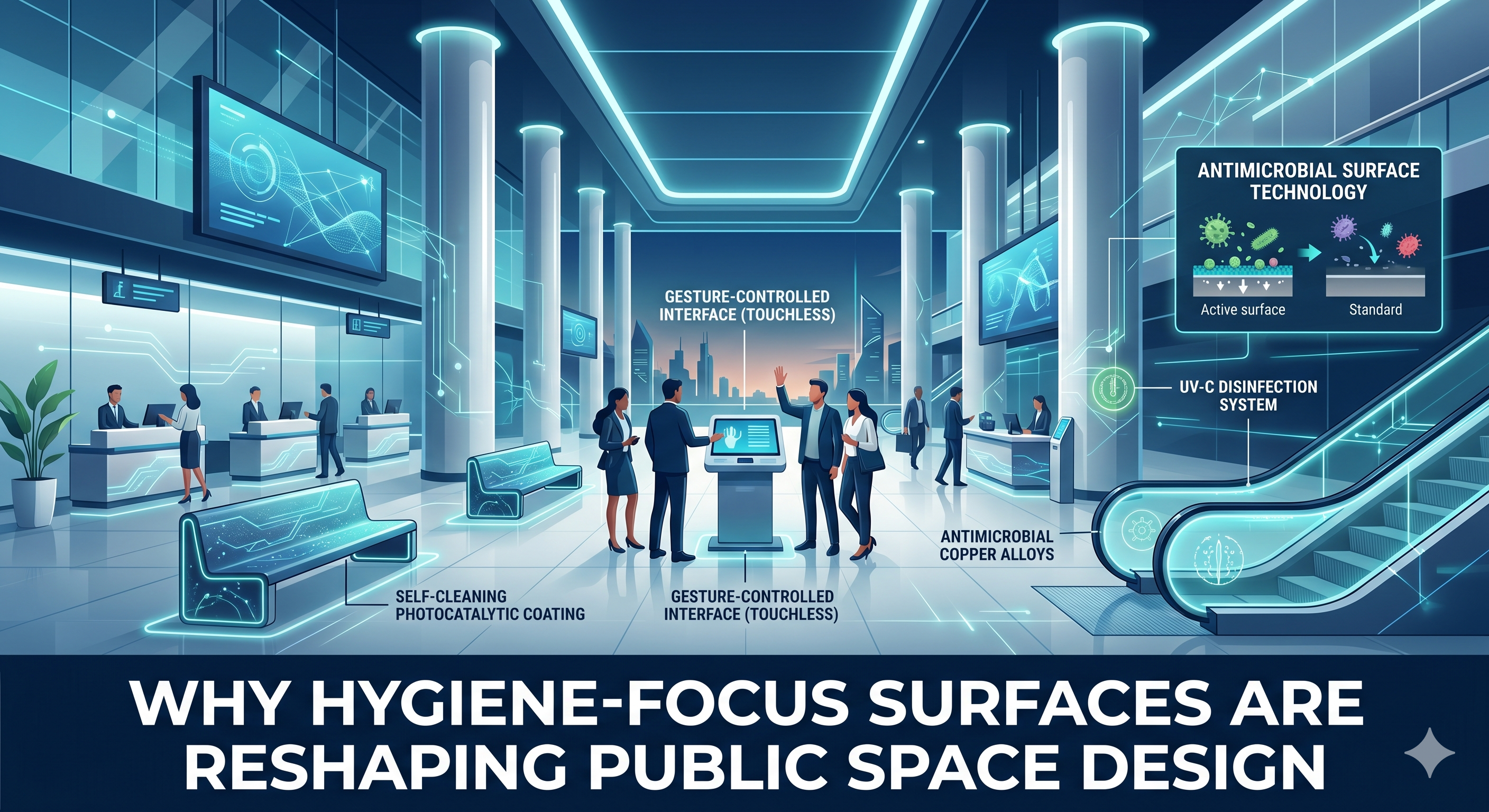
For most of modern architectural history, the design of public spaces—airports, subways, hospitals, and shopping malls—was guided by a triad of priorities: aesthetics, durability, and cost. While cleanliness was always a consideration, it was treated as a maintenance task rather than a fundamental structural requirement. However, a global shift in public health consciousness has permanently altered this hierarchy.
Today, we are witnessing the rise of “Active Hygiene.” Architects and engineers are no longer relying solely on manual cleaning crews; instead, they are embedding antimicrobial and self-cleaning properties directly into the materials that form our environment. From copper-alloy door handles to photocatalytic glass walls, hygiene-focused surfaces are reshaping the DNA of public space design.
The Silent Threat: Fomites and Surface Transmission
To understand why surface design is changing, we must look at the science of “fomites.” A fomite is any inanimate object that, when contaminated with infectious agents, can transfer disease to a new host. In high-traffic public areas, surfaces like elevator buttons, handrails, and touchscreens act as massive hubs for microbial exchange.
Scientific research has shown that pathogens can survive on traditional surfaces for much longer than previously thought. Studies indicate that certain viruses can remain infectious on stainless steel and plastic for up to 72 hours, while some bacteria can persist for weeks. This “persistence gap” between cleaning cycles is where the danger lies. Hygiene-focused surfaces aim to close this gap by creating an environment where pathogens cannot survive.
The Technology Spectrum: How Surfaces Fight Back
Modern material science offers several pathways to creating a hygienic surface. These technologies generally fall into three categories: antimicrobial metals, photocatalytic coatings, and bio-inspired textures.
1. The Oligodynamic Power of Copper and Silver
Metals like copper and silver have been known for their antimicrobial properties since antiquity, but we now understand the molecular mechanics behind them.
-
Copper: When a bacterium or virus lands on a copper surface, the metal releases ions that penetrate the cell wall or viral envelope. This causes a “contact killing” effect by destroying the organism’s DNA or RNA, preventing it from developing resistance.
-
Silver: Silver ions interfere with the metabolic enzymes of microbes and inhibit their ability to replicate. Silver is frequently used in the form of nano-particles embedded in polymers or coatings.
2. Photocatalytic Nano-Coatings (Titanium Dioxide)
Titanium Dioxide (TiO2) represents the cutting edge of “self-cleaning” technology. When TiO2 is applied as a nano-coating and exposed to ultraviolet (UV) light—even the low levels found in indoor lighting—it triggers a chemical reaction.
-
The coating acts as a catalyst to create hydroxyl radicals and superoxide ions from the moisture and oxygen in the air.
-
These highly reactive molecules “oxidize” or chemically burn organic matter on the surface, breaking down bacteria, viruses, and even oily fingerprint residues into harmless water and CO2.
3. Superhydrophobic and Bio-inspired Surfaces
Instead of killing microbes, some surfaces are designed to be “non-stick.” By mimicking the “Lotus Effect,” engineers create microscopic textures that repel water and oils. Pathogens, which typically require a liquid medium or organic biofilm to adhere to a surface, simply cannot gain a foothold. If they cannot stick, they can be easily removed by the slightest airflow or a simple water rinse.
Key Research and Clinical Insights
The transition toward these materials is backed by significant clinical evidence. A landmark multi-center study funded by the U.S. Department of Defense investigated the impact of copper-alloy surfaces in Intensive Care Units (ICUs). The results were staggering: the use of antimicrobial copper on just six highly touched surfaces (such as bed rails and call buttons) led to a 58% reduction in healthcare-acquired infections (HAIs).
In the realm of public transport, researchers have tested photocatalytic coatings on subway grab bars and touchscreens. Clinical samples showed that surfaces treated with TiO2 maintained a 90-99% lower microbial load compared to untreated surfaces between cleaning shifts. These findings have turned “hygienic design” from a luxury into a proven public safety intervention.
Reshaping the Public Landscape: Design Applications
The integration of these materials is changing how we experience public infrastructure:
-
Transit Hubs: Airports are increasingly replacing stainless steel check-in kiosks with antimicrobial-infused polymers. Handrails on escalators are being fitted with internal UV-C LED systems that continuously disinfect the belt as it rotates.
-
Healthcare Environments: Hospitals are moving away from porous materials and complex joints where bacteria can hide. Seamless, antimicrobial flooring and “touchless” copper-infused door hardware are becoming the new standard.
-
Shared Workspaces: Office designs are incorporating “hygienic zones.” Desk surfaces are being treated with long-lasting antimicrobial shields that bond to the material at a molecular level, providing protection that doesn’t wash off with standard cleaners.
Advantage vs. Risk Assessment
As with any major technological shift, there are critical evaluations to be made regarding the widespread adoption of hygiene-focused surfaces.
The Advantages
-
Continuous Protection: Unlike liquid disinfectants that work only at the moment of application, these surfaces provide 24/7 protection.
-
Reduced Chemical Dependency: By utilizing self-cleaning surfaces, facilities can reduce their reliance on harsh chemical cleaners, leading to better indoor air quality and less toxic runoff.
-
Long-Term Durability: Many antimicrobial metals and nano-coatings are designed to last the lifetime of the product, offering a high return on investment through reduced infection-related costs.
The Risks and Challenges
-
Microbial Resistance: There is an ongoing scientific debate about whether widespread use of silver or copper could lead to “biocide-resistant” superbugs, similar to antibiotic resistance. Current research suggests this risk is low for copper due to its multi-targeted killing mechanism, but it remains a point of monitoring.
-
The “False Sense of Security”: A significant risk is that people might stop washing their hands or facilities might reduce cleaning frequency because they believe the surface is “invincible.” These technologies are meant to supplement, not replace, traditional hygiene practices.
-
Environmental Impact: The leaching of nano-silver into wastewater systems is a concern for aquatic ecosystems. Designers must choose “non-leaching” bonded technologies to mitigate this.
-
Cost of Implementation: The initial capital expenditure for copper alloys or specialized nano-coatings is significantly higher than for standard steel or plastic.
The Future of Public Space: “Active Architecture”
We are entering an era where our buildings will act as an extension of our immune systems. Future public space design will likely feature “smart surfaces” that can signal when they are contaminated—perhaps by changing color—and use integrated light frequencies to self-sterilize.
The “Nanokar” approach to materials—focusing on the strategic application of nanotechnology to solve industrial and civil challenges—is becoming the blueprint for modern construction. We are no longer just building walls; we are building biological barriers.
Conclusion
Hygiene-focused surfaces are not a temporary trend born of a pandemic; they are a fundamental evolution in how we interact with our environment. By leveraging the unique properties of nano-silica, titanium dioxide, and antimicrobial metals, we can create public spaces that are not only beautiful and functional but also inherently protective. As the technology matures and costs decrease, the “active” surface will become as standard as the smoke detector or the fire extinguisher—an invisible, ever-present guardian of public health.