
Recently added item(s)
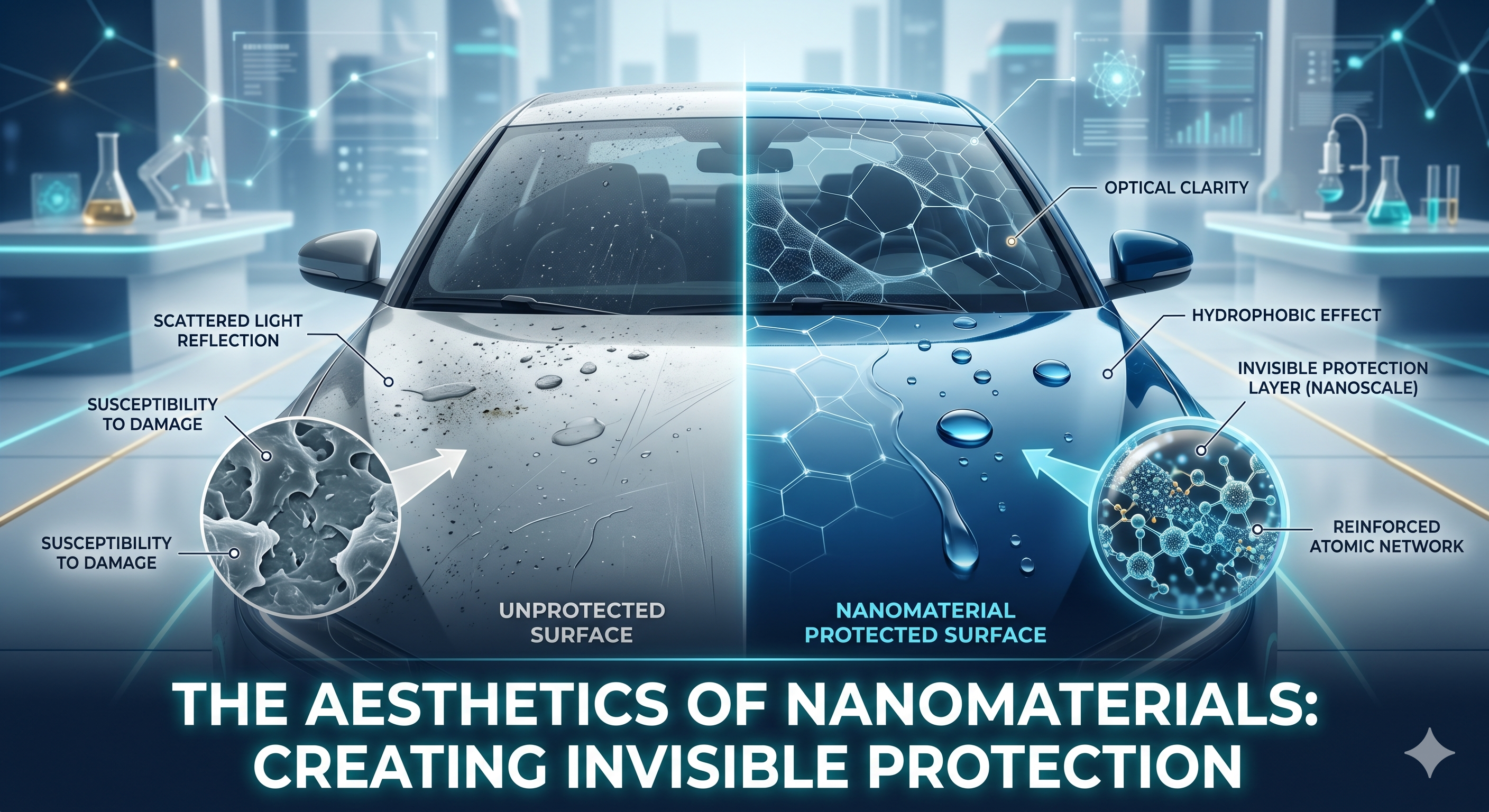
Throughout human history, protection has been visually apparent. Think of the thick, heavy coats of varnish on ancient Renaissance paintings, the metallic armor of knights, or the bulky plastic casings on our smartphones. Our concept of shielding something valuable—be it art, infrastructure, or our own skin—has almost always required a compromise: we must add a visible layer of defense that fundamentally changes how the object looks.
We are now entering a revolutionary era in materials science where that compromise is becoming obsolete. Nanotechnology is giving rise to “invisible protection,” allowing us to safeguard the aesthetics of objects while enhancing their longevity. This is the new frontier of “Aesthetic Nanomaterials”: advanced materials designed not to be seen, but to ensure that the beauty of what lies beneath is preserved indefinitely.
The Nanoscale: Where Light Becomes Irrelevant
To understand how protection can be invisible, we must first understand the scale at which nanotechnology operates. A nanometer (nm) is one billionth of a meter. To put this in perspective, a human hair is about 80,000 to 100,000 nanometers wide.
The reason nanomaterials can provide invisible protection lies in their interaction with light. When an object appears opaque, white, or foggy, it is because it is scattering visible light. The wavelength of visible light ranges roughly from 400 nm to 700 nm. When particles within a coating are larger than half of these wavelengths, they cause significant scattering.
By manipulating materials at the nanoscale—making protective particles smaller than 100 nm—we can create layers that light simply cannot “see.” Light passes through them unimpeded, revealing the texture and color of the material below as if nothing were there. This decoupling of visual presence from functional presence is the fundamental breakthrough of aesthetic nanomaterials.
Conserving Culture: The Canvas of Invisibility
One of the most significant domains for invisible protection is cultural heritage conservation. Museums and architectural societies have long struggled with a paradox: they must apply protective coatings to artifacts to prevent degradation from pollutants, UV light, and biological growth, yet these traditional coatings often yellow, crack, and hide the original artist’s intention.
Nanocoatings for Historical Stone
The ancient stones of Rome and Athens face a constant battle against acid rain and soot. In the past, restorers used thick polymeric sealants. These kept water out but also trapped humidity inside the stone, leading to faster internal degradation and an altered, glossy appearance.
Modern research focuses on hydrophobic and photocatalytic nanocoatings. Calcium Hydroxide Nanoparticles, for instance, are being used to consolidate and strengthen porous limestone. Because these particles are smaller than the stone’s pores, they penetrate deeply without altering the stone’s surface color or texture.
Simultaneously, titanium dioxide (TiO_2) nanoparticles are being deployed as self-cleaning agents. Under UV light (sunlight), these particles become highly reactive, breaking down organic dirt and atmospheric pollutants that land on the stone. The particles are so small they do not scatter light, meaning the facade looks naturally clean, not chemically coated.
The Problem of Varnish in Fine Art
For fine paintings, the problem is even more delicate. Conservationists have traditionally used varnishes to protect oil paint. Over centuries, these varnishes oxidize, turning the blue skies of a masterpiece a dull yellow. Removing them is risky and time-consuming.
Nanotechnology offers a potential, non-invasive alternative. Research is ongoing into ultra-thin nanocoatings that are durable, non-yellowing, and completely transparent. These coatings could be engineered to act as sacrificial layers that are easily removed using specialized nanogels, without ever touching the sensitive paint layer itself.
Skin Deep: The Clinical Shift in Invisible Sunscreen
Perhaps the most common encounter a person has with aesthetic nanomaterials is in the pharmacy aisle. Historically, mineral sunscreens, which utilize zinc oxide (ZnO) or titanium dioxide (TiO_2), provided excellent protection but were dreaded by consumers because they left a thick, ghostly white paste on the skin. This aesthetic failure led many to choose chemical sunscreens, which often come with significant health and environmental concerns.
The solution was a nanotechnology triumph. By engineering ZnO and TiO_2 into nanoparticles (typically between 15 nm and 100 nm), sunscreen manufacturers created products that were just as effective at blocking UV rays but became completely transparent when rubbed into the skin.
Advancing the Clinical Dialogue
This innovation, however, prompted serious clinical and toxicological questions. The public began to ask: If these particles are small enough to be invisible, are they small enough to penetrate my skin and enter my bloodstream?
A decade of rigorous clinical studies has addressed this. In the European Union, the Scientific Committee on Consumer Safety (SCCS) has published extensive reviews confirming that ZnO and TiO_2 nanoparticles, when applied in sunscreen formulations to healthy or even slightly damaged skin (such as sunburn), do not penetrate beyond the stratum corneum (the outermost, dead layer of skin).
Furthermore, recent research has moved past simple transparency. The focus now is on optimizing the particle shape to maximize UV scattering while ensuring zero visible light scattering and minimizing photocatalytic activity (which could create free radicals on the skin). Some newer coatings even integrate antioxidants onto the nanoparticles to protect the skin from any free radicals that might accidentally form.
A Surface Revolution: Everyday Aesthetics
The principles derived from conservation and toxicology are now infiltrating our everyday lives through advanced surface engineering.
-
Consumer Electronics: Modern smartphones use hydrophobic and oleophobic (oil-repelling) nanocoatings on their screens. While invisible, they drastically reduce fingerprint smudging and make the screen feel “smoother” without altering the display’s color accuracy.
-
The Automotive Industry: High-end automotive coatings now utilize nanomaterials in their clear coats. These advanced polymrs are self-healing. A shallow scratch, caused perhaps by a car wash, will “reflow” when exposed to heat, restoring the mirror finish. These layers are invisible but maintain the “showroom look” for years.
-
Aesthetics of Architecture: Skyscrapers in urban environments can utilize photocatalytic coatings, much like the ancient monuments, to remain clean of urban smog without the use of expensive manual cleaning crews.
Advantage vs. Risk Assessment: Navigating the Unknown
Aesthetic nanomaterials represent an undeniably elegant solution to a universal problem, but like all powerful new technologies, they require a balanced assessment of their advantages and risks.
The Advantages
-
Preservation of True Aesthetics: This is the primary driver. We can now protect artifacts, structures, and our bodies without adding visual clutter.
-
Unprecedented Functionality: Nanomaterials offer self-cleaning, water-repelling, self-healing, and superior UV-blocking properties that standard materials cannot match.
-
Longevity and Sustainability: By enabling surfaces to clean and heal themselves, we extend the lifespans of buildings, cars, and consumer goods, reducing the overall environmental impact of production and replacement.
The Risks and Challenges
-
Health and Safety of Workers: While nanomaterials may be safe when embedded in a final product (like sunscreen or clear coat), the manufacturing phase is critical. Inhalation of airborne nanoparticles during production poses significant respiratory risks. Rigorous occupational safety standards are paramount.
-
Environmental Persistence (The “Grey Goo” Dilemma): As these materials become widespread, where do they go? When a car’s nano-clear coat wears off, do the particles accumulate in the soil or waterways? This is known as the “grey-goo” concern—not the apocalyptic sci-fi scenario, but a very real environmental accumulation problem. Ongoing ecological toxicology research is vital to determine the long-term impact of nanomaterial micro-pollution.
-
Regulatory Gaps: Our legal and regulatory systems often lag behind scientific breakthroughs. Currently, the definition of a “nanomaterial” can vary by jurisdiction, creating confusion and potential loopholes in safety reporting. Harmonized international regulation is necessary for public trust.
Conclusion: Balancing the Seen and Unseen
Aesthetic nanomaterials are reshaping our relationship with preservation. They are making the protective barrier a passive, invisible participant in our environment. This shift is a triumph of scientific engineering, allowing us to simultaneously achieve maximum defense and authentic beauty.
However, the pursuit of invisibility requires that we keep a very visible and rigorous eye on the science. To truly harness the beauty of nanomaterials, we must ensure that the science of safety and sustainability advances just as quickly as the science of aesthetics. Only then can we guarantee that this new invisible shield will protect not just the beauty of our world, but the health of its inhabitants.