
Recently added item(s)
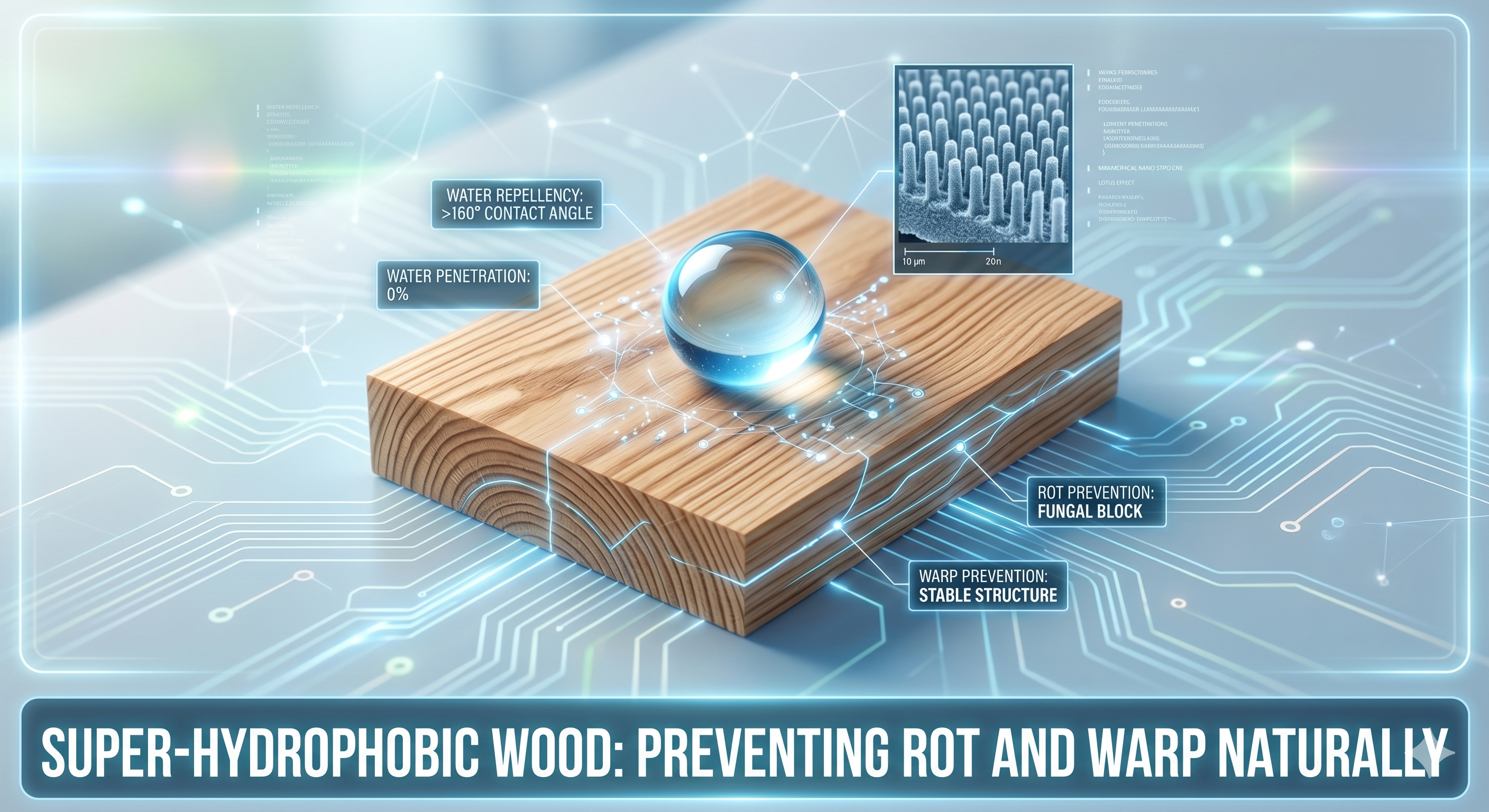
Wood is arguably humanity’s oldest building material. It is renewable, aesthetically warm, structurally sound, and ubiquitous. However, from the oldest ship to the newest backyard deck, wood faces a singular, relentlessly destructive enemy: water.
Water ingress is the harbinger of rot, fungus, insect infestation, and structural deformation (warping). For centuries, we have fought this battle using chemical shields—creosote, chromated copper arsenate (CCA), various sealants, and paints. While effective to a degree, many traditional treatments pose significant environmental risks, leeching heavy metals or volatile organic compounds (VOCs) into the soil and air. Furthermore, they are often superficial coatings that eventually crack, allowing water to slip back in.
Today, materials science is turning to nature itself to solve this dilemma. The result is the revolutionary field of super-hydrophobic wood modification. By fundamentally altering the way wood interacts with water at a microscopic level, researchers are developing methods to prevent rot and warp naturally, without reliance on harsh toxins.
The Science of Invisibility: What is Super-Hydrophobicity?
To understand how super-hydrophobic wood works, we must understand the fundamental principles of surface chemistry.
Most natural wood surfaces are “hydrophilic” (water-loving). If you drop water on an untreated wooden board, it spreads out, “wetting” the surface, and is quickly absorbed through capillary action into the cellular structure.
A super-hydrophobic surface does the exact opposite. To achieve this state, the surface must combine two key features: a specific chemical composition (low surface energy) and a specific physical structure (nano-scale roughness).
The Lotus Effect
The gold standard for super-hydrophobicity in nature is the Lotus leaf. Under a microscope, a Lotus leaf isn’t smooth. It is covered in tiny, hierarchical papillae (micro-scale pillars) which are further covered in wax crystals (nano-scale texture). When water lands on this surface, it cannot wet the leaf. Instead, the droplet rests on the tips of these tiny pillars, supported by microscopic pockets of trapped air beneath it.
The contact angle—the angle formed between the water droplet and the surface—exceeds 150 degrees. At this point, the water beads up into almost perfect spheres. They don’t just sit there; they slide off at the slightest tilt, carrying dirt particles with them. This is known as “self-cleaning” or the “Lotus Effect.”
Super-hydrophobic wood modification aims to recreate this effect on, and slightly within, the wooden structure.
The Core Mechanisms: How it Prevents Rot and Warp
The destruction of wood by water isn’t instantaneous; it is a process driven by biology and physics.
1. Stopping the Rot (Biological Decay)
Rot is caused by various types of fungi that consume the structural components of wood (cellulose, hemicellulose, and lignin). However, fungi have very specific requirements for survival: oxygen, optimal temperatures, a food source (the wood), and, crucially, moisture.
Most rot fungi require wood to reach its “fiber saturation point”—approximately 28% to 30% moisture content—before they can really begin to thrive. By making the wood surface and cells super-hydrophobic, liquid water is relentlessly repelled. It cannot accumulate. It cannot penetrate. Without that essential moisture, fungal spores cannot germinate, and existing fungi go dormant or die. It is a natural biological blockade created by advanced physical chemistry.
2. Preventing the Warp (Dimensional Instability)
Warping, splitting, and cracking are caused by “dimensional instability.” Wood is “hygroscopic”—it continuously absorbs and releases moisture to stay in balance with the surrounding environment’s humidity.
When wood absorbs water (or humidity), its cells swell. When it dries, they shrink. Warping occurs because this swelling and shrinking do not happen uniformly. One side of a board might get wetter (and swell more) than the interior or the other side, causing the board to bend, twist, or cup.
Super-hydrophobic modification doesn’t just treat the surface; many advanced methods create a deep barrier. By repelling liquid water entirely and significantly slowing the absorption of water vapor, these modifications flatten the dramatic humidity fluctuations that wood experiences. The cells remain stable, leading to a massive reduction in warping and cracking over time.
Creating Nature’s Armor: Current Engineering Methods
Turning a regular plank of pine into a super-hydrophobic powerhouse requires sophisticated engineering. The traditional “spray-on” hydrophobic coatings bought at a hardware store are purely superficial; they wear off quickly when exposed to sunlight (UV radiation) or foot traffic. Scientific research today focuses on creating a ruggedized, permanent solution.
Here are the prominent research directions:
Sol-Gel Modification
The sol-gel process is a versatile chemical method often used in material science. Researchers create a “sol” (a solution) containing precursors for various compounds, often silica-based (like nano-silica). The wood is soaked in this solution, which penetrates the cellular structure.
A chemical reaction (gelation) is triggered within the wood, growing nano-structures (a silica network) inside the cell walls and on the surface. These nano-structures provide the required roughness. Finally, the wood is treated with low-surface-energy molecules, such as fluorinated compounds or, increasingly, eco-friendly organosilanes, to complete the super-hydrophobic chemistry.
Deep Inpregnation and Mineralization
One of the most promising avenues for preventing warping involves deep impregnation, rather than just surface treatment. In these methods, the wood is placed in a vacuum chamber to remove air from the cells, followed by a pressure cycle to force the super-hydrophobic solution deep into the core of the timber.
Some studies are focusing on wood “mineralization.” They inject minerals, such as calcium carbonate or silica, into the wood pores where they solidify, creating a “fossil-like” structure that is inherently resistant to water absorption and, coincidentally, significantly increases the wood’s fire resistance.
“Green” Nanotechnology
The biggest driver in current research is finding alternatives to fluorinated molecules. Early super-hydrophobic treatments relied on fluoro-chemicals which are highly hydrophobic but are also notorious “forever chemicals,” persisting in the environment and accumulating in human tissue.
Researchers are actively developing methods using bio-based wax nanoparticles, natural polyphenols (extracted from plants), and biodegradable polymers. These green nano-methods aim to provide the same Lotus Effect while ensuring the final wooden structure is completely biodegradable at the end of its life cycle.
Scientific Assessment: Engineering Trials and Field Tests
Unlike medicine, where new treatments undergo human clinical trials, engineered materials undergo rigorous laboratory testing and long-term field trials (exposure studies) to prove their effectiveness. The data emerging from recent studies is exceptionally promising.
Dimensional Stability Tests
In laboratory trials, super-hydrophobic wood is subjected to extreme “water uptake” tests. Modified wood planks are submerged completely in water for hours or days. Studies consistently show that super-hydrophobic wood reduces water absorption by 80% to over 95% compared to untreated controls.
Perhaps even more important is “anti-swelling efficiency” (ASE) testing. When measured after dramatic humidity cycles (moving wood from a desert environment to a rainforest environment), super-hydrophobic wood maintains an ASE often exceeding 70-80%. This means it distorts 70-80% less than natural wood would under the same conditions.
Rot and Decay Trials
These trials use a methodology called “accelerated weathering” or “natural decay exposure.” The wood is placed in environments simulating worst-case scenarios, such as in direct contact with soil infested with brown-rot or white-rot fungi, and maintained at the optimal temperature and moisture for fungal growth.
Untreated wood in these conditions often loses significant mass (structure) in a few months. Long-term studies on deeply impregnated super-hydrophobic wood show it can resist fungal colonization for years, often remaining entirely decay-free where traditional untreated controls have completely crumbled.
The Analytical View: Advantages vs. Risks Assessment
Super-hydrophobic wood is a breakthrough, but a critical analysis reveals a landscape of both immense promise and significant technical challenges.
The Clear Advantages
-
Massive Lifespan Extension: By eliminating the primary drivers of degradation (water, rot, warp), wood structures could last 5 to 10 times longer than they do now. This massively reduces maintenance costs and the need for expensive repairs.
-
Natural Decay Resistance (Toxin Free): This is the ultimate goal. The technology makes it possible to utilize renewable fast-growth timber (like pine) for heavy-duty construction (bridges, decks, foundations) without having to soak it in environmental toxins like copper or arsenic.
-
Reduced Maintenance: A super-hydrophobic surface is also often self-cleaning. Dirt is washed away by rain, reducing the need for power washing, sanding, and re-sealing.
-
Dimensional Integrity: Doors that don’t jam in winter, decks that don’t warp and create tripping hazards, and furniture that doesn’t split—this dimensional integrity is a major functional advantage.
Risks and Current Technical Challenges
-
UV Degradation (The Durability Problem): The single biggest challenge facing the technology is sunlight. UV radiation from the sun rapidly degrades the tiny organic “anchors” that hold the hydrophobic nano-structures to the wood surface. In many trials, a surface that was super-hydrophobic in the lab lost its water-repelling abilities after only a few months of direct sun exposure in the field. This is the main focus of current development—ruggedizing the nano-anchors against UV light.
-
Abrasion Resistance: Nano-structures are inherently fragile. While great for a wall or ceiling, super-hydrophobicity on a deck or floor where people walk can be quickly worn away (abrasion). The texture gets squashed or stripped off, returning the surface to its natural hydrophobic state. Developing “self-repairing” nano-textures or integrating the chemistry deep into the wood are the proposed solutions.
-
Economic Scalability: Currently, methods involving nanotech, vacuum pressure cycles, and sol-gel chemistry are significantly more expensive to produce on a factory scale than standard chemical pressure treatments. It may be years before it is cost-competitive for general construction lumber.
The Future: Integrating the Tech into the Wood Industry
Super-hydrophobic wood modification is transitioning from laboratory curiosity to a viable, niche technology. We are already seeing high-end “modified wood” products, such as acetylated wood (Accoya) or thermally modified wood, which use related stabilization techniques. Deeply impregnated super-hydrophobic timber is the logical next step.
The future of this field lies in finding the chemical sweet spot: a treatment that is 100% eco-friendly, deeply penetrating (for dimensional stability), abrasion-resistant (for walking surfaces), and, critically, durable against UV radiation.
When materials science achieves this combination, it will revolutionize the construction and forestry industries. Wood will no longer be seen as a vulnerable material that “wets and rots,” but as a highly engineered, natural polymeric material that can rival steel and concrete in longevity, while remaining the most sustainable building material on Earth. The battle against water is being won, not with chemical warfare, but by learning the elegant physics of nature’s own design.