Recently added item(s)
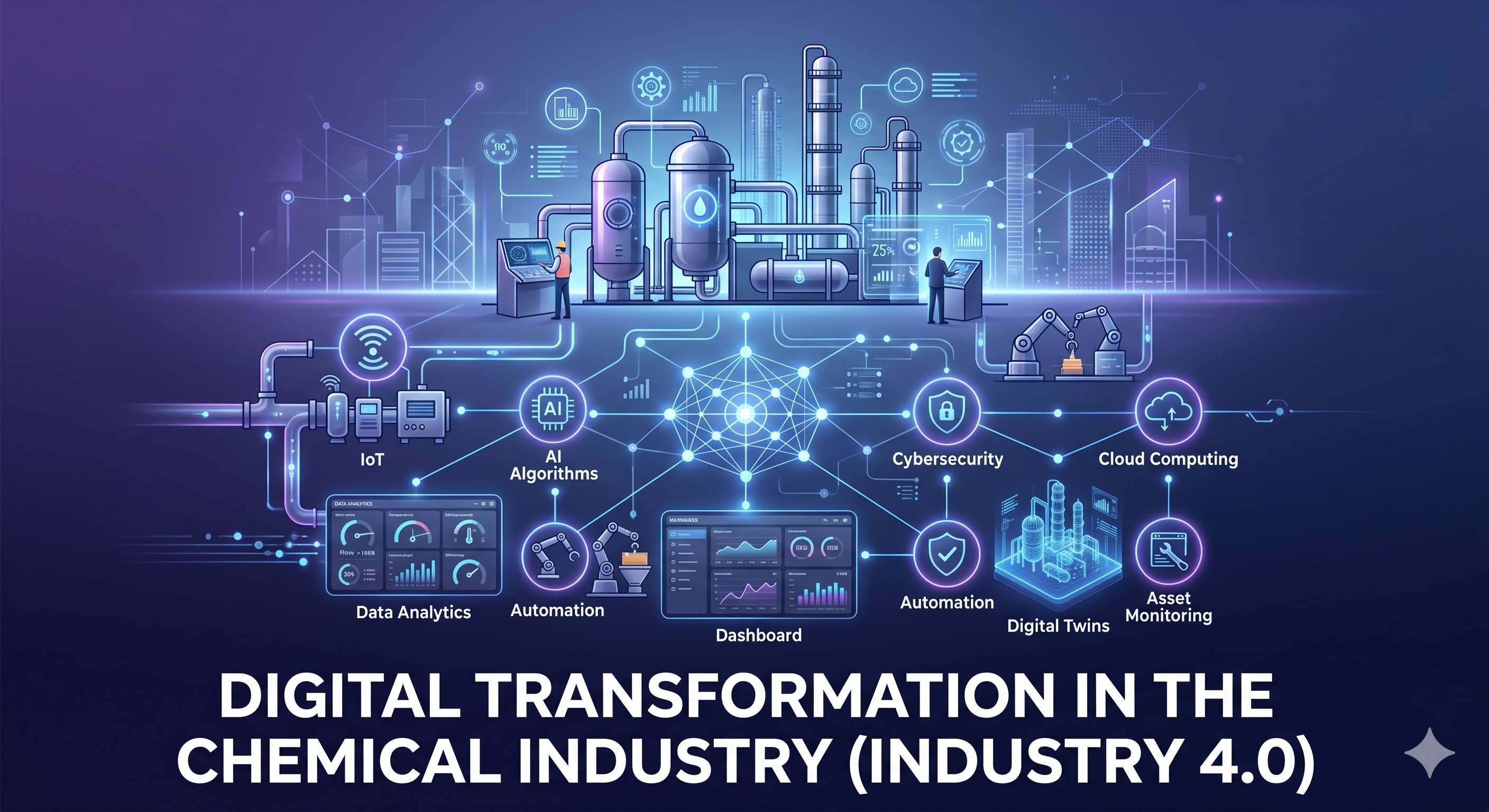
The chemical industry has traditionally been defined by physical assets: massive reactors, miles of stainless steel piping, and the precise manipulation of atoms. However, a new catalyst is transforming the sector from the inside out. Digital transformation, often referred to as Industry 4.0 or “Chemistry 4.0,” is the integration of “bits” with “atoms.” It represents a shift where data becomes as valuable as the raw materials themselves.
For an industry focused on advanced materials like graphene, carbon nanotubes, and specialized metal powders, this digital shift is not just a trend—it is a functional necessity. As the complexity of material synthesis increases, the human capacity to monitor every variable reaches its limit. Industry 4.0 provides the “digital nervous system” required to manage these complexities, ensuring that the next generation of industrial chemicals is produced with unprecedented precision and efficiency.
1. The Pillars of Chemistry 4.0: Beyond the Lab Bench
Industry 4.0 is not a single technology but a convergence of several digital pillars that work in harmony to optimize the chemical lifecycle.
The Industrial Internet of Things (IIoT)
In a modern chemical facility, every valve, pump, and reactor is equipped with sensors. These IIoT devices provide a real-time stream of data on temperature, pressure, flow rates, and vibration. This allows for a transition from reactive maintenance (fixing things when they break) to predictive maintenance (fixing things before they break), saving millions in potential downtime.
Big Data and Advanced Analytics
Chemical processes generate staggering amounts of data. Advanced analytics platforms can sift through years of batch records to identify the “hidden” variables that lead to a perfect yield. This is particularly critical when producing sensitive materials like 35 µm thick graphene sheets, where even a minor fluctuation in vacuum filtration pressure can alter the material’s properties.
Digital Twins
A “Digital Twin” is a virtual replica of a physical production line. Before a company commits to a new chemical recipe or a hardware change, they can simulate the entire process in a digital environment. This reduces the risk of expensive laboratory failures and accelerates the time-to-market for new innovations.
2. The “Jarvis” Architecture: Autonomous Assistants in Chemical Ops
One of the most exciting developments in digital transformation is the move toward autonomous assistants. By utilizing modular workflows and platforms like n8n, chemical enterprises can now build custom AI agents—often dubbed “Jarvis” systems—to manage the “brain work” of the factory.
These assistants do more than just answer questions; they act as an operational layer:
-
Customer Behavior Analysis: AI agents can analyze incoming communications via WhatsApp or email to predict demand spikes for specific materials like nickel or tungsten powders.
-
Real-time Monitoring: An n8n-based assistant can be programmed to monitor reactor data and automatically send alerts to engineers if a batch deviates from its “Golden Profile”.
-
Workflow Automation: By automating routine data entry and reporting, these digital assistants free up human scientists to focus on high-level R&D and material functionalization.
This modular approach allows even mid-sized enterprises to implement high-level AI without the need for a massive, centralized IT department.
3. Nanotechnology and the Digital Frontier
Nanotechnology is perhaps the biggest beneficiary of Industry 4.0. The production of carbon nanotubes and graphene requires a level of control that was previously impossible.
Precision Synthesis
Digital systems allow for the “bottom-up” control of material structures. When functionalizing carbon nanotubes for enhanced conductivity, digital controllers can manage the chemical vapor deposition (CVD) process with millisecond precision. This ensures that each nanotube has the correct length, diameter, and surface chemistry to meet the rigorous demands of sectors like aerospace and energy storage.
Accelerating Graphene Research
The journey to create stable graphene paper or levitated graphene sheets involves thousands of iterations. Machine learning algorithms can analyze previous experimental results to suggest the “next best” combination of precursors and filtration techniques, effectively acting as a digital co-pilot for the materials scientist.
4. Supply Chain 4.0: Tracking Atoms Across Borders
The logistics of chemicals, especially hazardous or high-value materials, is notoriously complex. Industry 4.0 transforms the supply chain from a series of “black boxes” into a transparent, real-time map.
-
Hazardous Logistics: Using GPS and IoT sensors, companies can track the real-time status of metal powders in transit. If a container’s internal temperature rises or if it experiences an unusual shock, the system can automatically flag the shipment for inspection.
-
Blockchain for Purity: To ensure the quality and purity of a material like 99.9% pure tungsten powder, blockchain technology can be used to create an immutable “digital passport.” This provides the end customer with a guaranteed record of the material’s origin and purity levels, from the mine to the final delivery.
5. Advantage-Risk Assessment: The Digital Balance Sheet
While the benefits of Industry 4.0 are clear, the transition is not without its pitfalls. A scientific approach requires a balanced evaluation of the rewards and the inherent risks.
| Feature | Advantage of Digital Transformation | Risk and Challenge Factor |
| Operational Efficiency | Drastic reduction in waste and energy consumption. | High initial Capital Expenditure (CapEx) for sensors and software. |
| Product Quality | Near-perfect consistency across every batch produced. | “Data Silos”—difficulty in getting different software systems to talk to each other. |
| Safety | Early detection of leaks, thermal runaways, and equipment failure. | Cybersecurity—the risk of “state-sponsored” or criminal hacking of industrial systems. |
| Market Speed | Faster R&D cycles through simulations and AI-driven experiments. | Skill Gap—the need for workers who understand both chemistry and data science. |
| Sustainability | Ability to track and reduce the carbon footprint of every molecule. | Complexity—the risk of over-automating and losing “human intuition” in the lab. |
6. Research and “Clinical” Industrial Trials
Current industrial research is focused on the “Self-Optimizing Plant.” In a pilot program recently conducted by a major European chemical conglomerate, an AI-driven system was given control of a specialized polymer reactor. By adjusting parameters in real-time based on high-frequency sensor data, the AI achieved a 12% increase in yield and a 15% reduction in energy usage compared to the best human operators.
In the realm of advanced materials, researchers are using “Clinical” data modeling to study the long-term stability of nano-composites. By feeding decade-long environmental data into a digital twin, scientists can predict how a graphene-reinforced bridge or a carbon-nanotube-enhanced battery will behave after 20 years of use. This predictive power is essential for the commercial adoption of materials that are otherwise considered “too new” for critical infrastructure.
7. Sustainability and the “Green” Digital Twin
The chemical industry is under immense pressure to meet the goals of the European Green Deal. Digitalization is the primary tool for decarbonization. By using Industry 4.0 tools, companies can calculate the “Product Carbon Footprint” (PCF) of every kilogram of material they produce.
For a company managing domains like nanokar.com, this data can be a powerful marketing tool. Being able to prove to a customer that a specific batch of carbon nanotubes was produced using 30% less energy than the industry average provides a significant competitive advantage in a world that is rapidly moving toward “Green Chemistry.”
8. The Road Ahead: 2026 and Beyond
As we move through 2026, the distinction between “Chemical Company” and “Tech Company” will continue to blur. The winners in this new era will be those who can most effectively translate their physical expertise into digital intelligence.
The future involves:
-
Hyper-Personalization: Using AI to create “custom” molecules for a single client’s specific needs.
-
Quantum Chemistry: Using quantum computers to simulate chemical reactions that are too complex for even the most powerful classical computers today.
-
Decentralized Production: Using 3D printing and modular “mini-factories” to produce chemicals closer to the end-user, reducing logistics costs and emissions.
Conclusion: Embracing the Digital Catalyst
Digital transformation is not a destination; it is a continuous process of evolution. For the chemist of today, the mouse and the keyboard are as important as the pipette and the flask. By embracing the pillars of Industry 4.0—from IoT and Big Data to modular AI assistants like the “Nanokar Jarvis” model—the chemical industry can reach new heights of safety, efficiency, and innovation.
The atomic world is vast and complex, but with the power of digital tools, we are finally gaining the ability to navigate it with total clarity. The era of Chemistry 4.0 is here, and it is rebuilding the world, one bit and one atom at a time.