
Recently added item(s)
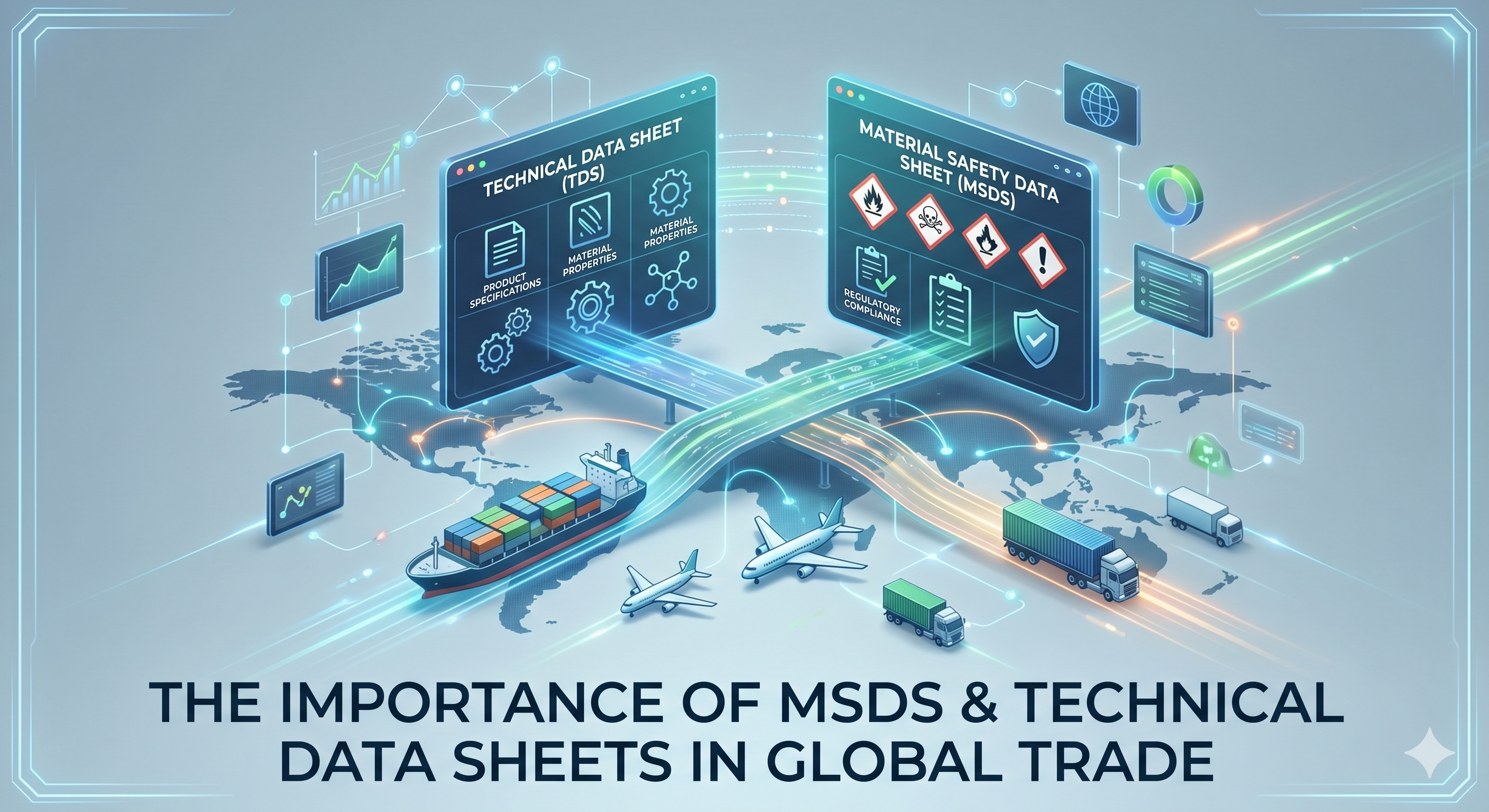
In the modern global economy, the movement of goods across borders is often viewed through the lens of logistics—ships, planes, and trucks. However, there is an invisible infrastructure of data that dictates whether a shipment moves smoothly or faces a costly, and sometimes dangerous, standstill. At the heart of this data infrastructure are two critical documents: the Material Safety Data Sheet (MSDS)—now more commonly referred to as the Safety Data Sheet (SDS) under international standards—and the Technical Data Sheet (TDS).
While a TDS describes what a product can do, the MSDS describes how to handle it safely. Together, they form the “passport” and “user manual” of any industrial or chemical product entering the global market. As supply chains become more complex and regulations like REACH and GHS become more stringent, understanding these documents is no longer just a task for compliance officers; it is a strategic necessity for entrepreneurs, engineers, and international traders.
1. Defining the Pillars: MSDS/SDS vs. TDS
To appreciate their importance, we must first distinguish between these two frequently confused documents.
The Technical Data Sheet (TDS): The Performance Profile
A Technical Data Sheet is a document provided by a manufacturer that summarizes the performance and other technical characteristics of a product. It is primarily a marketing and engineering tool. If you are selling a high-performance polymer or a specialized metal powder, the TDS is what the buyer’s engineering team will study to see if the material meets their specifications.
Key elements of a TDS include:
-
Physical Properties: Density, viscosity, melting point, and color.
-
Performance Metrics: Tensile strength, electrical conductivity, or thermal resistance.
-
Application Instructions: Recommended temperatures for processing or mixing ratios.
-
Certifications: Compliance with industry-specific standards (e.g., ISO, ASTM).
The Safety Data Sheet (SDS/MSDS): The Risk Compass
The SDS is a regulatory document. Its primary purpose is to protect human health and the environment. It provides comprehensive information about a substance or mixture for use in workplace chemical management. Since the adoption of the Globally Harmonized System of Classification and Labelling of Chemicals (GHS), the SDS has been standardized into a 16-section format used worldwide.
2. The Science of Safety: Clinical Foundations and Toxicology
An SDS is not just a collection of warnings; it is a summary of rigorous scientific research. When we look at Section 11 (Toxicological Information) of an SDS, we are seeing the results of years of clinical studies and laboratory testing.
LD50 and LC50: The Benchmarks of Toxicity
The scientific data within an SDS is often derived from “Lethal Dose” (LD50) and “Lethal Concentration” (LC50) studies. These clinical benchmarks represent the amount of a substance required to kill 50% of a test population. For global trade, these numbers determine the hazard classification of a product. If a new carbon-based nanomaterial shows a lower LD50 in recent clinical trials than previously thought, its SDS must be updated immediately to reflect higher risk, impacting how it is shipped and insured.
Inhalation and Dermal Studies
Current research in occupational health has shifted focus toward long-term (chronic) exposure rather than just immediate (acute) toxicity. For instance, recent studies on the inhalation of micronized powders have led to stricter requirements in SDS Section 8 (Exposure Controls/Personal Protection). Scientific research into “nanotoxicology” has revealed that materials at the nanoscale can behave differently in the human body than their bulk counterparts, leading to a new era of “Nano-specific SDS” that account for high surface area and cellular penetration.
3. The 16-Section SDS: A Global Standard
Under the GHS framework, the SDS is organized to ensure that emergency responders and workers can find information quickly.
-
Identification: Product and company info.
-
Hazard Identification: Hazards of the chemical and the appropriate warning information.
-
Composition/Information on Ingredients: Identifying the chemical ingredients.
-
First-Aid Measures: Initial care that should be given by untrained responders.
-
Fire-Fighting Measures: Recommendations for fighting a fire caused by the chemical.
-
Accidental Release Measures: Cleanup and containment.
-
Handling and Storage: Safe handling practices.
-
Exposure Controls/Personal Protection: TLVs (Threshold Limit Values) and PPE.
-
Physical and Chemical Properties: The “science” of the substance.
-
Stability and Reactivity: Chemical stability and the possibility of hazardous reactions.
-
Toxicological Information: Clinical data on health effects.
-
Ecological Information: Impact on the environment.
-
Disposal Considerations: Proper waste management.
-
Transport Information: Requirements for shipping (UN numbers).
-
Regulatory Information: Safety, health, and environmental regulations.
-
Other Information: Date of preparation or last revision.
4. The Role of TDS in B2B Decision Making
In global trade, the TDS is the first step in the technical sales funnel. While the SDS ensures the product is allowed to enter a country, the TDS ensures the customer actually wants to buy it.
For industries involved in advanced manufacturing—such as those dealing with graphene, carbon nanotubes, or specialized metal powders—the TDS is a critical competitive tool. It provides the empirical evidence of a product’s superiority. For example, a TDS for a conductive coating might highlight a specific “Sheet Resistance” measured in $\Omega/sq$. This precision allows engineers to calculate the efficiency of their final product before even placing a sample order.
5. Advantage–Risk Evaluation: Why Documentation Matters
The Advantages of High-Quality Documentation
-
Streamlined Customs Clearance: Complete and accurate SDS and TDS minimize the risk of “red channel” inspections. If customs agents can clearly identify a substance’s UN number and hazard class, the shipment is less likely to be detained.
-
Reduced Liability: In the event of a workplace accident involving your product, having provided a compliant, science-backed SDS is your primary legal defense. It proves that you fulfilled your “Duty to Warn.”
-
Enhanced Brand Trust: Professional documentation signals to global partners that a company is sophisticated and reliable. It reduces the “perceived risk” of trying a new supplier from across the globe.
-
Insurance Optimization: Marine and cargo insurers often require these documents to assess the risk of a voyage. Accurate data can lead to lower premiums.
The Risks of Poor Documentation
-
Financial Penalties: Many jurisdictions, including the EU (under REACH) and the US (under OSHA), impose heavy fines for missing or inaccurate SDS information.
-
Environmental Catastrophes: If Section 6 (Accidental Release) is vague or incorrect, a spill during transit could lead to irreversible ecological damage and massive cleanup costs for the exporter.
-
Product Rejection: If the TDS claims a performance level that the product cannot meet, it leads to costly returns, chargebacks, and a damaged reputation.
-
Worker Safety: The most significant risk is human. Inaccurate toxicological data can lead to improper PPE selection, resulting in long-term health issues for employees handling the materials.
6. Current Trends: Digitalization and “Green” SDS
The world of industrial documentation is undergoing a digital revolution. We are moving away from dusty binders of paper toward Smart SDS.
QR Codes and Real-Time Updates
Many global manufacturers now include QR codes on product packaging that link directly to the latest digital version of the SDS and TDS. This ensures that the user always has the most current version, which is vital since scientific understanding of chemical risks is constantly evolving.
The Rise of “Green” Chemistry
As the world pivots toward sustainability, TDS documents are increasingly including “Environmental Impact Scores” and “Life Cycle Assessment” (LCA) data. Modern research into biodegradable polymers and non-toxic solvents is being reflected in these documents, helping companies meet their ESG (Environmental, Social, and Governance) goals.
7. Conclusion: The Passport to Global Success
In the intricate dance of global trade, the MSDS/SDS and TDS are more than just paperwork. They are the synthesis of laboratory science, legal compliance, and marketing strategy. The TDS opens the door by proving the product’s value, while the SDS keeps the door open by ensuring safety and regulatory adherence.
For any business looking to lead in sectors like nanotechnology, advanced materials, or chemicals, mastery of these documents is non-negotiable. By investing in accurate, scientifically grounded, and professionally presented technical and safety data, companies do more than just follow the law—they build a foundation of trust that spans continents.