
Recently added item(s)
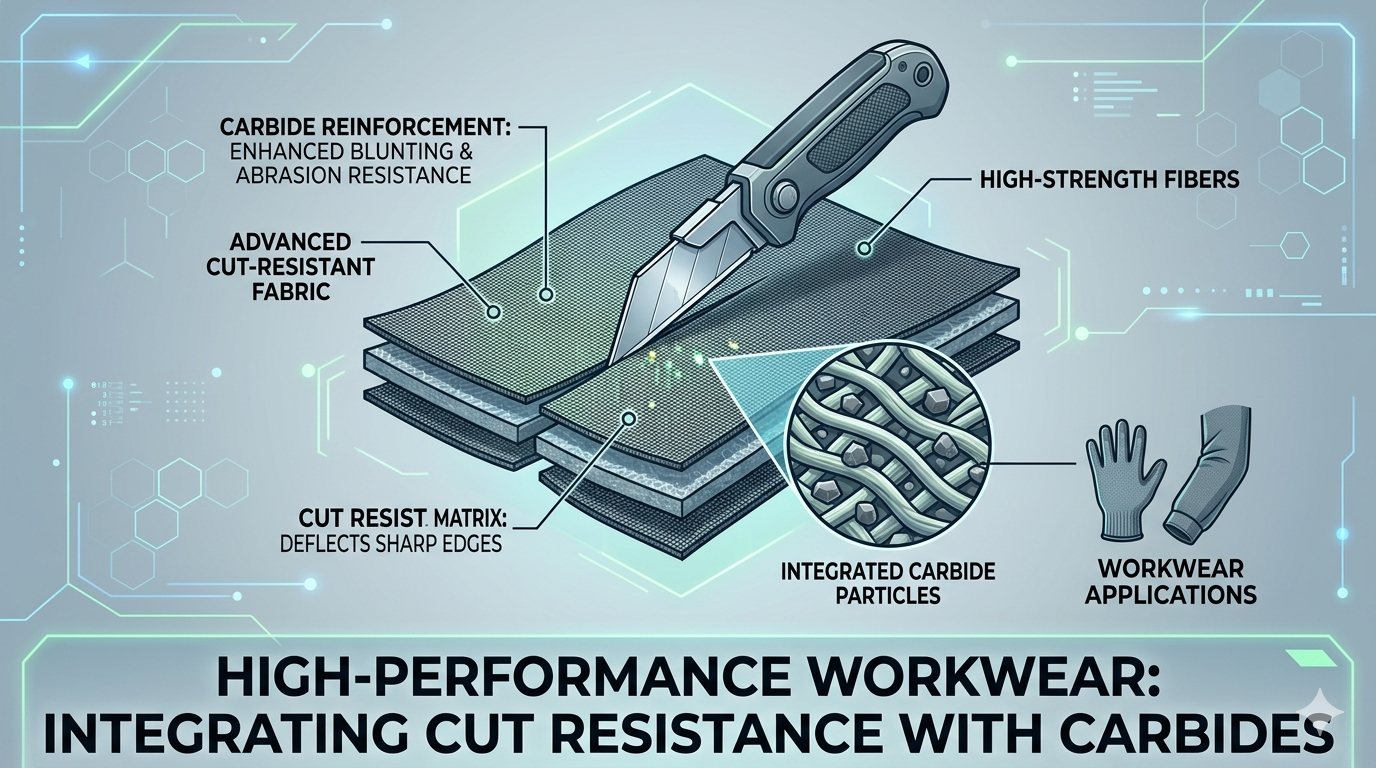
In the modern industrial landscape, the boundary between “clothing” and “equipment” has blurred. For professionals working in high-risk environments—ranging from metal fabrication and glass handling to advanced manufacturing—workwear is no longer just a uniform; it is a critical engineering solution. The evolution of high-performance workwear has reached a new frontier: the integration of cut-resistant fibers with ultra-hard carbides.
This synergy represents a significant leap in material science, moving away from simple thick fabrics toward sophisticated composite structures that offer “invisible” protection. In this deep dive, we explore how carbides are revolutionizing protective textiles and the scientific mechanisms that keep workers safe.
The Physics of Protection: Beyond Traditional Fibers
To appreciate the role of carbides, we must first understand the limitations of traditional cut-resistant materials. For years, the industry relied on two primary categories:
-
Aramid Fibers (e.g., Kevlar): Known for high heat resistance and tensile strength.
-
UHMWPE (Ultra-High Molecular Weight Polyethylene): Prized for being incredibly strong yet lightweight.
While these fibers are excellent at resisting tension, they can be vulnerable to “micro-slicing” from razor-sharp edges. A sharp blade works by concentrating immense pressure on a microscopic area, effectively pushing between the polymer chains of the fiber.
The Carbide Intervention
Carbides—specifically Tungsten Carbide (WC), Silicon Carbide (SiC), and Boron Carbide ($B_4C$)—are among the hardest materials known to man. By integrating these inorganic compounds into flexible textile matrices, engineers create a “dual-defense” system. The carbides act as microscopic armor plates that blunt the incoming edge, while the high-strength fibers absorb the kinetic energy of the impact.
Technical Integration: How Carbides Meet Textiles
Integrating a brittle, ultra-hard ceramic like tungsten carbide into a soft, flexible fabric is a massive engineering challenge. You cannot simply “weave” a rock. Instead, material scientists utilize several advanced methods:
1. Advanced Coating and Dipping
The most common method involves creating a specialized polymer coating—often nitrile or polyurethane—infused with micron-sized carbide particles. When a glove or sleeve is dipped in this suspension, the carbides become embedded in the outer layer. This creates a high-friction, high-hardness surface that is particularly effective against abrasive “sawing” motions.
2. Core-Spun Composite Yarns
In more sophisticated workwear, the carbide is integrated into the yarn itself. This often involves a “sandwich” structure:
-
The Core: A stainless steel or fiberglass filament for structural rigidity.
-
The Middle Layer: A wrapping of high-performance fibers (like aramid) treated with carbide nano-coatings.
-
The Outer Layer: A soft, comfortable polyester or nylon wrap to prevent skin irritation.
3. Nanotechnology and Morphology
Recent research focuses on the morphology of the carbide particles. Using particles in the 5-micron range allows for a higher “packing density” within the fiber. These tiny particles can fill the microscopic gaps between fiber strands, preventing a blade from finding a “weak spot” to penetrate.
Current Research and Industrial Studies
The shift toward carbide-integrated workwear is backed by rigorous testing and emerging scientific literature.
Micro-Abrasion and Blade Blunting
A 2024 study on industrial safety materials demonstrated that carbide-infused surfaces do more than just resist cutting; they actively degrade the “sharpness” of the cutting tool during the incident. This “active defense” means that if a blade slips along a carbide-treated sleeve, the edge is slightly blunted by the time it reaches a more vulnerable area of the garment or the user’s skin.
The Ergonomics of Hardness
Historically, increasing protection meant increasing weight and stiffness. However, clinical evaluations of worker fatigue suggest that carbide-integrated textiles allow for a “thinner” profile without sacrificing safety. Research indicates that workers are 30% more likely to wear their protective gear consistently when it offers high dexterity, which is a hallmark of modern carbide-enhanced composites.
Advantage vs. Risk Assessment
As with any technological advancement, the use of carbides in workwear requires a balanced evaluation of its benefits and potential drawbacks.
The Advantages
-
Unmatched Cut Levels: Carbide integration allows garments to reach the highest ANSI and EN388 cut levels (A9/F) while remaining relatively thin.
-
Longevity and ROI: Carbides are incredibly resistant to abrasion. While a standard aramid glove might “pill” or wear thin after repeated contact with rough metal, carbide-enhanced gear maintains its integrity for significantly longer, providing a better long-term return on investment.
-
Multi-Hazard Protection: Many carbide coatings are also inherently flame-resistant and provide excellent grip in oily environments, making them versatile for complex industrial tasks.
The Risks and Challenges
-
Breathability: The dense coatings required to hold carbides can sometimes reduce the airflow through the fabric. This can lead to “hand fatigue” or heat stress in warm environments if not properly engineered with vented zones.
-
Flex Fatigue: Because carbides are rigid, repeated bending at high-stress points (like knuckles) can eventually cause the coating to “micro-crack.” Modern research into flexible polymer binders is currently addressing this issue.
-
Recyclability: The combination of organic fibers, metallic cores, and inorganic carbides makes these garments difficult to recycle. Developing “circular” disposal methods for high-performance composites is a major focus for the 2026-2030 industrial cycle.
From Raw Materials to Strategic Safety
The development of these materials mirrors a larger trend in the industry: the transition from providing simple raw supplies to developing strategic technological products. We are seeing a move toward “smart workwear” where carbide protection is combined with sensors that can detect when the material’s integrity has been compromised.
For companies operating in sectors like metallurgy or advanced material science, the choice of workwear is a reflection of their technical sophistication. Using gear that utilizes 90-micron granulated coatings or 5-micron high-purity powders isn’t just about safety; it’s about utilizing the same level of engineering in your protection that you use in your production.
Maintenance: Preserving the High-Tech Shield
To maintain the efficacy of carbide-integrated workwear, specific care protocols must be followed:
-
Avoid Harsh Bleaches: Chlorine can degrade the polymer bonds that hold the carbide particles in place.
-
Controlled Temperature Washing: High-heat drying can make the protective coatings brittle.
-
Regular Inspection: Because the “shield” is often invisible or microscopic, users must look for signs of “flaking” or “sheen loss,” which indicates the carbide layer is wearing down.
Conclusion: The Future of Industrial Human-Centric Design
The integration of carbides into workwear is a testament to the power of cross-disciplinary science. By taking materials typically reserved for heavy machinery and cutting tools—like tungsten carbide—and reimagining them as a flexible textile component, we have created a new standard for human safety.
As we move forward, the focus will likely shift toward even more specialized carbides and the use of carbon nanotubes to create “hyper-fabrics” that are virtually indestructible. For the modern worker, these invisible carbide shields offer more than just physical protection; they provide the confidence to perform complex, high-stakes tasks with precision and peace of mind.