
Recently added item(s)
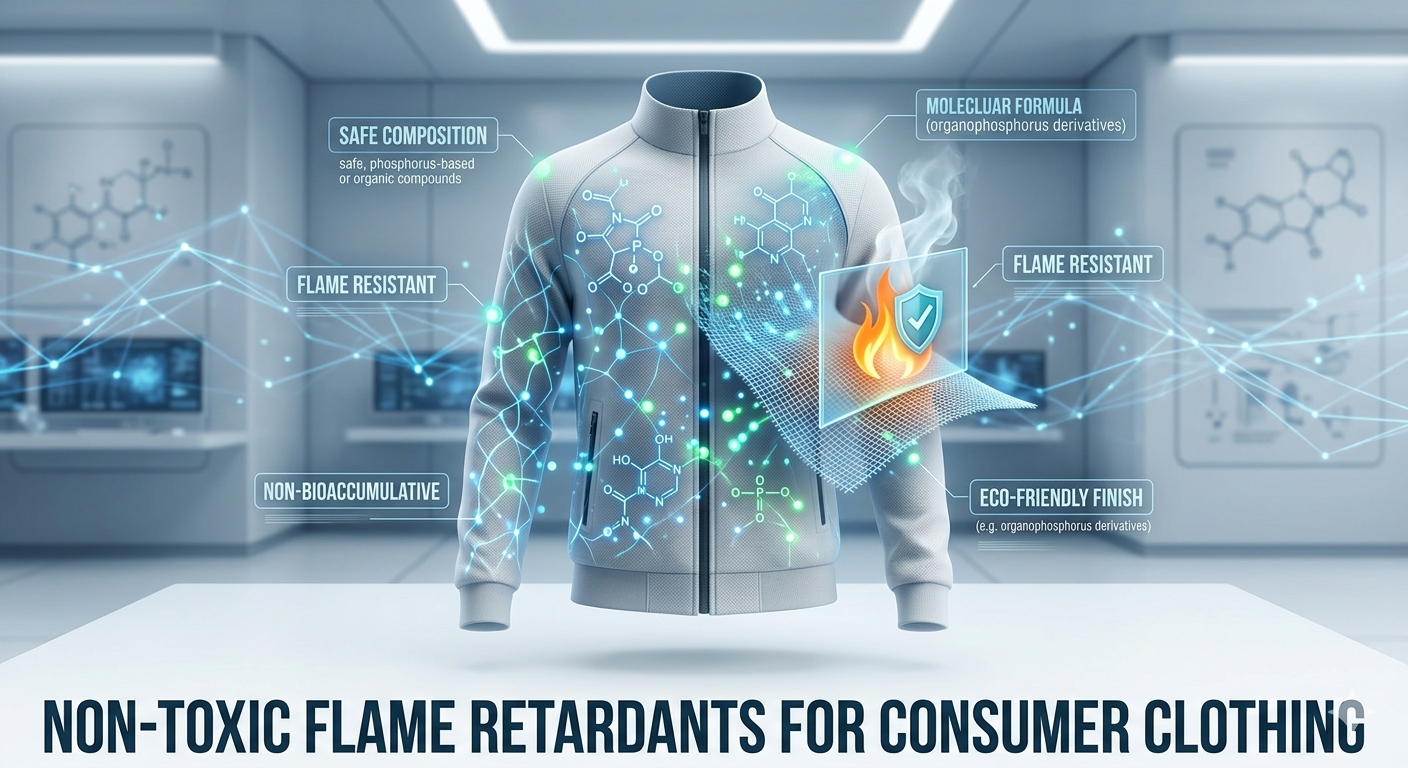
We often focus on the comfort, style, and durability of the clothes we wear every day. However, an invisible layer of chemistry exists within many textiles—one designed to protect us from fire. Flame retardants (FRs) are substances applied to materials to prevent or slow the spread of fire. For decades, the industry relied on highly effective, but ultimately problematic, chemical compounds to meet safety standards.
Today, a significant shift is underway. Driven by alarming scientific evidence concerning human health and environmental impact, researchers and apparel manufacturers are urgently seeking and developing a new generation of non-toxic flame retardants for consumer clothing. This blog post will explore the scientific necessity of this transition, the innovative technologies leading the way, and the advantages and risks of this vital evolution in wearabls safety.
The Flammable Truth: Why Apparel Needs Fire Protection
To understand the shift, we must first appreciate the hazard. Clothing flammability is a significant public safety concern. When a textile ignites, it doesn’t just burn; it can melt, drip, and adhere to the skin, causing devastating, deep-tissue burn injuries.
The flammability of a garment depends primarily on its fiber composition:
-
Natural Cellulose Fibers (e.g., Cotton, Linen): These fibers ignite easily, burn rapidly, and produce hot, flowing ashes.
-
Synthetic Fibers (e.g., Polyester, Nylon): While they may resist ignition slightly better than cotton, synthetics often melt and drip when exposed to intense heat, causing severe contact burns.
Historically, the response to this risk was to coat textiles in powerful fire-suppressing chemicals. This was particularly mandatory for children’s sleepwear, carpets, and upholstery, governed by strict standards like the U.S. Flammable Fabrics Act.
The Invisible Danger: The Toxic Legacy of Halogenated Flame Retardants
The most common class of flame retardants used throughout the latter half of the 20th century were halogenated flame retardants, primarily those containing bromine or chlorine. Key examples include Polybrominated Diphenyl Ethers (PBDEs).
The Scientific Problem
Halogenated FRs work incredibly well in the “gas phase” of a fire. When heated, they release halogen radicals that interrupt the chemical chain reaction of combustion, essentially “quenching” the flames before they can spread.
However, their effectiveness came with a massive hidden cost, revealed through decades of scientific research and toxicity assessments:
-
Persistence and Bioaccumulation: These chemicals are chemically stable and do not break down easily in the environment. They are “forever chemicals.” They escape from textiles through dust or washing, entering ecosystems where they accumulate in the fatty tissues of animals and humans.
-
Human Health Risks: Numerous studies have linked exposure to halogenated FRs to a range of adverse health effects. Clinical observations and toxicological research on animal models indicate they can act as:
-
Endocrine Disruptors: Interfering with thyroid hormone function, which is critical for brain development.
-
Reproductive Toxins: Impairing fertility and affecting fetal development.
-
Neurodevelopmental Toxins: Linked to lower IQ, attention deficit disorders, and motor skill issues in children prenatally exposed.
-
-
Toxic Combustion By-products: Ironically, when these chemicals do burn in a real-world fire, they can produce highly toxic gases, including dioxins and furans, which pose severe risks to victims and firefighters.
Due to these findings, many older halogenated FRs have been banned or voluntarily phased out globally under international agreements like the Stockholm Convention. This created a critical void: the industry needed to maintain fire safety without sacrificing human health.
The Innovation Shift: Defining “Non-Toxic” Flame Retardancy
The search for non-toxic alternatives is not about finding a single magic chemical. It is a multi-pronged scientific approach to create FR systems that are inherently safer throughout their life cycle—from production to use to disposal.
What Does “Non-Toxic” Mean in Apparel?
In the context of the textile industry’s modern shift, “non-toxic” generally implies FR technologies that satisfy several criteria:
-
Low or Zero Toxicity: The chemicals themselves do not show evidence of acute or chronic toxicity (carcinogenicity, mutagenicity, or reproductive toxicity).
-
Non-Bioaccumulative: The substances do not accumulate in living organisms.
-
Formaldehyde-Free: Traditional FR finishing processes for cotton often used formaldehyde-based resins as cross-linkers, which is a known human carcinogen. Non-toxic finishes must be formaldehyde-free.
-
Permanence: A non-toxic FR must be chemically bound to the fiber so it doesn’t “bleed” onto the wearer’s skin or wash out into the water supply.
There are two primary scientific routes to achieving this in consumer clothing: using inherently fire-resistant fibers or applying permanent, environmentally friendly treatments.
Frontiers of Research: Leading Non-Toxic Flame Retardant Technologies
Current research in textile chemistry is exceptionally dynamic. We can categorize the most promising non-toxic FR technologies into several groups based on their scientific mechanisms.
1. Phosphorus-Based Flame Retardants
Phosphorus compounds have emerged as the leading alternative to halogens. Unlike halogens that work in the gas phase, phosphorus-based systems primarily operate in the condensed phase (the solid material).
Scientific Mechanism: Char Formation
When exposed to heat, phosphorus compounds decompose to form phosphoric acid. This acid acts as a catalyst, promoting the dehydration of cellulosic fibers (like cotton). Instead of burning into volatile gases that fuel the fire, the fabric decomposes into a stable, insulating layer of carbonaceous char. This char acts as a physical barrier, blocking oxygen from reaching the fabric and shielding the underlying material from heat.
-
Advantages: Phosphorus compounds are generally considered to have lower toxicity than halogens. They can be covalently bound to cotton fibers, ensuring high wash permanence.
-
Examples: Ammonium polyphosphate (APP), organophosphorus monomers. Recent research focuses on reducing the total amount of phosphorus needed by combining it with synergists like nitrogen.
2. Inorganic Mineral Flame Retardants
These are the simplest and, in some ways, the safest FRs. The most common examples are Metal Hydroxides, specifically Aluminum Hydroxide ($Al(OH)_3$) and Magnesium Hydroxide ($Mg(OH)_2$).
Scientific Mechanism: Endothermic Cooling and Water Release
These minerals work purely physically. They require a significant amount of heat to decompose (they are endothermic). When they reach their decomposition temperature, they absorb heat from the fire, cooling the fabric. Simultaneously, they release water vapor ($H_2O$), which dilutes the flammable gases around the material and creates a protective vapor barrier.
-
Advantages: Zero toxicity, low smoke production, and very environmentally friendly.
-
Risks/Challenges: Their fire-suppressing efficiency is relatively low. To achieve a good FR rating, they must be applied in high concentrations (“loading”). This high loading can significantly degrade the softness, drape, and mechanical strength of consumer apparel, making them more suitable for industrial wear than a t-shirt.
3. Bio-Based Flame Retardants
A truly sustainable frontier involves using natural, renewable biopolymers as flame retardants. This supports a “circular economy” and minimizes reliance on fossil fuels.
Frontier Research Examples:
-
Phytic Acid: Found in plant seeds and beans, phytic acid is rich in phosphorus. Studies have demonstrated its efficacy in promoting char formation on cotton when applied in combination with other natural compounds like chitosan (derived from shellfish shells) or casein (milk protein). An emerging concept from recent research involves creating hybrid coatings using phytic acid and agricultural waste products, such as micronized eggshells (rich in calcium carbonate, which can act as a heat sink).
-
Lignin: A major component of plant cell walls, lignin is inherently rich in aromatic rings, making it a natural char-promoter. Researchers are investigating how to chemical modify lignin to make it water-soluble and suitable for textile finishing.
4. Nanotechnology Applications
Nanotechnology offers a way to create highly effective fire barriers using minimal amounts of additives.
Scientific Mechanism: Tortuous Path Barrier
Nanoparticles, such as nano-clays or metal oxides, can be applied to fibers, often using a “Layer-by-Layer” (LbL) assembly technique. This creates a nanoscopic coating on individual fibers. When exposed to heat, these nanoparticles create a convoluted (“tortuous”) path for volatile gases attempting to escape and oxygen trying to enter, effectively stifling the combustion process at the surface.
Safety Assessment and “Clinical” Perspectives
It is important to clarify that “clinical studies” in the context of flame retardants rarely involve humans wearing treated garments to test for health effects. Instead, safety assessment relies on comprehensive toxicological and safety screening of the FR chemicals themselves.
Modern Safety Evaluation Protocols
For an FR chemisty to be considered genuinely non-toxic for apparel, it must undergo rigorous screening, which often includes:
-
Cytotoxicity Tests: Assessing whether an extract of the treated fabric is toxic to human skin cells grown in a lab culture. A “non-toxic” fiber should have no inhibitory effect on cell growth.
-
Skin Irritation and Sensitization Studies: Conducted on validated model systems to ensure the treatment does not cause allergic reactions or dermatitis.
-
pH Stability: Ensuring the fabric maintains a slightly acidic pH (5.5–7.5), consistent with the skin’s natural barrier, to prevent irritation.
-
REACH and OEKO-TEX Compliance: Compliance with international regulations like REACH (Registration, Evaluation, Authorisation, and Restriction of Chemicals) in Europe or independent certifications like OEKO-TEX ECO PASSPORT provides a level of verification that restricted, hazardous substances are absent.
While these assessments offer high confidence in the safety of the new chemistry compared to the old, independent scientific scrutiny remains vital to ensure that new alternatives do not have unforeseen long-term effects.
Advantage-Risk Evaluation: Weighing the New Generation
The transition to non-toxic flame retardants is necessary, but it involves technical trade-offs.
Advantages
-
Improved Human Health: The primary benefit is the reduction of wearer exposure to bioaccumulative, endocrine-disrupting chemicals.
-
wearer Safety (Toxic Gases): Non-toxic, char-forming FRs (especially phosphorus) often reduce the amount of toxic Carbon Monoxide (CO) and Hydrogen Cyanide (HCN) released during combustion, providing a clearer evacuation path in an emergency.
-
Environmental Sustainability: Bio-based and inorganic alternatives are significantly more eco-friendly throughout their lifecycle.
-
Regulatory Compliance: They allow manufacturers to meet fire safety standards without violating strict chemical restriction laws.
Risks and Challenges
-
Wearer Comfort (“Hand Feel”): Inorganic and some phosphorus FRs require high loading, which can make fabrics stiff, heavy, or less breathable. Research focuses on optimizing performance at lower loading.
-
Durability (Permanence): Creating non-toxic finishes that are “permanent durable”—meaning they resist degradation after 50 or more industrial laundry cycles—remains a major scientific challenge, particularly for bio-based solutions.
-
Mechanical Strength: Chemical treatments, particularly those designed to react with cellulose, can slightly weaken the base fiber, reducing the fabric’s overall tensile and tear strength.
-
Cost and Scalability: Many advanced nano-coatings and bio-based systems are currently more expensive to produce at scale than traditional halogenated finishes.
Conclusion: The Wearable Future
The invisible layer of chemistry within our clothing is undergoing a quiet revolution. Science has conclusively shown that the old method of using toxic “forever chemicals” to achieve fire safety is unsustainable and hazardous.
The rise of non-toxic flame retardants—powered by phosphorus chemistry, nanotechnology, and natural, renewable polymers—represents a massive step forward. These innovations offer a path toward inherently safer apparel, where we no longer have to choose between protection from fire and protection from chemical exposure. As computational modeling improves FR design and bio-based production scales up, we can look forward to a future where every garment is safe, comfortable, sustainable, and truly non-toxic.