
Recently added item(s)
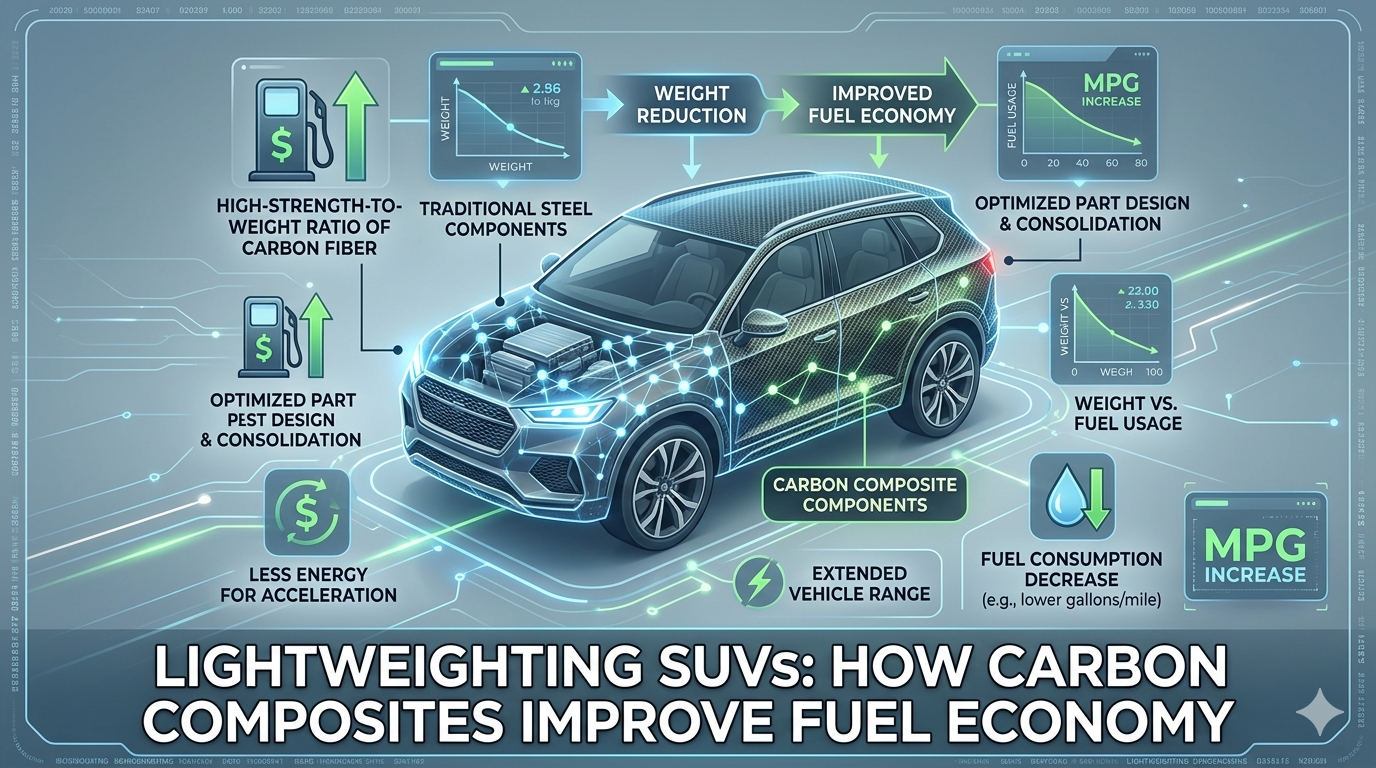
Sports Utility Vehicles (SUVs) have taken over the world’s roads. They offer utility, comfort, a commanding view of the road, and a sense of safety that many drivers find irresistible. However, there is a fundamental engineering paradox built into every SUV: their size and weight are their greatest selling points, yet their greatest enemies of efficiency.
Historically, making a vehicle safer and more luxurious meant making it heavier. Modern SUVs are packed with steel reinforcement beams, sophisticated multi-zone climate control systems, massive infotainment screens, and electric seat motors. While these features enhance the user experience, they add significant mass. Moving that mass requires energy.
In an internal combustion engine (ICE) vehicle, that energy comes from burning fossil fuels. In an electric vehicle (EV), it comes from chemical energy in a battery. Regardless of the power source, if you reduce the weight of the vehicle, you reduce the energy required to move it. This is the simple premise of vehicle lightweighting, and the automotive industry is currently undergoing a materials revolution, with carbon fiber composites leading the charge to make the iconic SUV compatible with a sustainable future.
The Physics of Miles per Gallon: Why Weight Matters
To understand why lightweighting is the “Holy Grail” of automotive engineering, we need to revisit a little classical physics. To move any object—whether a grocery cart or a 5,000-pound SUV—you must overcome inertia. According to Isaac Newton’s Second Law ($Force = Mass \times Acceleration$), the more massive an object is, the more force is needed to accelerate it.
Once the SUV is up to speed, you still need force to keep it moving against air resistance (aerodynamic drag) and rolling resistance (the friction between the tires and the road). SUVs have a double disadvantage here: their sheer mass means high inertia and high rolling resistance, while their boxy shape means high aerodynamic drag.
Experts at the Union of Concerned Scientists (UCS) and other engineering institutions estimate a reliable rule of thumb: for every 10% reduction in vehicle weight, fuel consumption can be cut by approximately 7%. In an ICE vehicle, this translates directly to better miles per gallon (MPG) and lower tailpipe emissions. For EVs, lightweighting translates to an equally crucial metric: increased range from the same battery pack. When you are dealing with a vehicle class as naturally heavy as an SUV, shaving off 10% can mean hundreds of pounds, leading to substantial gains in efficiency.
Enter the Superhero Material: Carbon Fiber Reinforced Polymer (CFRP)
Traditionally, vehicles were made of steel. While cheap and strong, steel is dense (heavy). Aluminum became the first major alternative, offering significant weight savings, but it cannot match the extreme strength-to-weight ratio of carbon composites.
Carbon Fiber Reinforced Polymer (CFRP), often simply called “carbon fiber,” is not a metal; it is a composite material. It consists of two primary components:
-
The Fiber: Thousands of incredibly thin strands of carbon atoms, bonded together in a crystalline structure. By weight, these fibers are significantly stronger and stiffer than steel.
-
The Matrix: A polymer resin (like epoxy) that surrounds the fibers, binds them together, and allows them to distribute loads throughout the component.
You can think of it like reinforced concrete: the steel rebar provides tensile strength, and the concrete holds it all in shape. In CFRP, the carbon fibers are the “rebar,” and the polymer matrix is the “concrete.” The final product is a material that is up to 50–60% lighter than steel but offers equivalent or superior strength. Crucially for automotive designers, CFRP can be engineered with anisotropic properties—meaning its strength can be tuned in specific directions depending on how the fibers are woven, allowing for part optimization that is impossible with standard metals.
The MPG Dividend: Quantifying Carbon Fiber’s Impact on SUVs
When an automaker replaces a steel or aluminum SUV component with a CFRP part, the results on fuel economy are measurable and significant. We are no longer limited to niche supercars; the technology is migrating down to luxury SUVs and high-performance electric crossovers.
Weight Loss in Critical Areas
Lightweighting an SUV doesn’t mean just one component. It’s an integrated strategy:
-
Body Panels and Closures: CFRP hoods, roofs, and liftgates are becoming more common. A carbon fiber roof reduces weight at the vehicle’s highest point, lowering the center of gravity and improving stability—a major benefit for tall SUVs.
-
Chassis and Structures: This is where the most significant gains lie. Some luxury SUVs now utilize CFRP “carbon cores” in conjunction with high-strength steel and aluminum to create a chassis that is both remarkably rigid and lightweight. A stiff chassis improves handling, allowing the suspension to work more efficiently.
-
Powertrain Components: Lightweighting rotating mass is even more beneficial. CFRP driveshafts are common in performance SUVs because they require less energy to rotate, resulting in sharper throttle response and marginal gains in powertrain efficiency.
Quantifiable Case Studies from Automotive Research
Research published by bodies such as McKinsey & Company and the Massachusetts Institute of Technology (MIT) confirms that extreme lightweight concepts utilizing significant amounts of carbon fiber are essential for meeting stringent future fuel economy and emission targets, particularly as powertrains become heavier due to electrification.
McKinsey’s research predicts a massive shift, with the automotive industry increasing its “lightweight material” share from 30% to 70% by 2030, with CFRP positioned as the material offering the “highest weight reduction potential.” When an automaker shaves 200 kg (440 lbs) off a luxury luxury vehicle, as has been achieved in some large sedan platforms migrating toward carbon cores, the MPG dividend is substantial. In an SUV, where the baseline weight is higher, the opportunity for a similar 5–10% improvement in fuel economy is readily achievable through aggressive CFRP adoption.
Technical and ‘Clinical’ Studies: Safety and Crash Performance
A common concern when drivers think of “plastic” composites replacing “strong” metals is safety. However, rigorous technical studies and crash testing data present a different reality. Genuinely “clinical” studies in the medical sense do not apply, but field testing and crash simulations from major OEMs demonstrate that CFRP is a potent tool for improving occupant safety.
Energy Absorption
While metals absorb crash energy by deforming plastically (crumpling), brittler CFRP absorbs energy by fracturing and shattering into thousands of smaller pieces. While this sounds alarming, it can be engineered to absorb incredibly high amounts of energy in a controlled manner.
Automakers use sophisticated computational modeling to design predictable crumple zones made of carbon composites. The BMW Project i vehicles (i3 and i8) were groundbreaking case studies: they utilized a complete “Carbon Life Module”—a cabin structure made entirely of CFRP. This created an incredibly strong safety cell for the occupants that resisted deformation better than comparable steel structures, while being significantly lighter. When engineered correctly, CFRP crash structures can meet or exceed the performance of traditional metals in regulatory crash tests.
The Advantage-Risk Evaluation of Carbon Fiber SUVs
While the fuel economy benefits are clear, CFRP is not a materials science miracle without drawbacks. Automakers must perform a careful matrix assessment of the trade-offs.
| Factor | Advantages | Risks and Challenges |
| Fuel Economy / Range | Highest potential for reduction: Directly translates to significant MPG gains (ICE) or increased range (EVs). | Lifecycle analysis suggests production is energy-intensive, reducing some tailpipe savings. |
| Manufacturing | Part Consolidation: Complex assemblies can sometimes be molded as a single carbon part, reducing assembly time. | High Cost: Raw material (precursors) and slow manufacturing cycle times are prohibitive for mass-market vehicles. |
| Performance | Stiffness-to-Weight: Improved handling, acceleration, and dynamic response due to lower mass and high rigidity. | Carbon fiber is brittle. While tough, it does not dent; it shatters or delaminates under localized impact. |
| Repair | Complex and Expensive: Minor damage that would be a simple dent in steel might require full component replacement in CFRP. Specialized repair facilities are rare. | |
| Sustainability | Fewer emissions during the “Use Phase” of the vehicle. | Recycling is Difficult: Thermoset resins (the “concrete”) cannot be easily melted down. Recycling carbon fiber often requires chemical dissolution or high heat, which degrades fiber quality. |
The Road Ahead: Reducing Cost and Closing the Loop
Currently, your family hatchback is unlikely to be made of carbon fiber because the manufacturing costs are roughly 20 times higher than using the same amount of steel. However, current research is focused on closing this gap.
Automated Production and New Resins
Major automakers like the Hyundai Motor Group have announced strategic collaborations with material suppliers like Toray Industries to expand the use of advanced carbon composites. Research is focused on automating the complex production processes, such as Resin Transfer Molding (RTM), to reduce slow cycle times.
Furthermore, the industry is moving toward thermoplastic resins, which, unlike the traditional thermoset resins, can be heated and remolded. This opens the door to more straightforward recycling methods, potentially making CFRP a fully circular material compatible with a zero-carbon automotive economy.
Lower-Cost Precursors
Research at institutions supported by the U.S. Department of Energy (DOE) is exploring ways to produce the precursor material for carbon fiber from renewable, low-cost biomass (like agricultural waste) instead of the traditional expensive petrochemical-based precursor, Polyacrylonitrile (PAN). If successful, this could reduce raw material costs significantly, making carbon fiber viable for standard, mass-produced SUVs.
Summary
Vehicle lightweighting is not optional; it is a critical requirement for a sustainable transportation future. In the highly popular but naturally heavy SUV segment, Carbon Fiber Reinforced Polymer (CFRP) provides an unmatched materials solution.
By replacing dense steel with this advanced composite, automakers can achieve hundreds of pounds of weight reduction, leading to substantial gains in fuel economy for ICE vehicles and a direct increase in range for electric SUVs. While challenges in cost, repair complexity, and circularity remain, the trend toward smarter, stronger, and lighter materials is irreversible. The athletic SUV of tomorrow will be built on a foundation of carbon composites, improving efficiency without compromising the utility and safety that drivers demand.