
Recently added item(s)
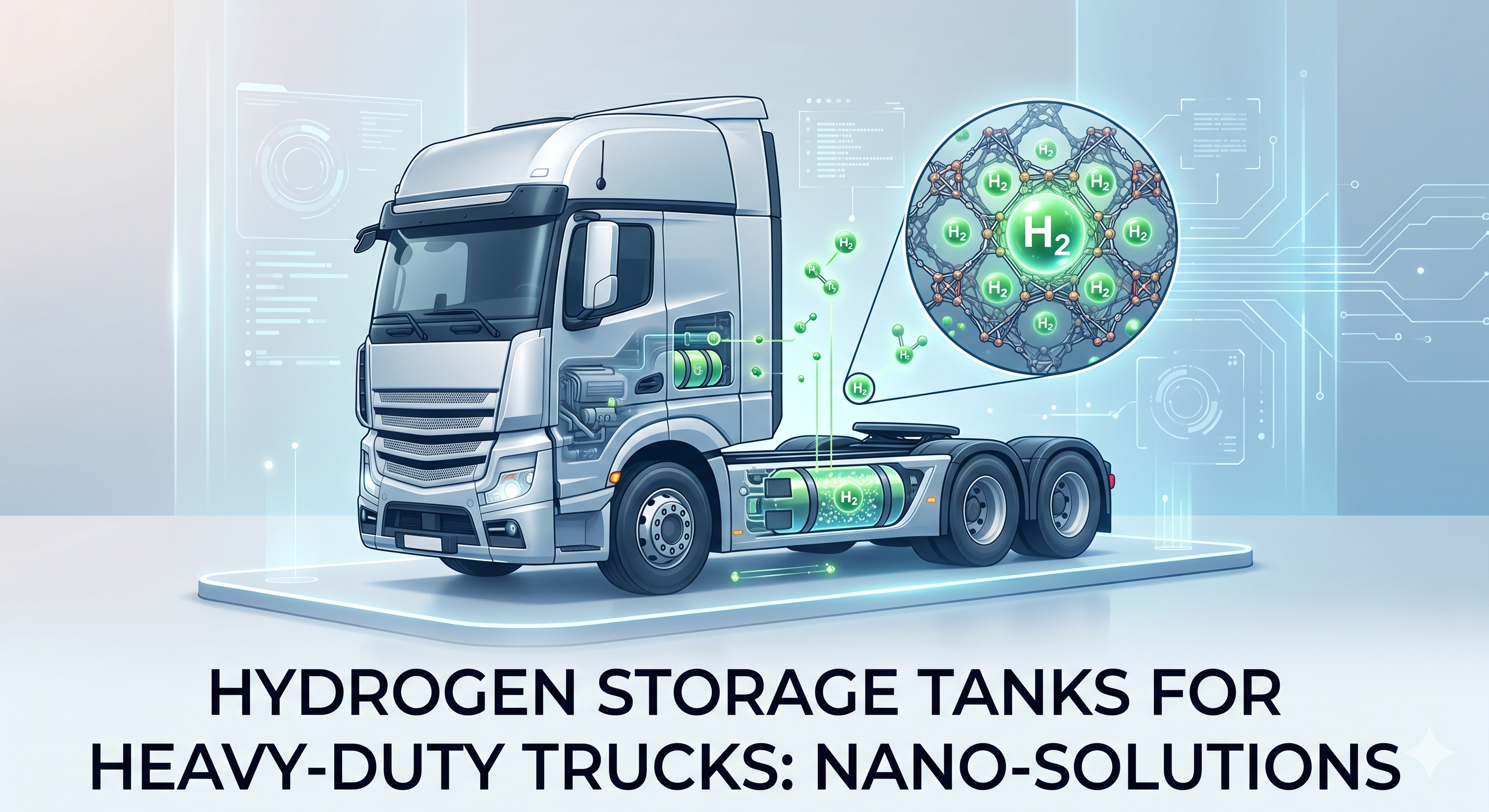
The global logistics industry is currently standing at a crossroads. While passenger vehicles have made a rapid transition toward battery electric power, the heavy-duty trucking sector faces a much steeper climb. For a 40-ton long-haul truck, the weight of the batteries required to achieve a 1,000-kilometer range would consume nearly a quarter of its payload capacity. This is where hydrogen steps in as the high-energy-density hero of zero-emission transport.
However, hydrogen has a “space” problem. As the lightest element in the universe, it is incredibly difficult to pack tightly. Traditional storage methods—high-pressure tanks or cryogenic cooling—are functional but far from optimized. This is where nanotechnology enters the frame. By manipulating matter at the atomic and molecular levels, researchers are developing “nano-solutions” that could make hydrogen storage safer, lighter, and far more efficient.
The Hydrogen Storage Dilemma: Why Current Tanks Aren’t Enough
To understand the value of nanotechnology, we must first look at the limitations of current Type IV composite tanks. These tanks typically store hydrogen at pressures of 350 or 700 bar.
-
Volumetric Efficiency: Even at 700 bar, hydrogen’s energy density is significantly lower than diesel. This means trucks need massive tanks that eat into cargo space.
-
The Weight Penalty: High-pressure tanks require thick carbon fiber walls to prevent catastrophic failure. This adds “dead weight” to the vehicle.
-
Permeation and Boiling: Hydrogen atoms are so small they can actually leak through the walls of solid steel or plastic liners over time. In the case of liquid hydrogen, “boil-off” losses occur as the fuel warms up, leading to wasted energy.
Nanotechnology aims to solve these issues not by just building “stronger” walls, but by changing how hydrogen is held within the tank itself.
Nanomaterials: The “Atomic Sponges” of Hydrogen Storage
The most promising area of research involves solid-state storage using nanomaterials. Instead of just squeezing gas into a void, we fill the tank with materials that have an astronomical surface area, allowing hydrogen molecules to “stick” to them (adsorption) or bond with them (absorption).
1. Metal-Organic Frameworks (MOFs)
Imagine a structure so porous that a single gram of it has the surface area of a football field. That is a Metal-Organic Framework. MOFs are crystalline materials consisting of metal ions coordinated to organic molecules to form one-, two-, or three-dimensional structures.
In recent studies (2024–2025), researchers have successfully engineered MOFs that can store hydrogen at much lower pressures than 700 bar while maintaining high density. By “tuning” the pore size at the nano-scale, these materials act like a sponge, pulling hydrogen molecules into their structure and packing them tighter than they would be in a pressurized vacuum.
2. Carbon Nanotubes (CNTs) and Graphene
Carbon is the backbone of the nanotechnology revolution. Carbon nanotubes and graphene sheets offer incredible mechanical strength and unique chemical properties.
-
Structural Reinforcement: Incorporating CNTs into the resin of carbon fiber tanks allows for thinner, lighter walls that can withstand higher pressures.
-
Adsorption: Graphene “sandwiches” can store hydrogen between layers. Recent breakthroughs in “pillared graphene” have shown that by creating nano-pillars between graphene sheets, we can create ideal spaces for hydrogen molecules to reside, significantly increasing the storage capacity per kilogram of tank weight.
3. Nano-Magnesium Hydrides
Magnesium hydride ($MgH_2$) is a well-known candidate for hydrogen storage because it can hold a large amount of hydrogen by weight. However, it traditionally requires very high temperatures to release that gas—not ideal for a truck that needs to start on a cold morning.
By reducing magnesium to nanocrystals and adding catalysts like titanium or nickel at the nano-scale, scientists have drastically lowered the “release temperature” and sped up the refueling process. This makes solid-state chemical storage a viable competitor to high-pressure gas.
Advantage-Risk Assessment: The Nano Perspective
Transitioning to nano-enabled hydrogen storage isn’t just about better specs; it’s about a fundamental shift in vehicle safety and economics.
The Advantages
-
Safety: Solid-state storage (using MOFs or hydrides) is inherently safer than high-pressure gas. If a tank is punctured, the hydrogen is released slowly as it de-bonds from the nanomaterial, rather than exploding in a high-pressure burst.
-
Energy Density: Nano-solutions can potentially double the range of heavy-duty trucks by storing more hydrogen in the same volume.
-
Lower Pressures: If we can store hydrogen effectively at 100 bar instead of 700 bar using MOFs, the entire infrastructure—from refueling stations to truck compressors—becomes cheaper and more durable.
The Risks and Challenges
-
Scalability and Cost: Producing high-quality graphene or specific MOFs in ton-scale quantities remains expensive. The “lab-to-factory” gap is the biggest hurdle for 2026 and beyond.
-
Thermal Management: When hydrogen “sticks” to a nanomaterial, it releases heat. When it is released, it absorbs heat. Managing these temperature swings during rapid refueling of a massive truck tank requires complex nano-fluid cooling systems.
-
Durability: How many times can a nano-sponge be filled and emptied before the structure degrades? Current research focuses on the “cycling stability” of these materials over a 10-year vehicle lifespan.
Recent Research and “Clinical” Industrial Trials
In late 2025 and early 2026, the focus has shifted from pure lab science to “Real-World Industrial Validation.”
Recent papers published in Nature Energy and Advanced Materials highlight a shift toward Hybrid Storage Systems. Instead of choosing between high pressure and nanomaterials, researchers are using a Type IV tank lined with a graphene-reinforced polymer and filled with a small amount of MOF “pellets.”
Early pilot programs in Northern Europe have begun testing these hybrid tanks in 18-wheeler configurations. The goal is to achieve a “Gravimetric Capacity” (the weight of the hydrogen vs. the weight of the tank) of over 6%. For context, most current systems struggle to hit 4%. Reaching 6-10% would effectively make hydrogen trucks lighter and more efficient than their diesel counterparts.
The Safety Protocol: Why Nanotechnology Wins
One of the greatest fears regarding hydrogen in the heavy-duty sector is the “Hindenburg Syndrome.” However, nanotechnology offers a “fail-safe” mechanism. Nano-porous materials act as a natural regulator. Because the hydrogen is physically or chemically bound to the material, the “leak rate” during an accident is controlled.
Furthermore, “Nano-coatings” on the interior of tanks are being developed to solve the problem of Hydrogen Embrittlement. Hydrogen atoms tend to seep into metals and composites, making them brittle and prone to cracking. Nano-ceramic coatings create an impenetrable barrier, extending the life of the storage system from 15 to 30 years.
Conclusion: Driving Toward 2030
The marriage of nanotechnology and hydrogen storage is not just a scientific curiosity; it is a necessity for the survival of long-haul logistics in a carbon-neutral world. While the “battery vs. hydrogen” debate continues, the reality is that heavy-duty transport requires the unique density that only hydrogen can provide.
As we move through 2026, the focus is clearly on bringing the cost of nanomaterial production down. Once we achieve economies of scale for MOFs and carbon-based nano-composites, the “Hydrogen Truck” will cease to be a prototype and become the standard for global trade. We are moving toward a future where the fuel of the stars is carried in tanks engineered at the scale of atoms.