
Recently added item(s)
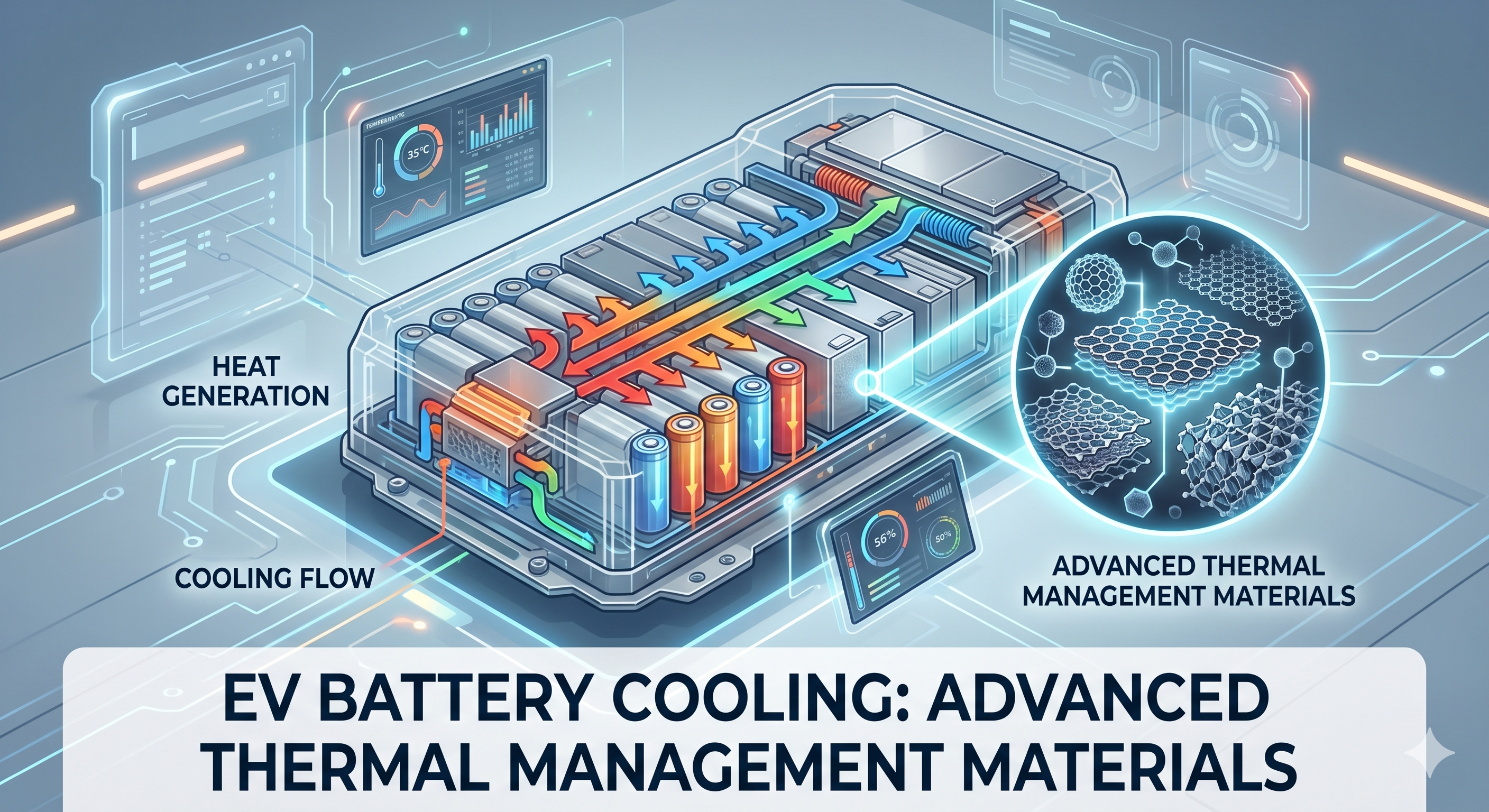
As the world pivots toward a carbon-neutral future, the electric vehicle (EV) has moved from a niche alternative to the primary driver of global mobility. However, the Achilles’ heel of the EV remains the lithium-ion battery. Beyond range and charging speed, the most critical factor determining a battery’s lifespan, safety, and performance is how it handles heat.
In the high-stakes world of automotive engineering, “Thermal Management” is no longer just about preventing fires; it is about keeping the battery in its “Goldilocks Zone”—typically between 20 and 40 degrees Celsius. When batteries operate outside this window, they degrade faster, charge slower, and in extreme cases, face thermal runaway. To solve this, a new generation of Advanced Thermal Management Materials (ATMM) is emerging.
The Physics of Battery Heat: Why Cooling is a Challenge
To understand the solution, we must first understand the problem. A battery pack is a dense assembly of thousands of individual cells. During rapid charging or high-speed driving, these cells generate heat through two primary mechanisms:
-
Joule Heating: Heat generated by the resistance of the battery’s internal components as electricity flows through them.
-
Chemical Heat: Exothermic reactions within the electrolyte and electrodes during the ion-exchange process.
As battery densities increase—moving toward 300 Wh/kg and beyond—the heat generated per square centimeter of the pack rises exponentially. Traditional air cooling is now obsolete for high-performance EVs, and even standard liquid-to-pipe cooling is reaching its physical limits.
1. Phase Change Materials (PCMs): The Latent Heat Heroes
One of the most promising “nano-solutions” in thermal management is the use of Phase Change Materials. PCMs are substances that absorb and release thermal energy during the process of melting and freezing.
How They Work
Think of a PCM as a high-tech “ice pack” built directly into the battery structure. As the battery heats up, the PCM absorbs the heat and begins to melt. Because the material is undergoing a phase change, its temperature stays constant even as it absorbs vast amounts of energy (latent heat).
Recent Research (2024–2026)
Current industrial studies are focusing on Nano-Enhanced PCMs (NePCMs). By infusing traditional paraffin waxes with carbon nanotubes or graphene, researchers have solved the PCM’s biggest flaw: low thermal conductivity. These “hybrid” materials can pull heat away from the cell surface 5 to 10 times faster than standard wax, providing a passive safety buffer that buys time during a thermal event.
2. Thermally Conductive Adhesives and Gap Fillers
In a battery pack, there is often a physical gap between the cells and the cooling plate. Air is a terrible conductor of heat, so these gaps must be filled with “Thermal Interface Materials” (TIMs).
Advanced Fillers
The industry is moving away from basic silicone-based greases toward advanced composites loaded with:
-
Alumina ($Al_2O_3$): Provides high electrical insulation with decent thermal conductivity.
-
Boron Nitride: Often referred to as “white graphene,” this material offers exceptional thermal conductivity while remaining a perfect electrical insulator—a “holy grail” for high-voltage battery systems.
Modern “Cell-to-Pack” (CTP) designs, which remove the heavy modules to save weight, rely heavily on these structural adhesives to both hold the battery together and act as a thermal highway.
3. Immersion Cooling: The Total Contact Revolution
Perhaps the most radical shift in EV thermal management is the move from “indirect” cooling (liquid flowing through pipes) to “direct” immersion cooling.
The Concept
In immersion cooling, the entire battery pack is submerged in a specialized dielectric fluid (a liquid that does not conduct electricity). This allows the coolant to be in direct contact with every square millimeter of the battery cell, including the tabs where the most heat is generated.
Industrial Clinical Studies
Recent trials in 2025 have shown that immersion cooling can reduce “peak cell temperature” by up to 25% compared to traditional cold plates during a 10-minute ultra-fast charge. This technology is already being adopted in high-end hypercars and is expected to trickle down to mass-market SUVs by 2027. The fluids used are typically synthetic esters or fluorinated liquids that are non-flammable and biodegradable.
4. Graphene and Carbon-Based “Thermal Spreaders”
While liquid and PCMs handle the “bulk” heat, we need materials that can spread heat horizontally across the battery pack to prevent “hot spots.”
Graphene, with its atomic-thin structure and world-class thermal conductivity, is being used to create “thermal foils.” These foils are placed between cells to whisk heat away to the edges of the pack where it can be handled by the primary cooling system. This ensures that the cell in the center of the pack stays just as cool as the cell on the outside, preventing uneven aging.
Advantage-Risk Assessment: The Trade-offs of Innovation
Every leap in technology comes with a cost-benefit analysis. Here is how the current landscape of advanced thermal materials looks:
The Advantages
-
Ultra-Fast Charging: With better thermal materials, we can push more current into the battery without hitting the “thermal ceiling,” enabling 10 to 80 percent charges in under 12 minutes.
-
Extended Lifespan: By keeping a battery consistently at 25 degrees Celsius, the chemical degradation (capacity fade) is significantly slowed, potentially giving EVs a 20-year service life.
-
Safety: Advanced PCMs and non-flammable dielectric fluids act as internal “fire extinguishers,” preventing a single cell failure from spreading to the entire pack.
The Risks and Challenges
-
Weight Penalty: Some PCMs and immersion fluids add significant weight to the vehicle, which can slightly reduce total driving range.
-
Cost of Raw Materials: High-purity Boron Nitride and Graphene remain expensive to produce at the scale required for millions of vehicles.
-
Recyclability: Separating complex “gap filler” adhesives from battery cells at the end of their life makes recycling more difficult and energy-intensive.
Case Study: High-Performance Real-World Validation (2026)
A 2026 industrial report on a new European electric SUV platform demonstrated that by switching from a traditional water-glycol cold plate to a Nano-fluid Immersion System, the vehicle could maintain its maximum towing capacity even in 40-degree Celsius ambient temperatures without “derating” (cutting power to protect the battery).
This study highlighted that while the material cost increased by 15%, the overall system efficiency improved by 8%, allowing for a smaller, lighter battery pack to achieve the same real-world range.
The Future: AI-Driven Thermal Materials
Looking toward 2030, the next frontier is “Active” thermal materials—substances that can change their thermal properties on command using low-voltage electrical signals. Coupled with AI algorithms that predict driving habits, these materials will allow the car to “pre-cool” or “pre-heat” specific zones of the battery in anticipation of a high-load event, like a steep mountain climb or a scheduled stop at a fast charger.
Conclusion
The evolution of the EV is no longer just a battle of “who has the biggest battery.” It is a battle of “who has the best thermal management.” Through the use of nanotechnology, phase-change science, and advanced dielectric fluids, we are finally unlocking the full potential of lithium chemistry. These materials are the silent guardians of the electric revolution, ensuring that our transition to sustainable transport is safe, efficient, and built to last.