
Recently added item(s)
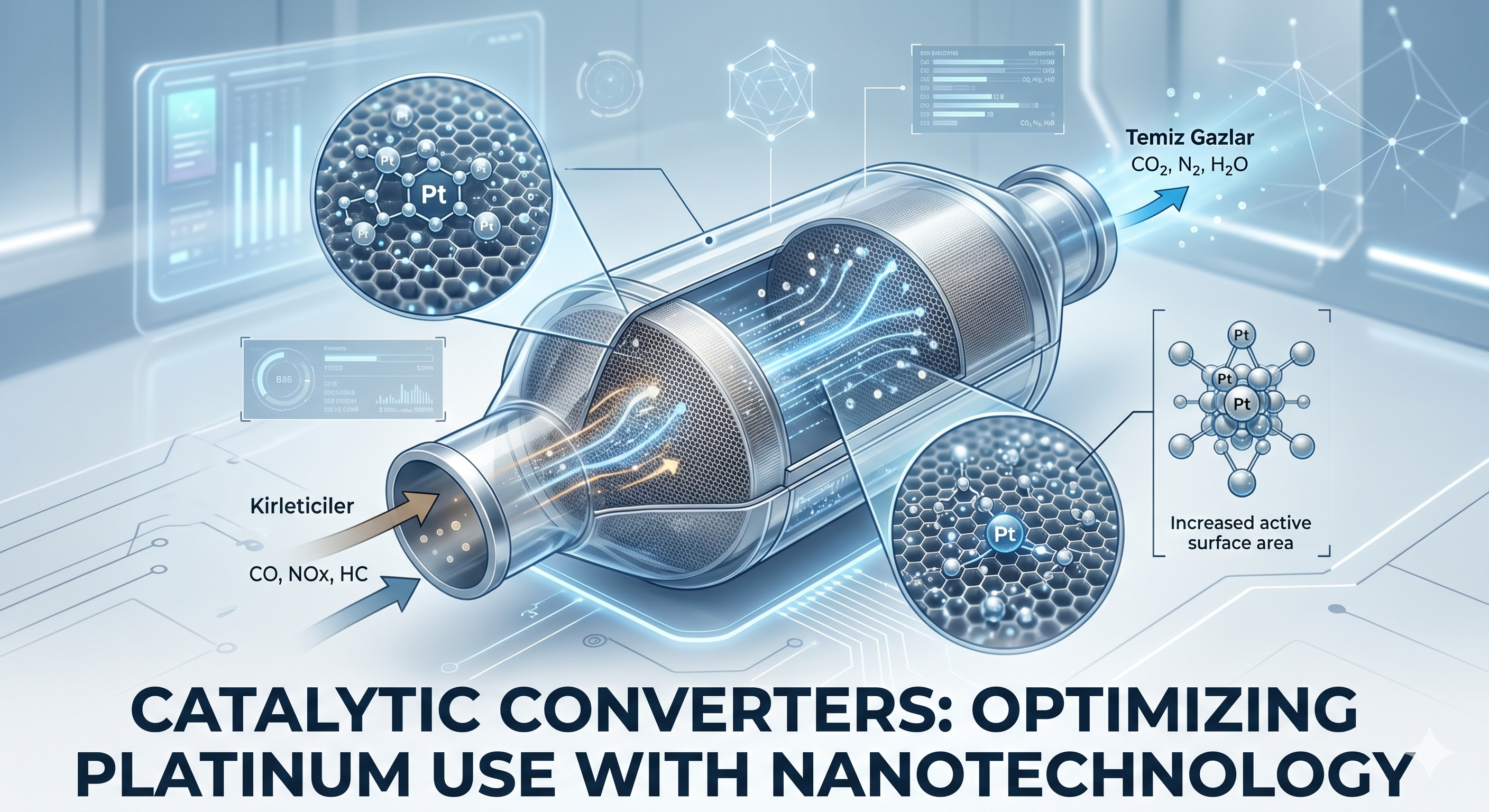
For decades, the catalytic converter has been the silent guardian of our atmosphere, sitting beneath billions of vehicles and transforming toxic gases into breathable air. However, this environmental miracle relies on a group of the rarest and most expensive materials on Earth: Platinum Group Metals (PGMs). As we navigate 2026, the automotive industry faces a significant challenge. Global platinum demand is currently outstripping supply, with a projected deficit of roughly 539,000 ounces in 2025 alone Roughly 33% of the world’s total platinum production is consumed by the automotive catalyst sector. To sustain the internal combustion and hybrid vehicle markets while meeting increasingly strict global emission standards like Euro 7 and China VI-b, we cannot simply mine more; we must engineer better. This is where nanotechnology—the science of the incredibly small—is providing a billion-dollar solution by optimizing platinum use at the atomic level.
The Platinum Paradox: Why Traditional Converters Are Inefficient
A standard catalytic converter works through a series of redox (reduction-oxidation) reactions. It uses platinum and rhodium to convert carbon monoxide and unburned hydrocarbons into carbon dioxide and water vapor, while also reducing nitrogen oxides into harmless nitrogen.
The “paradox” lies in the surface area. In a traditional converter, platinum is applied as a “washcoat” over a ceramic honeycomb structure. However, most of the platinum atoms are buried deep within the coating. Only the atoms on the very surface can actually interact with the exhaust gases. This means that a large portion of the expensive metal is effectively “dead weight,” providing structural support rather than catalytic action. Furthermore, at the extreme temperatures of an exhaust system, small clusters of platinum tend to “sinter”—they clump together into larger, less effective blobs, further reducing the active surface area over time.
Nanotechnology: The Atomic Architect
Nanotechnology allows scientists to manipulate matter at the scale of one-billionth of a meter. By transitioning from bulk coatings to engineered nanoparticles, researchers can ensure that nearly every single atom of platinum is exposed to the exhaust stream.
In 2026, the market for platinum nanoparticles is estimated at over 357 million USD, driven almost entirely by the need for more efficient catalysts. These particles are often engineered into specific shapes—such as cubes or faceted spheres—to maximize the number of “active sites” where chemical reactions occur.
The Supporting Cast: Titanium Dioxide Nanofibers
One of the most significant breakthroughs involves replacing traditional ceramic substrates with titanium dioxide nanofibers. These fibers provide an immense surface area-to-volume ratio. When platinum nanoparticles are loaded onto these fibers, the titanium dioxide doesn’t just sit there; it provides additional electrons that speed up the detoxification of exhaust gases. This synergistic relationship allows for a drastic reduction in the total amount of metal needed to achieve the same—or better—emission results.
The Ultimate Frontier: Single-Atom Catalysis (SAC)
The most cutting-edge research in 2026 centers on Single-Atom Catalysts (SACs). If a nanoparticle is an improvement over a bulk coating, a single atom is the theoretical limit of efficiency. In an SAC system, individual platinum atoms are isolated and anchored onto a stable support material, such as a metal oxide or carbon-based framework.
Because every single atom is an active site, SACs can potentially reduce platinum requirements by 70% to 90% compared to conventional converters. The challenge, which 2026 industrial trials are currently addressing, is “stabilization.” Keeping a single atom from wandering off and clumping with its neighbors under the intense heat of an engine requires precise molecular “anchors.”
The Shielding Strategy: Porous Silica Coatings
To combat the problem of sintering (clumping), nanotechnology has introduced a “shielding” technique. Scientists are now coating platinum nanoparticles with a thin, porous layer of silica.
Think of this as a molecular cage. The pores in the silica are large enough to let exhaust molecules like carbon monoxide in and harmless gases like carbon dioxide out, but the silica structure is strong enough to keep the platinum nanoparticles physically separated. This ensures the converter remains highly active even after years of high-temperature operation, effectively doubling the operational lifespan of the device.
Industrial “Clinical” Trials and Market Impact
While much of this science began in university labs, 2025 and 2026 have seen a surge in industrial-scale validation. Major automotive suppliers in the Asia Pacific region—which holds over 73% of the catalytic converter market—are now integrating nano-enhanced PGM solutions into mass-production lines.
-
Cold Start Efficiency: Recent trials have shown that nano-catalysts “light off” (reach operating temperature) much faster than traditional systems. This is critical because a large percentage of a vehicle’s total emissions occur in the first few minutes after the engine starts.
-
Recycled PGM Integration: Companies are also focusing on “Verdium” and other recycled platinum sources. By combining recycled platinum with nanotechnology, manufacturers can reduce the carbon footprint of the converter itself by up to 97%.
Advantage-Risk Assessment
The Advantages
-
Cost Reduction: By using up to 90% less platinum, the manufacturing cost of a converter drops significantly, helping to offset the rising prices of raw materials.
-
Environmental Compliance: Nano-solutions allow internal combustion engines to meet ultra-low emission standards that were previously thought to be impossible without total electrification.
-
Durability: Molecular shielding and nanofiber supports prevent the degradation that typically kills older catalytic converters.
The Risks and Challenges
-
Synthesis Toxicity: Traditional methods of creating nanoparticles often involve hazardous chemicals. The industry is currently shifting toward “Green Synthesis”—using plant extracts and biowaste to create nanoparticles—to mitigate this risk.
-
Nano-Toxicity: There are ongoing concerns regarding the potential health impacts if nanoparticles were to be released into the environment through exhaust wear. Current designs prioritize “encapsulation” to ensure the particles remain fixed within the converter.
-
Scalability: While SACs work perfectly in a lab, producing them by the millions with 100% consistency remains a complex engineering hurdle.
Sustainability and the “Green Synthesis” Shift
A major trend in 2026 is the “Green Synthesis” of nano-catalysts. Instead of using toxic reducing agents, researchers are using extracts from peels, leaves, and fruits to convert platinum ions into nanoparticles. This “bio-mediated” approach is not only safer but often cheaper, utilizing agricultural waste to create high-value industrial materials. This aligns perfectly with the principles of green chemistry, ensuring that the device we use to clean the air doesn’t pollute the water during its own manufacture.
The Road Ahead: 2030 and Beyond
As we look toward 2030, the role of platinum in the automotive sector will continue to evolve. While pure electric vehicles don’t need catalytic converters, the massive growth of the “Green Hydrogen” economy will keep platinum demand high. The nanotechnology developed for today’s exhaust systems is already being adapted for hydrogen fuel cells and electrolyzers. By optimizing platinum use today, we aren’t just making cleaner cars; we are mastering the materials science necessary for the entire energy transition. The catalytic converter is no longer just a “muffler-like unit”; it is a sophisticated nano-reactor.