
Recently added item(s)
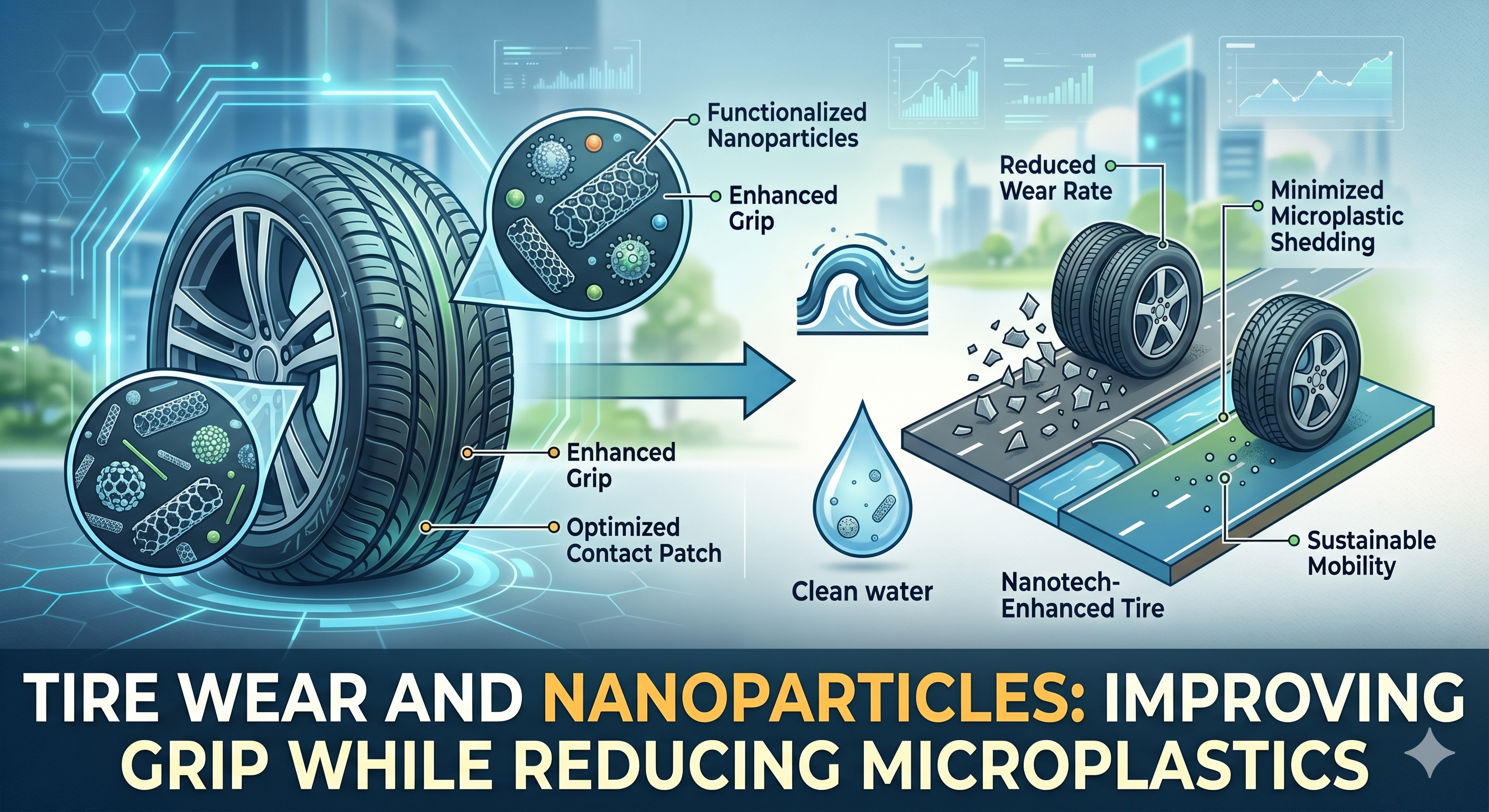
When we discuss vehicle pollution, our minds immediately jump to the exhaust pipe. We visualize clouds of carbon dioxide and nitrogen oxides. However, as the world transitions to electric vehicles (EVs), a more insidious form of pollution is taking center stage: Tire Road Wear Particles (TRWP).
Every time a vehicle accelerates, brakes, or turns, friction tears microscopic bits of rubber from the tires. These particles—a complex cocktail of synthetic rubber, carbon black, and chemical additives—are a primary source of primary microplastics in our environment. In fact, research suggests that tire wear can contribute up to 28% of all microplastics found in the world’s oceans.
As we move through 2026, the automotive industry faces a “Grip Paradox.” We need high-grip tires for safety, especially for heavier EVs with instant torque, but higher grip traditionally leads to faster wear. Nanotechnology is the key to breaking this cycle, offering a way to improve road safety while drastically reducing the environmental footprint of our tires.
The Anatomy of a Microplastic Crisis: What is TRWP?
Tire Road Wear Particles are not just “rubber dust.” They are hybrid particles formed by the intense heat and pressure at the contact patch where the tire meets the asphalt. These particles typically range from 10 nanometers to several hundred micrometers in size.
Once released, TRWP doesn’t just sit on the road. It is washed into waterways by rain or becomes airborne, contributing to PM2.5 and PM10 air pollution. One specific chemical used in tires, 6PPD, has been identified in recent studies (2024-2025) as a major environmental toxin. When 6PPD reacts with ozone in the air, it turns into 6PPD-quinone, a substance that has caused mass die-offs of Coho salmon in the Pacific Northwest and is now under intense scrutiny by global environmental agencies.
The Nano-Solution: Engineering the “Perfect” Contact Patch
To reduce microplastics, we must make the rubber compound more durable without making it “hard” or “plastic-like,” which would destroy grip and safety. This is achieved by manipulating the tire’s molecular architecture using nanofillers.
1. Nano-Silica and Silane Coupling Agents
Traditional tires used “carbon black” as a filler. While effective, it offers limited control over the tire’s rolling resistance. The “Green Tire” revolution, which has peaked in 2026, relies on precipitated nano-silica.
By using silica at the nano-scale, engineers can create a more flexible but stronger rubber matrix. The secret lies in Silane coupling agents—molecular bridges that bond the inorganic silica to the organic rubber. At the nano-level, this creates a “meshed” structure that is incredibly resistant to abrasion. Tires using this technology show a 15% to 20% reduction in wear rates while simultaneously improving wet-grip performance.
2. Graphene and Carbon Nanotubes (CNTs)
Carbon nanotubes and graphene are the “super-materials” of the 2020s. In tire manufacturing, they act as a nano-scale reinforcement grid.
-
Thermal Management: One major cause of tire wear is heat. Graphene is an extraordinary thermal conductor. By dispersing graphene nanoplatelets within the tread compound, heat is moved away from the contact patch more efficiently. Cooler tires wear down much slower.
-
Structural Integrity: CNTs act like microscopic “rebar” in concrete. They prevent the rubber from tearing at the molecular level during high-torque maneuvers common in EVs, effectively “stitching” the rubber together to prevent the release of microplastics.
3. Nano-Clays and Bio-based Nano-fillers
In an effort to move away from petroleum-based synthetics, 2026 research has highlighted the use of modified nano-clays and cellulose nanocrystals. these materials are not only sustainable but offer unique “self-healing” properties. If a micro-crack begins to form in the tire tread, the nano-fillers can help redistribute the stress, preventing the crack from expanding and shedding a microplastic particle.
Latest Research: The “Euro 7” Impact and 2026 Studies
In 2026, the implementation of the Euro 7 standards has changed the game. For the first time, vehicle regulations include limits on tire and brake wear emissions, not just tailpipe gases.
Recent industrial trials conducted in early 2026 by major European tire consortia have demonstrated that “Smart Nano-Composites” can reduce TRWP emissions by 30% across the vehicle’s lifespan. Furthermore, “clinical” environmental studies in urban corridors have shown that switching a fleet to nano-enhanced tires leads to a measurable drop in the concentration of 6PPD-quinone in nearby urban runoff within just six months.
Another breakthrough involves Encapsulated Additives. Instead of mixing chemicals like 6PPD freely into the rubber, they are now being placed inside nano-capsules that only release the chemical when specifically needed to prevent oxidation. This prevents the chemicals from leaching out prematurely into the environment.
Advantage-Risk Assessment: Balancing Innovation
While nanotechnology offers a path to cleaner oceans, it is not a “magic wand” without its own set of considerations.
The Advantages
-
Increased EV Range: Nano-silica reduces rolling resistance. Less resistance means the battery lasts longer, adding up to 5-7% more range per charge.
-
Safety in the Wet: Nanoscale roughness on the tire surface increases the “micro-interlocking” with the road, providing shorter braking distances on wet asphalt.
-
Longevity: Tires that wear slower need to be replaced less often, saving consumers money and reducing the total volume of tire waste in landfills.
The Risks and Challenges
-
Nano-Toxicity: There is an ongoing debate about the fate of the nanoparticles themselves. If a graphene-enhanced tire wears down, are we releasing graphene into the air? Current 2026 safety protocols ensure that nanoparticles remain “matrix-bound,” meaning they stay attached to the larger rubber fragments and do not become “free” nanoparticles.
-
Production Costs: Synthesizing high-purity carbon nanotubes or specialized silanes remains expensive. This currently places nano-enhanced tires in the “Premium” or “EV-Specific” price brackets.
-
Recycling Complexity: The more complex we make the rubber compound, the harder it is to recycle at the end of its life. Devulcanization processes (breaking the rubber back down) must be updated to handle these advanced nano-composites.
The Future: The “Non-Shedding” Tire?
The ultimate goal for 2030 and beyond is the development of tires that don’t “wear” in the traditional sense. Research into biomimetic surfaces—inspired by the skin of desert lizards or the pads of gecko feet—aims to create grip through molecular attraction rather than physical erosion.
In the meantime, the integration of nanotechnology into our current tire infrastructure is the most effective weapon we have against the microplastic crisis. By engineering materials at the atomic level, we can ensure that our journey toward a greener planet doesn’t leave a trail of plastic behind.
Conclusion
Tire wear is an environmental challenge that has been overlooked for too long. As our vehicles become heavier and more powerful, the “invisible rain” of rubber particles will only increase unless we change the fundamental chemistry of the tire. Nanotechnology provides the tools to build a tire that is safer, longer-lasting, and significantly kinder to our oceans and air. We are entering an era where high performance no longer requires high pollution.